
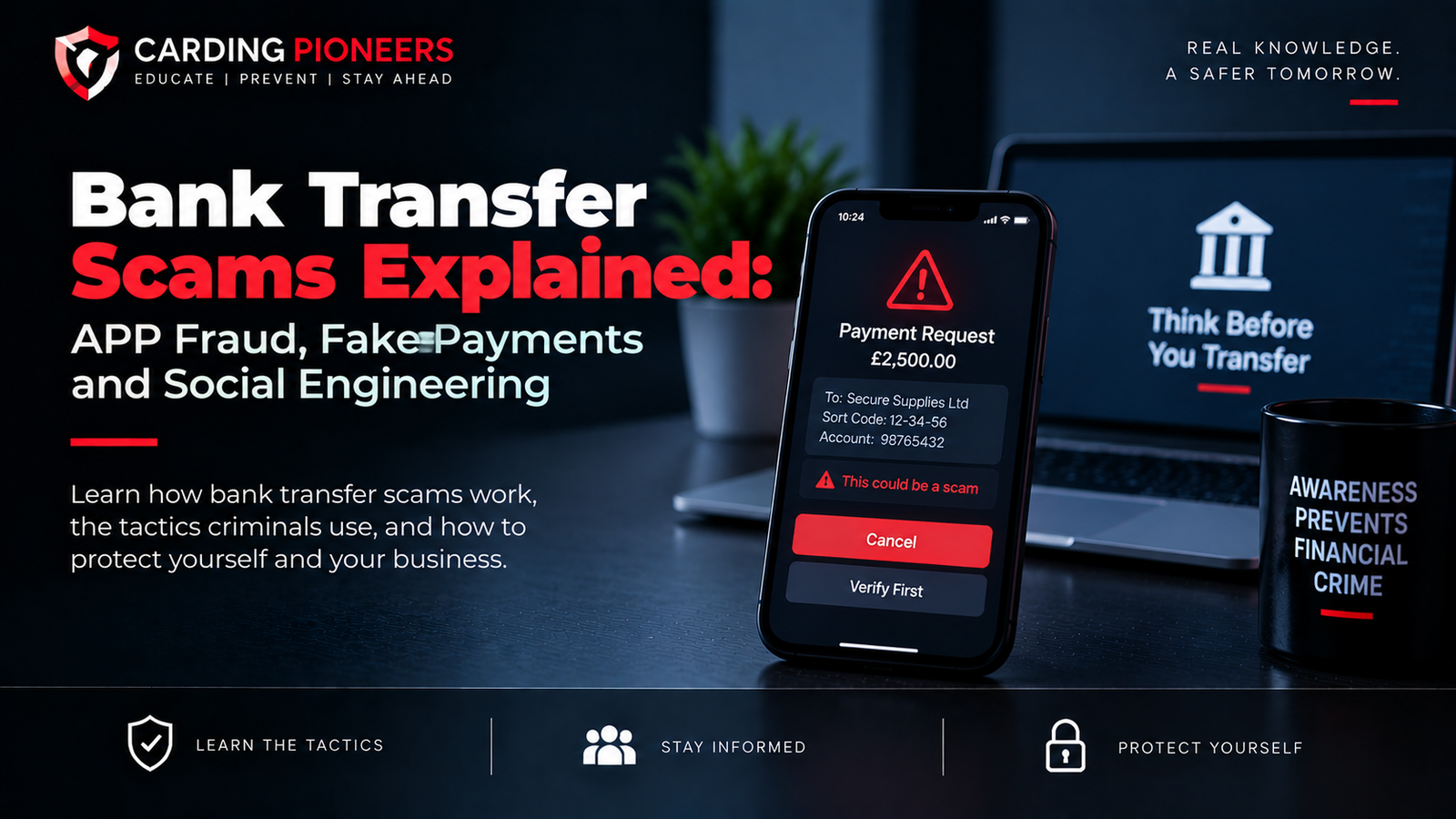
Bank transfer scams happen when a criminal manipulates a person or business into sending money to the wrong account. The payment itself may be genuinely authorized by the victim, but the decision to send it was based on deception.
In the United Kingdom, this is commonly described as Authorised Push Payment (APP) fraud. UK Finance defines APP fraud as a situation where a victim is tricked into making a bank payment to an account controlled by a criminal. Similar scams exist worldwide under names such as wire-transfer fraud, payment diversion, invoice fraud and business email compromise.
The common thread is social engineering: instead of breaking into the bank's systems, the scammer convinces the victim that the transfer is legitimate, urgent or necessary.
Quick answer: APP fraud is a bank-transfer scam where the victim is manipulated into authorizing the payment. Common examples include fake invoices, bank or police impersonation, purchase scams, romance scams, investment scams and business email compromise.
Safety scope: This article explains transfer scams for prevention and recovery. It does not provide social-engineering scripts, laundering routes, mule-account methods, transfer evasion techniques or instructions for redirecting stolen funds.
What Is Authorised Push Payment (APP) Fraud?
APP fraud occurs when a person or business intentionally authorizes a bank payment but has been deceived about who is receiving the money or why the payment is being made.
This differs from an unauthorized transaction, where someone else accesses the account or uses a payment credential without the account holder's permission.
Type | Who initiates the payment? | Typical example |
|---|---|---|
APP / authorized scam payment | The victim authorizes it after being deceived | Fake invoice, impersonation, romance or investment scam |
Unauthorized payment | A criminal initiates it without the victim's consent | Account takeover or stolen card use |
How Bank Transfer Scams Work at a High Level
1. The criminal creates a convincing identity or story.
They may impersonate a bank, supplier, employer, government body, romantic partner, seller or investment provider.
2. Trust or urgency is created.
The victim is pressured to act quickly, keep the matter secret, or believe that a payment protects them from a larger loss.
3. Payment instructions are supplied.
The fraudster gives bank details or substitutes different payment details for a legitimate recipient.
4. The victim authorizes the transfer.
Because the victim believes the story, the payment can look legitimate from the bank's perspective.
5. The fraud is discovered.
The victim later realizes the recipient was fraudulent, the invoice was fake or the supposed emergency never existed.
Common Type 1: Bank or Police Impersonation Scams
A fraudster may claim to be from a bank, police department, regulator or fraud team and say the victim's money is at immediate risk.
- The caller says there is suspicious activity.
- The victim is told to move money to a 'safe' or 'secure' account.
- The scammer creates urgency and discourages independent verification.
- Caller ID or a familiar-looking phone number may be used to increase credibility.
A legitimate bank or police service should not require a customer to transfer money to a new account in order to keep it safe.
Common Type 2: Invoice and Supplier Payment Fraud
Invoice fraud occurs when a criminal changes or substitutes payment details so that money intended for a legitimate supplier goes to the criminal instead.
The FBI's Business Email Compromise guidance describes scams in which criminals spoof or compromise business email accounts and trick employees into sending wire transfers to accounts believed to belong to trusted partners.
- A supplier suddenly changes bank details.
- The email address is slightly different from the genuine one.
- The payment request is unusually urgent.
- An executive or colleague allegedly asks for secrecy.
Common Type 3: Fake Purchase and Marketplace Payments
Purchase scams involve paying for goods or services that do not exist, are misrepresented or will never be delivered.
A scammer may steer the victim away from a platform's protected checkout process and request a direct transfer instead.

- The price is far below normal market value.
- The seller refuses safer payment options.
- The listing uses copied images or vague product details.
- The seller creates pressure by claiming other buyers are waiting.
Common Type 4: Romance and Relationship Scams
Romance scammers create emotional trust before asking for money. The request may involve travel, medical emergencies, business problems, customs fees or helping a family member.
The important warning sign is that the relationship becomes tied to repeated financial requests, especially when the person cannot be independently verified.
Common Type 5: Investment and Crypto Transfer Scams
Investment scams persuade victims to transfer money to fake or misrepresented opportunities. The platform may show fictional profits to encourage additional deposits.
- Guaranteed or unusually high returns
- Pressure to invest immediately
- Difficulty withdrawing supposed profits
- Unexpected contact from an 'investment adviser'
- Requests to pay additional taxes or fees before withdrawal
Common Type 6: Business Email Compromise (BEC)
BEC targets businesses and individuals involved in legitimate financial transactions. Criminals impersonate executives, vendors, title companies or other trusted contacts and send altered payment instructions.
The FBI advises organizations to verify changes in account numbers or payment procedures through a separate, trusted communication channel.
What Are Fake Payment Scams?
A fake payment scam creates the impression that money has been sent when it has not actually been received or cannot be relied upon.
- A forged or edited payment confirmation image
- A fake banking email or text claiming funds were transferred
- A counterfeit payment-platform notification
- A false claim that a transfer is 'pending' until the seller takes another action
Always verify incoming money inside the official banking or payment application rather than relying on screenshots, emails or messages supplied by the other party.
Why Social Engineering Is So Effective
Transfer scams exploit normal human decision-making rather than relying only on technical compromise.
- Authority: pretending to be a bank, police officer, executive or government official
- Urgency: claiming the victim must act immediately
- Fear: warning that money or an account is at risk
- Trust: impersonating a supplier, friend, relative or romantic partner
- Scarcity: claiming an opportunity will disappear
- Secrecy: telling the victim not to discuss the payment with anyone
Warning Signs Before You Send a Bank Transfer
Warning sign | Why it matters |
|---|---|
New bank details | A familiar supplier or contact suddenly requests payment to a different account. |
Urgency | You are told there is no time to verify the request. |
Secrecy | The sender asks you not to tell colleagues, family or your bank. |
Safe-account story | Someone tells you to move money to protect it. |
Unusual payment method | The recipient insists on direct transfer instead of the normal process. |
Changed contact details | The request comes from a slightly different email address or phone number. |
Emotional pressure | Fear, romance, sympathy or investment excitement is used to push the transfer. |
How to Verify a Payment Request Safely
- Use a phone number or contact method you already trust.
- Do not reply directly to the suspicious email or message.
- For business payments, verify bank-detail changes with a known contact.
- Check the recipient name and account details carefully.
- Use your bank's confirmation-of-payee or recipient-checking tools where available.
- Slow down when a request is urgent or unusual.
Why Confirmation of Payee Helps
Some banking systems compare the name entered by the payer with the name associated with the receiving account. This can reveal mistakes or suspicious mismatches before a payment is sent.
A match does not guarantee the underlying transaction is legitimate, because a scammer can still control an account in the correct name or manipulate the victim for another reason.
What to Do If You Already Sent Money to a Scammer
1. Contact your bank or payment provider immediately.
Tell them the transfer was induced by fraud and ask whether the payment can be stopped, recalled or traced.
2. Do not send any additional money.
Scammers may claim another payment is needed to release, refund or recover the first transfer.

3. Preserve evidence.
Keep messages, invoices, payment instructions, account details and transaction references.
4. Secure affected accounts.
Change compromised passwords and review email, banking and payment accounts.
5. Report the fraud.
Use the official fraud-reporting or law-enforcement channels in your country.
APP Fraud Reimbursement in the UK
The UK introduced mandatory reimbursement protections for many qualifying APP scam payments made through Faster Payments and CHAPS from 7 October 2024.
The Payment Systems Regulator states that the protections cover consumers, microenterprises and charities for qualifying APP fraud. The maximum reimbursement for Faster Payments claims is generally £85,000, subject to the detailed rules and exclusions.
Reimbursement rules vary by country, payment method and circumstances. Victims should contact their bank promptly rather than assuming reimbursement is automatic.
APP Fraud vs Account Takeover
APP fraud involves a victim authorizing a transfer because they were deceived. Account takeover involves a criminal gaining unauthorized control of the account.
Both can end in stolen funds, but they are different fraud pathways and can have different reimbursement and investigation rules.

Bank Transfer Scams vs Money Mule Scams
The victim's transfer may be sent to a mule account controlled by or used for a fraud network. A money mule is a person who receives or moves criminal proceeds for someone else.
The victim-transfer scam and the downstream movement of funds are separate stages in the fraud chain.
How Businesses Can Reduce Transfer Fraud
- Require independent verification for new or changed supplier bank details.
- Use dual approval for high-value transfers where practical.
- Train finance staff to recognize BEC and executive impersonation.
- Do not rely on email alone for payment changes.
- Protect business email accounts with strong MFA.
- Use transaction limits and bank alerts appropriate to the business.
- Create a documented process for urgent payment requests.
How Consumers Can Reduce Transfer-Scam Risk
- Never move money to a 'safe account' because of an unexpected call.
- Verify sellers before paying by direct bank transfer.
- Be skeptical of guaranteed investments and unexpected advisers.
- Do not send money to an online romantic partner you cannot independently verify.
- Use official banking apps and trusted contact information.
- Enable transaction alerts and review account activity.
Frequently Asked Questions
What is a bank transfer scam?
It is a scam in which a victim is deceived into sending money to an account controlled by or connected to a criminal.
What is APP fraud?
Authorised Push Payment fraud is when the victim authorizes a bank payment because a criminal has deceived them about the recipient or purpose.
Is APP fraud the same as account takeover?
No. APP fraud is victim-authorized under deception; account takeover is unauthorized control of the account.
What is invoice fraud?
It is payment diversion in which criminals replace or alter legitimate supplier payment instructions.
What is a fake payment scam?
It is a deception designed to make someone believe a payment has been made when the money has not genuinely arrived or cannot be relied upon.
How can I check whether someone really paid me?
Verify the transaction directly in your official bank or payment-provider account, not from screenshots or messages.
Will a bank ever ask me to move money to a safe account?
Treat such a request as a scam warning sign. Contact the bank independently using a trusted number.
What should I do after sending money to a scammer?
Contact your bank immediately, stop further payments, preserve evidence, secure affected accounts and report the fraud.
Can APP scam victims get reimbursed?
It depends on jurisdiction, payment method and circumstances. UK rules provide mandatory reimbursement for many qualifying Faster Payments and CHAPS APP scams from 7 October 2024.
How can a business prevent invoice-payment fraud?
Independently verify bank-detail changes, use dual approval where appropriate, secure email accounts and train staff to recognize BEC.
Final Thoughts
Bank transfer scams succeed because the payment can look completely normal to the banking system while the victim's decision has been manipulated by a criminal.
APP fraud, fake invoices, bank impersonation, romance scams and business email compromise all exploit trust, urgency or authority to redirect legitimate payments.
The most effective defense is verification before payment and speed after discovery: confirm unusual requests independently, use strong account security and contact the bank immediately when a transfer may have been fraudulent.
Authoritative References
- UK Finance - Authorised Push Payment Fraud Reimbursement
- FCA - Fraudulent Payments and APP Fraud
- Payment Systems Regulator - APP Fraud Reimbursement Protections
- Payment Systems Regulator - Maximum APP Reimbursement Level
- FBI - Business Email Compromise
Editorial note: This article is educational and defensive. It explains APP fraud, fake-payment scams and social engineering without providing scripts for manipulating victims, mule-routing methods, laundering steps or financial-control evasion.