
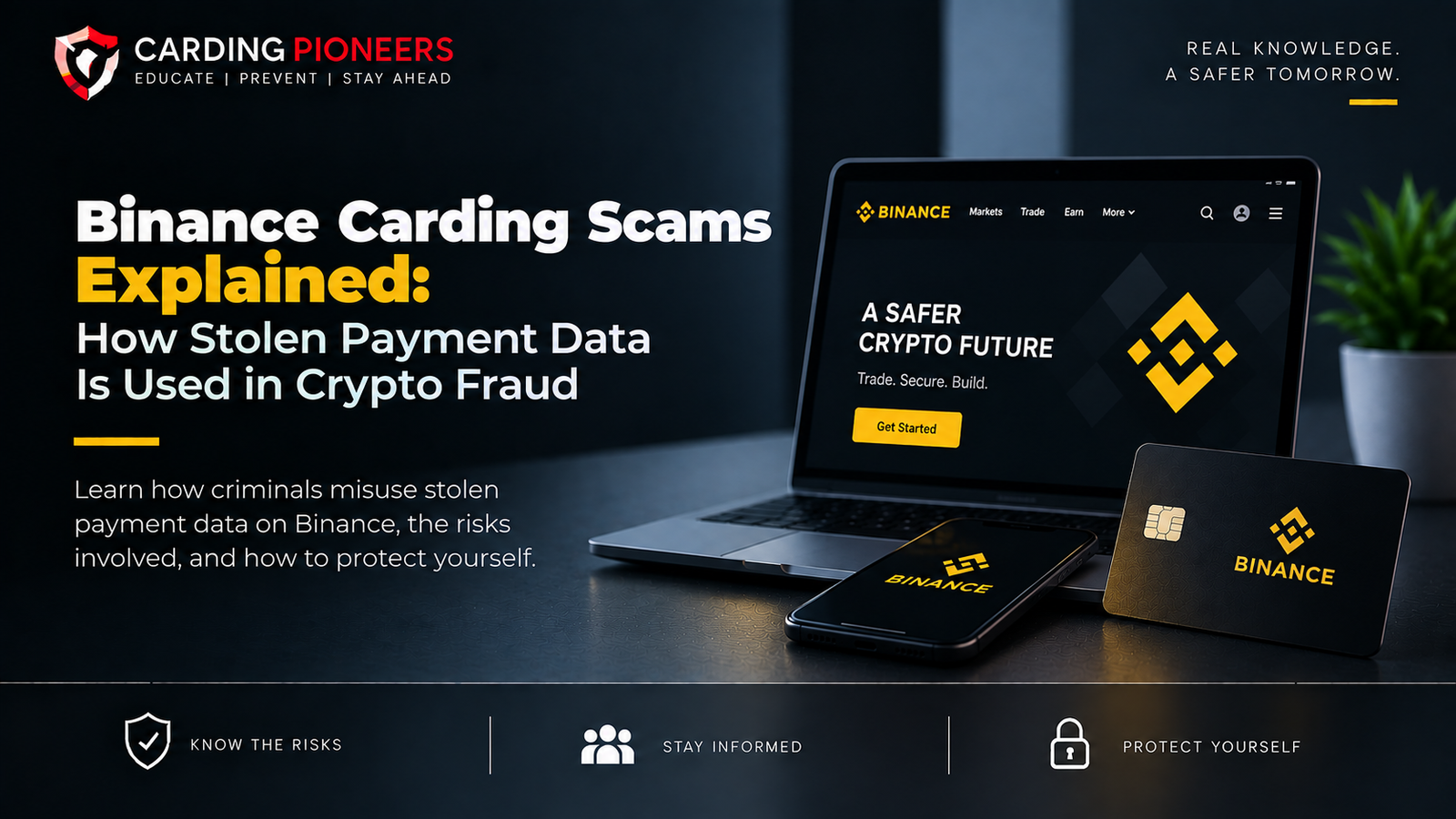
“Binance carding” is informal fraud slang, not an official Binance or payment-industry category. It is generally used to describe schemes in which stolen card or bank information, compromised accounts, fake payment evidence or other stolen payment data is used in connection with crypto purchases or peer-to-peer trading.
The term can hide several different fraud types. A stolen card may be abused as a funding source, a Binance account may be taken over through phishing, a P2P seller may be shown fake payment proof, or a criminal may attempt to pay from a third-party account that does not belong to the verified buyer.
For fraud awareness, the important question is not whether a scheme is called “carding,” but what was actually compromised: the payment card, the fiat account, the Binance login, or the victim's decision-making.
Quick answer: Binance carding scams usually refer to stolen-payment-data or account-abuse schemes connected to crypto purchases or P2P trading. Common risks include stolen cards, unauthorized transactions, account takeover, fake proof of payment, third-party payments, phishing and chargeback-related disputes.
Safety scope: This article explains the fraud ecosystem defensively. It does not provide stolen-card sources, card-testing instructions, Binance funding bypasses, fraud thresholds, account-acquisition methods or techniques for laundering or cashing out stolen funds.
What Does “Binance Carding” Mean?
In ordinary payment-security language, carding refers to the unauthorized use, testing or trafficking of payment-card information. In crypto-related slang, the phrase can be expanded to describe attempts to use stolen payment credentials to obtain crypto or move value through a crypto platform.
Binance does not use “carding” as a product label. Its public security material instead focuses on unauthorized transactions, phishing, account takeover, P2P scams, third-party payments, chargebacks and other forms of platform abuse.
Binance Carding vs Binance Account Takeover
Scenario | What is compromised? | Typical defensive concern |
|---|---|---|
Stolen-card abuse | Payment-card or bank funding data | Unauthorized crypto purchase, dispute or card replacement |
Binance account takeover | The user's Binance account | Unauthorized access, withdrawals or account changes |
P2P fake-payment scam | Seller's perception of payment | Crypto released when fiat was not actually received |
Third-party payment abuse | Payment identity does not match verified user | Chargebacks, frozen bank accounts or fraud investigations |
How Stolen Payment Data Can Enter Crypto Fraud
Stolen payment data can be misused at different points in the crypto purchase process. A criminal may attempt to use a stolen card directly, compromise a platform account, or manipulate a P2P counterparty into accepting payment from an unrelated account.
The exact outcome depends on the card issuer, bank, Binance account status, authentication, transaction risk signals and local payment rules.
Fraud Pattern 1: Stolen Card Funding
Binance supports card purchases in eligible regions, but card use remains subject to identity checks, issuer approval, platform controls and local availability.
A stolen card may be temporarily active before its legitimate owner notices and reports the theft. If an unauthorized transaction occurs, the cardholder can dispute it through the issuer's process, and the card can be blocked or replaced.
Temporary transaction success is not evidence that the card is legitimate to use.
Fraud Pattern 2: Account Takeover
Account takeover occurs when criminals gain unauthorized control of a legitimate Binance account, often through phishing, stolen credentials, malicious links, compromised devices or social engineering.

- Unexpected login alerts or device activity
- Unrecognized account-setting changes
- Unexpected 2FA or passkey prompts
- Withdrawal or transfer activity you did not initiate
- Loss of access to the account
Fraud Pattern 3: Fake Proof of Payment on Binance P2P
In P2P fraud, the attacker may try to convince a seller that fiat payment was completed when it was not.
Binance's P2P safety guidance warns sellers not to release crypto merely because a buyer provides a screenshot, email or payment receipt. The seller should independently confirm that the money actually arrived in the receiving account.

- Fake bank-transfer screenshots
- Edited payment receipts
- Fake Binance-looking emails
- Pressure to release crypto before funds are confirmed
Fraud Pattern 4: Third-Party Payment Accounts
Binance P2P rules generally require buyers to use a payment method whose account-owner name matches their verified identity. Third-party payments can create serious fraud and dispute risk.
Binance warns P2P users that accepting third-party payments can lead to chargebacks, bank-account freezes or other problems.
- The payer's name does not match the verified buyer.
- The buyer says a friend, relative or business partner will pay.
- The payment comes from an unrelated company or individual.
- The buyer pressures the seller to ignore the mismatch.
Fraud Pattern 5: Phishing and Fake Binance Communications
Phishing scams imitate Binance emails, SMS messages, websites or support staff to steal login details or persuade victims to approve a fraudulent action.
Binance provides an Anti-Phishing Code feature that places a user-selected code inside genuine Binance emails and SMS messages, making fake communications easier to identify.
- Unexpected security warnings
- Urgent requests to click a login link
- Requests to reveal authentication codes
- Messages that lack the user's Anti-Phishing Code after the feature has been enabled
Fraud Pattern 6: QR-Code Account Takeover Scams
Binance has warned about account-takeover scams in which P2P sellers are tricked into scanning a Binance login QR code that is falsely presented as part of an order or payment process.
A login QR code should be treated as an authentication request, not as ordinary payment proof. Users should never authorize an unexpected login supplied by a counterparty.
Fraud Pattern 7: Chargeback and Dispute Abuse
A cardholder can dispute transactions they believe are unauthorized or incorrect. Binance's current card-dispute guidance recognizes unauthorized card use as one reason a dispute may be raised.
In P2P trading, chargebacks can also create risk when a seller accepts a payment from a stolen or third-party financial account and later loses the fiat after the legitimate owner reports fraud.
Why Fake Payment Proof Is So Dangerous
Crypto transfers and P2P releases can be difficult or impossible to reverse after completion. That makes independent payment verification especially important.
- Check your bank or payment account directly.
- Do not rely on screenshots sent by the counterparty.
- Keep communication inside the Binance P2P platform.
- Do not release crypto because of threats, urgency or fake support messages.
Why Third-Party Payments Are a Red Flag
A payment from an unrelated person breaks the clear connection between the verified buyer and the financial account used to pay.
That mismatch can indicate identity abuse, money-mule activity or use of compromised financial accounts. Binance's P2P transaction policy requires real-name consistency for ordinary P2P payments.
How Binance Protects Accounts
- Two-factor authentication options for sensitive actions
- Passkeys in supported security flows
- Anti-Phishing Code for genuine Binance communications
- Monitoring of unusual login and transaction activity
- Identity verification and P2P real-name payment rules
- Escrow for P2P orders
- Security and fraud-risk alerts
Binance 2FA and Passkeys
Binance supports multiple two-factor authentication methods and allows eligible users to configure verification requirements for important scenarios such as login, asset access, account settings and security management.
The platform can also require additional authentication beyond the user's selected strategy in some situations.
What the Binance Anti-Phishing Code Does
The Anti-Phishing Code is a user-created security code that appears in genuine Binance emails and SMS messages after it is enabled.

If a supposed Binance message is missing the expected code or displays the wrong one, Binance says the message may be a phishing attempt and should be reported.
Warning Signs of Binance-Related Payment Fraud
Warning sign | Why it matters |
|---|---|
Unrecognized card charge | A card or bank statement shows a crypto-related transaction you did not authorize. |
Unexpected Binance login alert | Someone may be attempting to access your account. |
Payer-name mismatch | A P2P payment comes from someone other than the verified buyer. |
Fake payment proof | A buyer sends screenshots but the money is not in your account. |
Pressure to release crypto early | A scammer may be trying to bypass escrow safeguards. |
Missing anti-phishing code | A supposed Binance email or SMS does not contain your expected code. |
Unexpected login QR request | A counterparty asks you to scan or approve a login QR code. |
What to Do If Your Binance Account May Be Compromised
1. Secure the account immediately.
Use Binance's official account-security tools and disable the account if compromise is suspected.
2. Change compromised credentials.
Update passwords and secure the connected email account.
3. Review devices and security settings.
Remove unfamiliar devices and review 2FA, passkeys and account permissions.
4. Review transactions and withdrawals.
Identify anything you did not authorize.
5. Contact Binance Support.
Use official support channels and provide relevant records.
6. Contact your bank or card issuer if payment data was stolen.
Report unauthorized charges and follow the institution's card-replacement or dispute process.
What to Do If You Are a P2P Seller and Payment Looks Suspicious
- Do not release the crypto until the fiat funds are confirmed in your own account.
- Check that the payer name matches the verified counterparty, except where an official platform feature expressly permits otherwise.
- Keep communication and evidence inside the Binance platform.
- Use the appeal or support process if the buyer pressures you or provides suspicious proof.
- Do not follow off-platform instructions from supposed Binance staff.
What to Do If Your Card Was Used Without Permission
- Lock or freeze the card through your bank or issuer if available.
- Report the unauthorized transaction promptly.
- Request a replacement card when appropriate.
- Review other card and bank activity for additional fraud.
- Change passwords for accounts that may have been compromised at the same time.
Binance Carding vs Card-Not-Present Fraud
A stolen card used to fund an online crypto purchase can fall within the broader category of card-not-present fraud because the physical card is not presented at a merchant terminal.
But Binance-related fraud can also involve P2P bank transfers, account takeover or phishing, so not every incident is card fraud.
Binance Carding vs Money Mule Activity
Money mules receive or move criminal proceeds for other people. A stolen-card purchase or account-takeover incident can generate proceeds that criminals then try to move through mule-controlled bank or crypto accounts.
The roles can appear in the same fraud chain but should not be treated as the same crime.
Binance Carding vs APP and Bank Transfer Scams
In authorized push payment scams, the victim is deceived into sending money themselves. In carding or account takeover, the activity may be unauthorized from the beginning.
P2P trading can expose users to both categories, which is why verifying the counterparty and confirming actual receipt of funds matters.

How to Reduce the Risk
- Use a unique Binance password.
- Enable strong 2FA or passkeys where supported.
- Enable Binance's Anti-Phishing Code.
- Keep your email account and devices secure.
- Never approve unexpected login QR codes.
- Never release P2P crypto before confirming fiat receipt.
- Avoid third-party payments unless an official Binance feature specifically supports and identifies them.
- Verify Binance communications through official channels.
- Enable card and bank transaction alerts.
Frequently Asked Questions
What is Binance carding?
It is informal fraud slang generally referring to stolen-card, stolen-bank-data or account-abuse schemes connected to Binance or crypto trading.
Can stolen cards be used to attempt crypto purchases?
Fraudsters may attempt to use stolen cards, but issuers, Binance and payment partners apply authorization, identity and fraud controls, and unauthorized transactions can be disputed.
What is fake proof of payment on Binance P2P?
It is when a buyer tries to convince a seller that fiat payment was made using a screenshot, receipt or fake message even though the money was not actually received.
Should I accept a P2P payment from someone else's bank account?
Binance P2P generally requires the payer's account name to match the verified user. Third-party payments can create chargeback and fraud risks.
What is Binance's Anti-Phishing Code?
It is a user-created code that appears in genuine Binance emails and SMS after the feature is enabled.
Can a Binance login QR code be used in a scam?
Yes. Binance has warned about scams that trick users into scanning or authorizing login QR codes supplied by fraudsters.
How does Binance protect P2P trades?
Binance uses identity verification, escrow, platform rules, analytics and support processes to reduce fraud risk.
What should I do after an unauthorized crypto-related card charge?
Contact the card issuer promptly, lock or replace the card if needed, review other activity and secure related online accounts.
Is Binance carding the same as account takeover?
No. Carding focuses on stolen payment data; account takeover focuses on unauthorized access to a Binance account.
How can I reduce Binance fraud risk?
Use strong authentication, an Anti-Phishing Code, secure devices and email, verify P2P payments independently and avoid third-party payment mismatches.
Final Thoughts
“Binance carding” is best understood as an informal umbrella term for payment-data abuse around crypto rather than one fixed method.
A fraudulent crypto transaction can begin with a stolen card, a compromised Binance account, a phishing message, fake P2P payment proof or a third-party financial account. Each pathway requires a different response, but all depend on strong verification and fast detection.
For users, the most practical defenses are strong account authentication, careful verification of communications and payments, real-name consistency in P2P trades and immediate reporting when card, bank or Binance activity looks unfamiliar.
Authoritative References
- Binance - Anti-Phishing Code
- Binance - 2FA Verification Strategy
- Binance - QR Code-Assisted Account Takeover Scams
- Binance - Platform Security and Real-Time Monitoring
- Binance - P2P User Transaction Policy
- Binance - P2P Risk Alerts and Safety Tips
- Binance - Card Chargebacks and Disputes
Editorial note: This article is educational and defensive. It explains stolen-payment-data abuse, account takeover, P2P scams, warning signs and prevention without providing stolen-card sources, card-testing methods, fraud thresholds, authentication bypasses, laundering routes or cash-out techniques.