

Introduction
Credit card phishing scams use deception rather than technical payment processing to obtain sensitive financial information. A criminal pretends to be a trusted organization and tries to persuade the victim to reveal card details, banking credentials, or authentication information.
The Federal Trade Commission describes phishing scams as messages designed to trick people into revealing sensitive information or opening malicious links and attachments. Europol likewise identifies phishing, smishing, and vishing as common social-engineering methods used to obtain payment-card information and banking access.
Phishing can arrive through email, SMS, messaging apps, social media, QR codes, search advertisements, fake customer-support accounts, or voice calls. The delivery channel changes, but the core technique is usually the same: impersonation, urgency, and a request to take an action that benefits the scammer.
This article explains credit card phishing from a defensive perspective. It focuses on recognition, prevention, incident response, and merchant/customer education rather than providing instructions for creating convincing phishing attacks.
Quick Answer: What Is Credit Card Phishing?
Credit card phishing is a social-engineering scam in which criminals impersonate a trusted organization and attempt to obtain payment-card or account information.
A phishing message might claim that a card has been blocked, a payment failed, a suspicious transaction occurred, a refund is waiting, or account verification is required.
The victim is then pressured to click a link, scan a QR code, call a fraudulent number, download a file, or disclose information directly.
The safest response to an unexpected financial message is to avoid its links and contact the organization independently using an official app, a known website, or a trusted telephone number.
How Credit Card Phishing Works at a High Level
A phishing attack normally begins with impersonation. The criminal pretends to be a bank, card issuer, merchant, delivery company, payment service, government agency, or another organization the victim might trust.
The message then creates a reason for immediate action. Common themes involve supposed fraud alerts, failed payments, locked accounts, expiring rewards, refunds, delivery problems, or account verification.
The final step is an attempt to obtain something valuable: card information, online-banking credentials, passwords, authentication codes, or access to a device or account.
The defensive lesson is that the story used by the scammer matters less than the requested action. Unexpected requests for sensitive information should be independently verified.
Why Phishing Is Effective
Phishing attacks exploit normal human behavior. People react quickly when they believe money is at risk, a bank account has been locked, or an unauthorized purchase has occurred.
Attackers can also copy branding, logos, colors, writing styles, and website layouts, which makes visual appearance an unreliable indicator of legitimacy.
Modern scams may contain polished grammar and convincing personalization, so consumers should not depend only on spelling mistakes as a warning sign.
A better habit is to evaluate the context, destination, and requested action.
1. Email Phishing
Traditional phishing commonly arrives by email.
The message may impersonate a card issuer or merchant and claim that immediate verification is necessary.
The FTC advises people not to click links or download attachments in unexpected messages and instead contact the company using a phone number, email address, or website known to be genuine.
Email phishing can also target the email account itself because control of an email inbox can allow criminals to reset passwords for banking, shopping, and payment-related services.
2. Smishing: Phishing by Text Message
Smishing combines SMS and phishing.
A text message may claim there is suspicious card activity, an unpaid toll, a delivery fee, a bank-security problem, or another urgent issue.
Europol describes smishing as an attempt to obtain personal, financial, or security information through mobile text messages.
Consumers should not assume a message is legitimate merely because it appears in the same conversation thread as earlier bank messages. Sender identification and phone messaging systems can sometimes be abused or imitated.
If the message concerns a bank card, open the official banking application rather than using the link in the SMS.

3. Vishing: Phishing by Voice Call
Vishing is voice phishing.
A caller may claim to work for a bank's fraud department, payment provider, police agency, telecom company, or merchant.
The caller often creates urgency and may already know some personal information, which can make the call sound convincing.
A legitimate bank employee should not need the customer to disclose a PIN, complete banking password, or one-time authentication code simply because the caller claims a transaction must be cancelled.
If there is uncertainty, end the call and contact the issuer independently using the official number printed on the card or shown in the banking app.
4. QR-Code Phishing
QR codes can hide the destination of a link until the user scans them.
The FTC warns that malicious QR codes can direct users to spoofed websites that steal information entered by the victim and may also lead to malicious software.
Scammers can place QR codes in emails, text messages, posters, parking notices, unexpected packages, or other contexts.
Before entering financial information after scanning a QR code, confirm that the destination belongs to the organization expected.
For banking or card-security issues, it is safer to open the issuer's official application directly.
5. Fake Bank Security Alerts
A common phishing theme claims that suspicious activity has been detected on the card.
This works because a real fraud alert is something consumers are trained to take seriously.
The phishing version attempts to redirect that concern toward a fake website or fraudulent support number.
The strongest defensive habit is to treat the message as a notification only and verify the issue independently through the issuer's official channel.
If the alert is genuine, the same problem should normally be visible or verifiable through the legitimate issuer.
6. Fake Payment Failure Messages
Another common theme claims that a subscription, online order, tax, utility, or delivery payment failed.
The victim is asked to 'update' the payment method through a link.
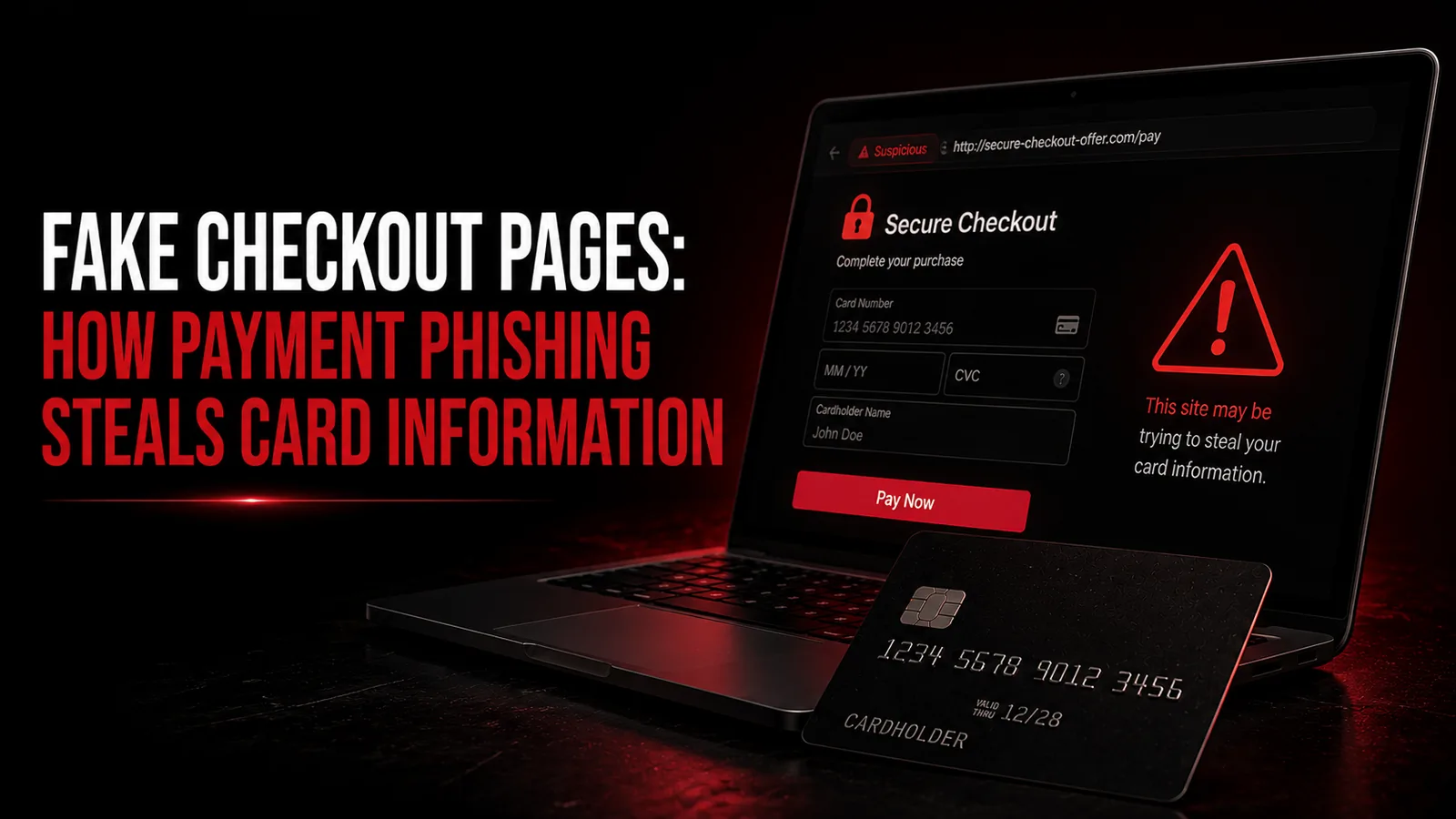
The fake form may request a card number, expiration date, verification value, billing information, or account credentials.
Consumers should navigate directly to the merchant's known website or app and inspect their account rather than entering card data through the message link.
7. Fake Refund and Reward Messages
Scammers sometimes use positive incentives instead of fear.
A message may promise a refund, rebate, loyalty reward, prize, or compensation and claim that card details are needed to receive the money.
Unexpected financial rewards should be independently verified.

A legitimate refund generally follows the merchant or issuer's normal process and should not require a customer to disclose unrelated banking passwords or authentication codes.
8. Fake Delivery and Postal Messages
Delivery-themed phishing can be especially effective because many people regularly receive online orders.
The message may claim that a small redelivery fee or address verification is required.
A fake payment page can then collect card and personal information.
Consumers should use the delivery company's official tracking service rather than links in unexpected messages.
The small amount requested is not evidence that the page is safe; the main objective may be collecting the payment information itself.
9. Fake Customer Support Accounts
Scammers may impersonate support teams on social media, messaging applications, or search results.
A customer who publicly complains about a payment problem can attract fraudulent accounts claiming they can help.
These accounts may ask for card information, authentication codes, screenshots, or remote access to the device.
Customers should initiate support through the merchant or issuer's verified website or application rather than trusting unsolicited replies.
Businesses should monitor impersonation and publish clear official support channels.
10. Search and Advertisement Phishing
Not every phishing victim begins with an email or text.
A criminal website may appear through a malicious advertisement, fraudulent search result, or impersonated support listing.
Consumers looking urgently for a bank's telephone number or login page may accidentally contact a scammer.
Bookmarks, official banking apps, and manually entered known domains can reduce dependence on search results for sensitive financial activity.
Organizations should monitor for brand impersonation and fraudulent advertisements that target their customers.
What Information Do Credit Card Phishers Try to Steal?
The information requested varies according to the scam.
Potential targets include the card number, expiration date, cardholder name, billing address, card-verification value, bank login credentials, email passwords, personal identifiers, and authentication codes.
Europol notes that phishing, smishing, and vishing attacks are used to convince people to hand over credit card information.
The combination of payment data and account credentials can create broader risks than theft of one isolated field.
Why OTP and Authentication-Code Requests Are Dangerous
One-time authentication codes are designed to confirm a particular login or transaction.
If a scammer asks the victim to read out or forward a code, the attacker may be attempting to complete an action that requires additional authentication.
Consumers should read the text of authentication messages carefully rather than assuming a caller's explanation is accurate.
A code generated for a banking transaction should be entered only into the legitimate banking or payment authentication process that the customer intentionally initiated.
Banks and merchants should educate customers that support personnel do not need customers to send authentication secrets through ordinary messages.
Phishing vs a Legitimate Bank Fraud Alert
Both real banks and scammers may contact customers about suspicious activity, so the existence of an alert alone does not establish legitimacy.
A safe way to handle the uncertainty is to avoid using the message's link or callback number.
Instead, open the banking app, visit the bank's known website, or call the trusted number printed on the card.
This independent-channel approach allows the customer to investigate the warning without trusting the sender.
The FTC explicitly recommends contacting the company or bank through a phone number, email, or website known to be real when an unexpected message might be legitimate.
Warning Sign 1: Unexpected Urgency
Messages that pressure the customer to act immediately deserve extra scrutiny.
Claims such as 'your account will close in ten minutes,' 'verify now to prevent suspension,' or 'respond immediately to stop the charge' are designed to reduce careful thinking.
Real financial problems may be urgent, but urgency does not require trusting the communication channel.
Customers can independently contact their issuer without interacting with the suspicious message.
Warning Sign 2: Requests for Sensitive Secrets
Be suspicious when an unexpected contact asks for a PIN, banking password, full authentication code, or other secret.
These values exist to authenticate the customer, so disclosing them can weaken the protections they provide.
A legitimate support interaction should use controlled verification processes rather than asking the customer to hand over every security factor.

The more secrets a message asks for at once, the more cautious the recipient should be.
Warning Sign 3: Suspicious Links and Domains
A phishing link may use misspellings, added words, confusing subdomains, or unrelated domains.
However, attackers can also use compromised websites or convincing domains, so visual inspection of the URL is helpful but not perfect.
The safer approach for financial accounts is to avoid unexpected links entirely and navigate independently to the known service.
Consumers should also be cautious of URL shorteners when the destination cannot be easily verified.
Warning Sign 4: Unusual Payment Instructions
Scammers frequently try to move victims away from ordinary payment procedures.
A message supposedly from a bank or merchant may insist on an unusual process, an unrelated payment account, or another method that does not fit the normal service.
The FTC's current scam guidance emphasizes that unusual or highly specific payment demands can be an important warning sign.
Customers should compare the request with the organization's normal payment process before taking action.
Warning Sign 5: Unrequested Attachments or Apps
Unexpected attachments and software downloads can introduce malware or steal credentials.
The FTC advises against downloading attachments in unexpected messages.
A bank-security alert should not require installing an unfamiliar remote-access application sent through chat or email.
Consumers should download banking applications only from official app stores and verify the publisher.
Organizations should clearly document their official apps so customers can distinguish them from impersonators.
Warning Sign 6: Authentication You Did Not Initiate
An unexpected 3-D Secure challenge, banking-app approval request, password-reset email, or one-time code can indicate that someone is attempting to use or access an account.
Do not approve a transaction or login simply to make the notification disappear.
Reject the request and investigate through the official account.
If repeated unexpected authentication prompts occur, contact the issuer and review account security.
Why Perfect Grammar Does Not Prove Legitimacy
Older phishing advice often focused heavily on spelling and grammatical errors.
Those can still be warning signs, but professional-looking writing is now easy for criminals to produce.
Users should instead focus on whether the contact was expected, whether the requested action makes sense, where links lead, and whether the information can be verified independently.
Security habits need to work even when the scam looks polished.
Why HTTPS and the Padlock Are Not Enough
HTTPS protects the connection between the browser and a website. It does not prove that the website belongs to the organization the user intended to visit.
A phishing site can obtain its own TLS certificate and display a secure connection.
Consumers should verify the actual organization and domain rather than assuming that a padlock means the page is trustworthy.
For highly sensitive activities, using a saved bookmark or official application can reduce the chance of visiting an impersonation page.
What to Do Before Entering Card Details Online
Confirm that you intentionally navigated to the merchant or service.
Check that the domain belongs to the expected organization.
Be cautious if the page came from an unsolicited message, advertisement, or QR code.
Avoid entering financial data while another person is instructing you by phone or message.
Use trusted payment methods and modern authentication where available.
If anything feels inconsistent, leave the page and reach the organization through a known channel.
How Multi-Factor Authentication Helps
Multi-factor authentication can reduce the risk that a stolen password alone gives an attacker access to an account.
CISA describes MFA as an important protection against compromised credentials and recommends phishing-resistant MFA where possible.
However, MFA is not magic. Attackers may try to socially engineer victims into approving prompts or disclosing codes.
Consumers should use MFA and also treat unexpected authentication prompts as warning signs.
Merchants should protect administrative and customer-support accounts with strong MFA because compromised staff accounts can expose many customers.
Why Phishing-Resistant MFA Is Stronger
Some authentication methods are harder to trick users into giving to a fake website.
CISA recommends phishing-resistant MFA as the security standard organizations should strive toward.
FIDO-based security keys and passkey-style authentication can provide stronger protection against credential phishing than reusable passwords and manually entered codes when properly implemented.
Organizations should adopt stronger authentication where practical, especially for staff with access to payment or customer systems.
How Merchants Can Reduce Customer Phishing Risk
Publish clear official support and payment channels.
Use strong account authentication and secure password resets.
Monitor lookalike domains and brand impersonation where feasible.
Avoid sending messages that train customers to enter sensitive financial data directly from unsolicited links.
Use consistent communication practices so customers know what legitimate fraud alerts look like.
Protect customer-support and administrator accounts with strong MFA.
Provide simple reporting channels for suspicious messages.
Use transaction monitoring and modern payment authentication to reduce the value of stolen static card details.
How Banks and Payment Providers Help
Issuers and payment networks use multiple layers of fraud prevention and detection.
Visa describes its security approach as using multiple fraud-prevention and detection systems across payment transactions.

Modern card authentication technologies can add issuer-controlled verification to online payments, while transaction monitoring can identify suspicious patterns.
These controls make phishing-obtained card information less reliable for criminals, but consumers still need to protect account credentials and authentication factors.
The most effective approach combines technology with user awareness.
What to Do If You Clicked a Phishing Link
Do not panic, but act based on what happened.
If you only opened the page and entered nothing, close it and avoid further interaction. If you downloaded a file, update security software and inspect the device according to trusted security guidance.
If you entered a password, change it immediately through the legitimate service and change it anywhere else it was reused.
If you entered card or banking information, contact the financial institution through an official channel.
If you approved an authentication prompt or disclosed a one-time code, tell the issuer exactly what happened because an unauthorized action may already have been attempted.
Review account activity and enable alerts.
What to Do If You Gave a Scammer Your Card Details
Contact the card issuer promptly using the official banking application or a trusted telephone number.
Explain which information was disclosed and whether any authentication requests were approved.
Review recent transactions and report anything unfamiliar.
Follow the issuer's guidance on locking, replacing, or reissuing the card.
The FTC directs people who believe scammers obtained credit-card or bank-account information toward identity-theft recovery resources and advises victims of fraudulent card transactions to contact the issuer.
Continue monitoring the account after replacement because phishing incidents can involve more than one credential.
What to Do If Your Email Account Was Phished
Secure the email account immediately because it may be used to reset passwords elsewhere.
Change the password, enable strong MFA, terminate unfamiliar sessions where supported, and review recovery email addresses and phone numbers.
Then inspect banking, shopping, social-media, and other important services for password reuse or suspicious reset activity.
A compromised email account can become a gateway to payment fraud even when the criminal did not initially obtain the card number.
How to Report Phishing
Report phishing to the impersonated bank, merchant, or organization using its official fraud-reporting process.
Mark phishing emails or messages as spam or phishing in the relevant service so filtering systems can learn from them.
In the United States, the FTC provides scam-reporting and identity-theft resources.
Other countries have their own national cybercrime or consumer-protection reporting channels.
Reporting helps organizations identify impersonation campaigns and warn other customers.
Common Myths About Credit Card Phishing
Myth: Phishing only happens by email. Reality: it can use SMS, messaging apps, voice calls, QR codes, social media, search results, and other channels.
Myth: A message using your real name must be genuine. Reality: personal information can come from breaches, public sources, or prior scams.
Myth: A website with HTTPS is automatically legitimate. Reality: HTTPS secures the connection but does not prove the operator is trustworthy.
Myth: Banks need your OTP to cancel fraud. Reality: authentication codes are security credentials and should not be given to unexpected callers or messages.
Myth: Bad grammar is the main way to identify phishing. Reality: modern phishing can be professionally written.
Myth: MFA makes phishing impossible. Reality: MFA helps significantly, but attackers may still target users with fake prompts or social engineering. Phishing-resistant MFA offers stronger protection.
Myth: Small payment requests are harmless. Reality: a small fake fee can be used to obtain valuable card and identity information.
Conclusion
Credit card phishing scams succeed by manipulating trust. The criminal does not need to break the payment network if the victim can be persuaded to provide the information or authentication needed for the next step.
The message may change from a fraud alert to a delivery problem, refund, reward, subscription issue, or customer-support conversation, but the safest response remains consistent: do not trust an unexpected communication merely because it looks official.
Navigate independently to the bank or merchant, verify the issue through a known channel, protect authentication codes, and treat unexpected payment prompts as security warnings.
For merchants and financial institutions, phishing defense also requires stronger account authentication, secure support processes, transaction monitoring, customer education, and rapid response to brand impersonation.
The most effective phishing defense is a combination of skepticism, independent verification, strong authentication, and layered payment security.