
Introduction
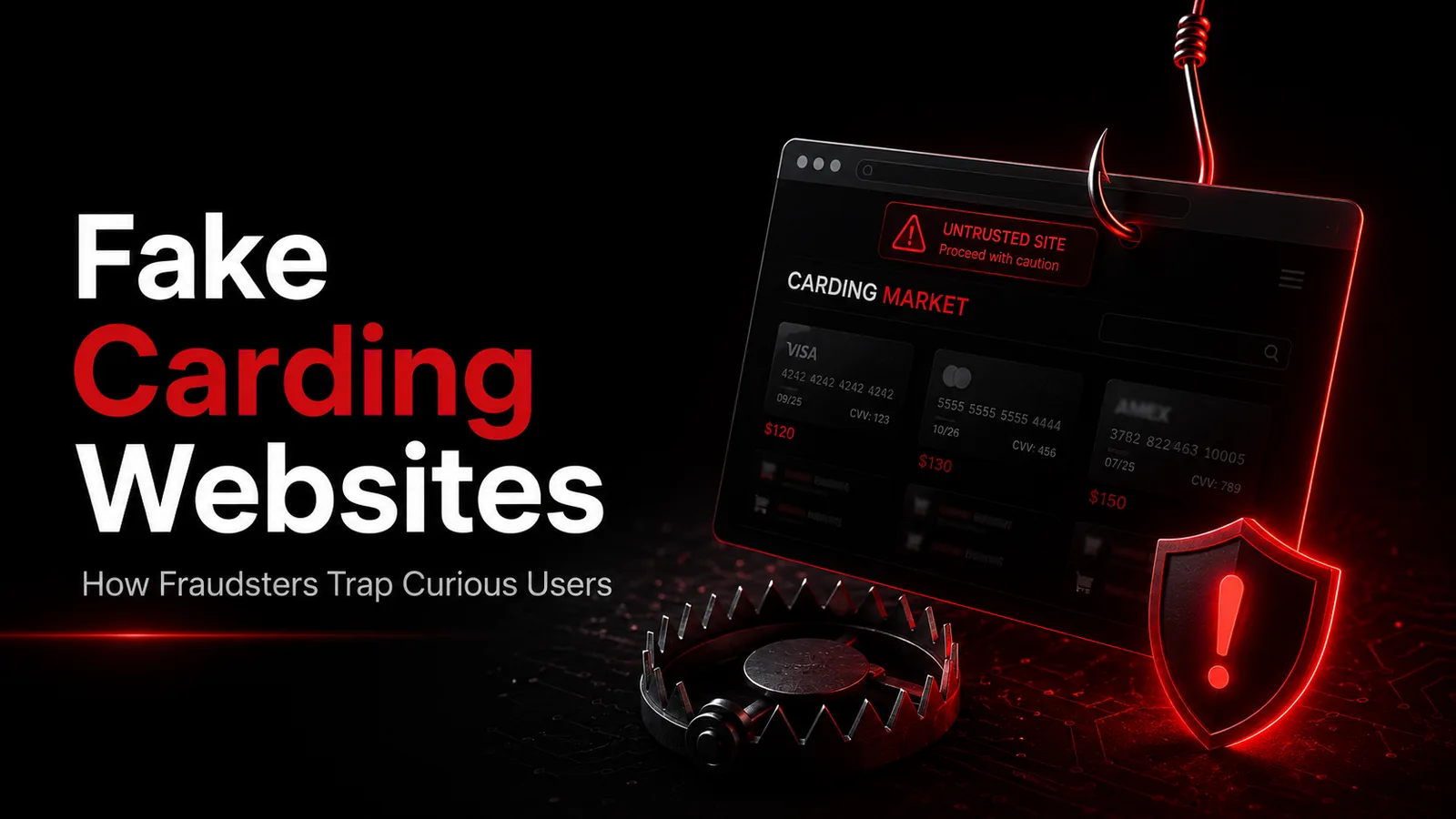
Fake carding websites are scam sites that imitate underground fraud marketplaces, “card shops,” training platforms, account dashboards, or private cybercrime services in order to exploit people curious about carding or illegal financial shortcuts.
The scam may be surprisingly simple. A visitor is promised easy money, access to supposedly stolen payment information, a secret method, a pre-funded account, or membership in an exclusive community. The site then demands a deposit, cryptocurrency payment, registration fee, identity “verification,” software download, or account credentials.
The supposed carding service may never have existed. The entire website may have been built to steal from the people trying to use it.
This is a particularly effective form of criminal-on-criminal or curiosity-driven fraud because victims may hesitate to report losses when the original site appeared to offer illegal services.
FTC and CISA guidance on online scams reinforces the underlying mechanism: criminals use spoofed websites, malicious links, fake forms, and deceptive downloads to steal money, credentials, and personal information or infect devices with malware.
This article explains fake carding websites defensively. It does not provide active carding-site names, links, marketplace addresses, access instructions, vendor recommendations, fraud methods, or guidance for purchasing stolen payment information.
Quick Answer: What Is a Fake Carding Website?
A fake carding website is a scam site designed to look like an underground payment-fraud marketplace or service while its real purpose is to steal from visitors.
It may pretend to sell stolen cards, account access, criminal tools, courses, memberships, or other illegal services.
The victim may be asked for cryptocurrency, a deposit, login credentials, personal information, an identity document, or a software download.
After payment, the site may disappear, demand additional fees, lock the account, display a fake balance, or send malware instead of the promised service.
The safest response is not to test whether the service is genuine. Leave the site and do not send money, credentials, identity documents, or install any files.
Why Curious Users Are Good Scam Targets
Curiosity creates an ideal opening for scammers.
Someone searching for carding may be inexperienced, excited by promises of easy money, and reluctant to ask legitimate institutions for advice.
The scammer can exploit secrecy, greed, urgency, fear of missing out, and the victim's own concern about admitting what they were trying to access.
The result is a population of victims who may be both vulnerable and unlikely to report losses.
This is one reason fake underground markets can be profitable even when they provide no real criminal service at all.
The Double-Scam Model
Fake carding sites often operate as a double scam.
The first deception is the promise that illegal financial gain will be easy, reliable, or anonymous.
The second deception is the website itself: instead of providing what was promised, it steals from the person who believed the first deception.
A visitor can therefore lose money before ever committing the fraud they thought they were preparing to commit.
This model is similar to many ordinary advance-fee scams, except the bait is access to supposed underground opportunities.
Fake Card Shops
A fake card shop imitates an illicit marketplace that supposedly sells compromised payment-card data.
The interface may contain product categories, account balances, seller ratings, search boxes, transaction histories, and support chat.
Those interface elements prove nothing.
A site can populate a database with invented listings and random numbers simply to make the marketplace appear active.
The visitor may deposit cryptocurrency but discover that purchases never complete, withdrawals are impossible, or additional fees are demanded.
Professional appearance is not evidence that the underlying service is real.
Fake Carding Forums
Some scam sites imitate forums rather than marketplaces.
The site may display fake discussions, user profiles, reputation scores, tutorials, and supposed success stories.
These can be fabricated to create social proof.
A newcomer may believe hundreds of experienced members are recommending the service when the activity is actually controlled by the same scammer.
Fake communities exploit the human tendency to trust what appears to be a large group consensus.
Fake Training and Course Websites
A website may claim to teach a secret carding method or offer private mentoring.
Payment unlocks a course containing generic information, recycled public material, invented techniques, or nothing at all.
The site may then demand higher payments for an “advanced method,” private group, special software, or one-on-one access.
The real product is often the promise of easy criminal income.
Legitimate cybersecurity education does not require stolen payment data, illegal marketplaces, or criminal transaction methods.

Fake 'Preloaded Card' and Easy-Money Claims
Some websites advertise supposedly preloaded cards, guaranteed balances, instant withdrawals, or other financial shortcuts.
These claims are highly attractive because they reduce a complicated criminal ecosystem to a simple purchase.
That simplicity is itself a warning sign.
There is no legitimate financial institution providing anonymous guaranteed criminal profit.
A website asking for an upfront fee in exchange for supposedly guaranteed illicit money may simply be an advance-fee scam.
Fake Account Dashboards
A scam website can display any balance it wants.
After a visitor deposits money, the dashboard may show a larger account balance, successful transaction, or available withdrawal even though no corresponding funds exist.
When the victim attempts to withdraw, the site may demand another payment for activation, tax, insurance, verification, unlocking, or account upgrading.
This mirrors fake-investment and fake-platform scams seen across legitimate-looking financial websites.
Numbers displayed on a webpage are not proof that real money exists.
The Withdrawal-Fee Trap
One common scam pattern is to keep the victim paying after the initial deposit.
The account supposedly contains funds, but every withdrawal attempt triggers another requirement.
The label may change: activation fee, security deposit, processing charge, verification payment, wallet fee, or release fee.
The important pattern is not the label.
If a criminal service requires repeated new payments before releasing supposedly existing funds, the victim is likely being manipulated through a sunk-cost scam.
Sending more money usually increases the loss rather than recovering the original payment.
Fake Verification Requirements
A fake underground site may ask users to verify their identity before purchasing or withdrawing.
The victim may be asked for a passport, driver's licence, selfie, phone number, address, or banking information.
That information can create a second form of victimization: identity theft.
A scammer can collect both the visitor's cryptocurrency and their real identity.
Never upload identity documents to an illegal or unverified service.
The request may also create blackmail risk because it links the person's identity to attempted participation in a criminal marketplace.
Credential-Harvesting Login Pages
A fake carding site can also operate as a credential-phishing site.
Users who reuse an email address and password from another service may unintentionally give criminals access to legitimate accounts.
FTC guidance warns that spoofed websites can collect usernames, passwords, account numbers, and other information entered by victims.
Password reuse makes this especially dangerous because one underground registration can become compromise of email, shopping, social-media, or other accounts.
Use unique passwords and multi-factor authentication on legitimate accounts so one stolen password cannot easily unlock everything else.
Malware Disguised as Carding Software
A fake site may require visitors to download a “checker,” “private tool,” browser extension, wallet application, security program, or other software.
The download may actually be malware.
FTC guidance warns that scammers use cloned websites and fake software advertisements to spread malicious software that can steal information or access online accounts.
CISA likewise warns that phishing and malicious sites can trick users into opening harmful links or downloading malware.
Someone searching for an illegal tool is particularly vulnerable because they already expect security software to flag the download as suspicious.
Fake Security Warnings
Scammers may use fake security prompts to convince a user to perform actions that compromise their own device.
In June 2026, the FTC warned about fake CAPTCHA scams that imitate ordinary human-verification screens but direct users to perform actions that actually install malware.
The broader lesson applies to suspicious underground sites: a page labeled “verification,” “anti-bot,” or “security check” should not be trusted merely because the interface looks familiar.
Do not run commands, install software, disable security protections, or change device settings because an unknown website instructs you to do so.
Fake Browser Extensions
A supposed marketplace may tell visitors that a special browser extension is required.
Extensions can request significant permissions and may be able to read or modify webpages, observe browsing activity, or access session data depending on their permissions.
Installing an untrusted extension can expose legitimate banking, email, shopping, or cryptocurrency sessions.
Do not install extensions distributed by criminal or unknown websites.
Use official browser stores and verify the publisher of legitimate extensions before installation.
Cryptocurrency Deposit Scams
Cryptocurrency is attractive to fake underground markets because transactions can be difficult to reverse and ordinary chargeback protections may not apply.
The website may display a unique deposit address and automatically update the fake account balance after payment.
That does not mean the service is legitimate.
Once the transfer is made, the operators may disappear or demand more money.
The use of cryptocurrency should never be treated as proof that a site is authentically part of an underground market.
Fake Escrow
A scam website may claim that deposits are protected by escrow.
The alleged escrow provider may simply be the same person operating the site.
There is no licensed third party, regulated fiduciary duty, or legitimate dispute mechanism.
The word “escrow” can be added to a website as easily as any other marketing text.
Underground escrow should not be confused with regulated escrow services used in lawful commerce.
Fake Seller Ratings and Reviews
A fake marketplace can generate unlimited reviews.
The operator controls the database and can create seller profiles with years of fake history, positive ratings, badges, completed orders, and testimonials.
Reviews on a site controlled by the alleged seller or market are therefore weak evidence.
This problem exists even in real criminal communities, where reviews can be manipulated; on a completely fake marketplace, the operator can fabricate the entire social environment.

Fake Live Transactions
Some scam platforms may display counters claiming that purchases are happening in real time.
These numbers can be generated automatically and do not prove that any transaction occurred.
Fake activity creates urgency by making the visitor think many other people are successfully using the service.
The same psychological tactic appears in ordinary scam shopping and investment websites.
Never use animated activity, recent-purchase popups, or rapidly changing balance counters as proof of legitimacy.
Fake Testimonials and Screenshots
Screenshots are easy to manufacture.
A fake site may show chat conversations, withdrawal confirmations, cryptocurrency transfers, account balances, or supposed buyer testimonials.
Images can be edited or created entirely from scratch.
A screenshot is not independent verification.
The more a site depends on dramatic proof rather than accountable identity and lawful business operations, the less confidence a visitor should place in it.
Fake Support Agents
Support chat can be another stage of the scam.
The agent may reassure the victim that the deposit is safe and claim that only one additional fee is needed.
When the victim becomes suspicious, the agent may create urgency, threaten account closure, or promise a bonus for paying immediately.
The purpose is to keep the victim engaged and paying.
A responsive support chat does not prove that the underlying platform is legitimate.
Impersonating Known Underground Brands
Scammers can copy the name or appearance of a criminal marketplace that has gained notoriety.
When an underground service is seized, closed, or goes offline, confusion creates an opportunity for fake replacement sites and impersonators.
Users searching for a new address may land on a scam clone.
This is one reason law-enforcement disruptions can increase distrust throughout criminal communities.
This article intentionally does not identify or provide access information for any active or historical criminal marketplace.
Why Takedowns Create Clone Scams
When a large cybercrime forum or marketplace disappears, users may urgently search for a successor.
Scammers can exploit that demand by registering lookalike sites, claiming to be the official replacement, or selling fake invitations.
Europol and DOJ continue to disrupt large cybercrime communities, which demonstrates both the instability of the ecosystem and the opportunity for impersonation after shutdowns.
A person cannot safely determine legitimacy simply because a site claims continuity with another underground brand.
Fake Marketplace Mirrors
A mirror is normally an alternate address for the same service.
But criminals can create fake copies that merely look like a legitimate mirror.
The visitor may believe they reached the correct marketplace while actually sending credentials and cryptocurrency to an impersonator.
This risk is another reason ordinary users should not attempt to navigate underground marketplace ecosystems.
The uncertainty is structural, not something that can be eliminated by one clever verification trick.
Why HTTPS Does Not Prove the Site Is Real
A fake carding site can use HTTPS.
HTTPS encrypts the connection between the browser and the website; it does not certify that the person operating the website is honest.
FTC guidance on spoofed websites and online scams repeatedly emphasizes that polished, encrypted-looking sites can still steal information.
A padlock therefore means the connection is encrypted - not that an illegal marketplace actually provides what it claims.
Why Onion or Dark-Web Hosting Does Not Prove Authenticity
Hosting a site through anonymity-oriented infrastructure does not prove the site is a genuine criminal marketplace.
A scammer can use the same technologies as other underground operators.
The fact that a site is difficult to access can actually increase its perceived exclusivity and legitimacy among curious users.
Technical obscurity should never be mistaken for trustworthiness.
This article does not provide instructions for accessing hidden services.
Why 'Invite Only' Is Not a Trust Signal
Restricted access can be used to manufacture prestige.

A scammer may claim that the site is private, invitation-only, or available only to professionals.
The restriction may exist solely to increase the victim's willingness to pay an entry fee.
A private community can be fake just as easily as a public one.
Exclusivity is a marketing mechanism, not independent verification.
Recovery Scams After the Website Disappears
Victims of fake carding websites can be targeted a second time.
Someone may claim to be an administrator, hacker, recovery specialist, law-enforcement contact, or cryptocurrency expert who can recover the lost funds.
The victim is told to pay another fee.
FTC scam guidance warns that people who have already lost money are common targets for follow-up recovery scams.
Do not send additional money to strangers claiming they can recover cryptocurrency or deposits from an illegal website.
Blackmail After Registration
A fake carding website can collect more than money.
Registration logs may reveal email addresses, usernames, IP information, messages, cryptocurrency addresses, and uploaded identity documents.
Operators can threaten to disclose that information unless the victim pays.
This makes a fake illegal marketplace particularly dangerous: the victim's curiosity itself becomes leverage.
Do not assume that a pseudonym prevents an operator from collecting other identifying information.
Fake Law-Enforcement Messages
After a scam, operators may impersonate law enforcement and claim the visitor has been identified.
The victim is told to pay a fine, settlement, cryptocurrency fee, or “case closure” charge.
Legitimate law-enforcement agencies do not resolve criminal investigations by demanding anonymous cryptocurrency payments through a marketplace chat.
Europol has itself warned the public about scammers impersonating Europol to demand money or personal information.
If a genuine legal concern exists, seek qualified legal advice through legitimate channels.
Why Users May Be Afraid to Report the Scam
The original intent behind visiting the website can make victims reluctant to report.
Scammers understand this.
They may explicitly threaten to report the person or expose browsing history unless more money is paid.
Victims should still secure compromised accounts and devices immediately.
If legal exposure is a concern, a qualified lawyer can advise on the appropriate reporting and response options.
Continuing to pay the scammer generally increases leverage rather than ending it.
What to Do If You Registered on a Fake Carding Site
Stop interacting with the website.
If the password was reused anywhere legitimate, change those passwords immediately.
Enable multi-factor authentication on email, financial, cryptocurrency, social-media, and other important accounts.
Review account-recovery email addresses, telephone numbers, active sessions, and authorized devices.
Be alert for follow-up phishing messages using information submitted during registration.
What to Do If You Downloaded Software
Treat the device as potentially compromised.
Disconnect it from sensitive activity and use reputable security software or qualified technical support to investigate.
Change important passwords from a known-clean device rather than from the potentially infected machine.
Review cryptocurrency and financial accounts for unauthorized activity.
If malware is confirmed, follow an appropriate incident-recovery process rather than trusting an “uninstaller” supplied by the same website.
What to Do If You Sent Cryptocurrency
Stop sending additional funds.
Preserve transaction information, screenshots, messages, and relevant account details.
Do not pay a supposed recovery agent who contacts you afterward.
Depending on jurisdiction and circumstances, a legitimate cryptocurrency exchange, fraud-reporting agency, law-enforcement body, or legal adviser may be able to explain available options.
Recovery is not guaranteed, which is precisely why cryptocurrency advance-fee scams are so damaging.
What to Do If You Uploaded Identity Documents
Treat the incident as potential identity-data exposure.
Monitor financial and online accounts.
Change compromised credentials.
If strong identity information was exposed, consider the identity-theft protections available in your jurisdiction.
In the United States, IdentityTheft.gov provides official recovery guidance.
Be especially cautious of follow-up scams because the operator may now possess enough personal information to impersonate a bank, marketplace, employer, or government agency convincingly.
What to Do If You Entered Card or Bank Information
Contact the bank or card issuer through an official channel.
Explain that payment information may have been entered into a fraudulent website.
Review recent transactions and enable alerts.
Follow the bank's guidance regarding card replacement, account restrictions, or credential resets.
Do not contact a phone number supplied by the fake website itself.
How to Recognize the Broader Scam Pattern
The safest detection method is not to memorize underground website designs.
Focus on the pattern.
The site promises easy or guaranteed illegal profit, requests an irreversible payment, displays unverifiable proof, asks for sensitive identity information or software installation, and introduces additional fees whenever the user tries to receive the promised benefit.
Each of these elements independently deserves caution. Combined, they strongly resemble an advance-fee or credential-theft scam.
Red Flag 1: Guaranteed Profit
No legitimate system can guarantee criminal profit.
Fraud attempts can fail, accounts can be blocked, marketplaces can be seized, and other criminals can steal the money.
Promises of guaranteed income or fixed returns are designed to suppress skepticism.
If the offer sounds simpler than the real financial system, the simplicity may be the bait.
Red Flag 2: Upfront Cryptocurrency Only
A demand for irreversible cryptocurrency payment removes many ordinary consumer protections.
Cryptocurrency itself is not proof of fraud, but an unknown illegal service demanding crypto while providing no accountable identity should be considered extremely high risk.
Do not confuse technical payment sophistication with legitimacy.
Red Flag 3: Repeated Unlock Fees
A fake platform may constantly move the goalpost.
After registration comes the deposit.
After the deposit comes activation.
Then verification, insurance, withdrawal, tax, or another invented charge.
The pattern is a classic advance-fee mechanism: every new payment is justified as the final step.

The safest step is to stop paying.
Red Flag 4: Required Security Disabling
A website telling users to disable antivirus, browser protections, application verification, or operating-system security before installing a tool is especially dangerous.
Cybercriminals know that security tools may block malicious files.
Do not lower device defenses because an unknown website claims that detection is merely a false positive.
Legitimate security research uses controlled environments rather than disabling safeguards on everyday personal devices.
Red Flag 5: Pressure and Scarcity
Limited memberships, countdown timers, expiring deposits, special invitation windows, and threats of account deletion can create urgency.
Urgency reduces careful thinking.
FTC phishing guidance repeatedly notes that scammers create stories designed to make victims act before verifying the situation.
A genuine opportunity does not become more trustworthy because a timer is counting down.
Red Flag 6: No Independent Accountability
If the site's only proof comes from material it controls, there is no independent verification.
The marketplace controls its own reviews, transactions, support chat, balances, and testimonials.
That means every visible trust signal can be fabricated.
In legitimate commerce, trust can be supported by accountable entities outside the merchant itself.
Illegal marketplaces lack that protection by design.
Why Carding Curiosity Can Lead to Broader Cybercrime Exposure
A person may begin by searching for information about carding and end up entering a much broader criminal ecosystem.
Links can lead to malware communities, identity-data markets, fake cryptocurrency services, phishing groups, or other illegal environments.
Europol's reporting describes cybercrime forums as marketplaces for stolen data, malicious software, tools, and criminal services.
Curiosity therefore creates both cybersecurity risk and potential legal risk.
Learning about fraud is safer through official cases, security research, payment-industry standards, and controlled educational environments.
Law-Enforcement Reality
Underground markets are not beyond law enforcement.
In January 2025, DOJ and Europol announced disruption of two very large cybercrime forums used to advertise stolen information, malware, and cybercrime tools.
Europol later announced additional operations against major cybercrime communities in 2025 and 2026.
Historical FBI carding investigations also used undercover participation to identify users and administrators.
A fake marketplace may steal from visitors, while a real criminal marketplace may create evidence leading to investigation. Neither is a safe destination.
Why Fake Sites Benefit From Real Takedowns
Law-enforcement seizures create name recognition.
A criminal marketplace mentioned in news reports can become a brand that scammers later impersonate.
Users looking for a replacement may have difficulty distinguishing a genuine successor from a clone.
The result is an ecosystem where enforcement disruption and criminal impersonation reinforce distrust.
This is another reason the safest guidance is not how to find the “real” market, but not to participate at all.
Legal Risks of Attempting to Participate
A person can be both scam victim and potential criminal suspect.
Attempting to buy stolen payment data, compromised accounts, or fraud services can create legal exposure even if the seller turns out to be fake.
Relevant offenses vary by jurisdiction and facts.
Being defrauded does not necessarily make the original intended conduct lawful.
Anyone worried about personal legal exposure should seek qualified legal advice rather than continuing to engage with the website or its operators.
Safer Ways to Learn About Carding
You do not need to visit underground websites to understand payment fraud.
Useful lawful sources include Europol, FBI, DOJ, FTC, CISA, PCI Security Standards Council, payment networks, academic cybersecurity research, and reputable threat-intelligence reporting.
Students can use synthetic data, capture-the-flag exercises, cyber ranges, and authorized labs.
Fraud-awareness education should explain how criminal ecosystems work without requiring contact with stolen credentials or active marketplaces.
What Parents and Educators Should Watch For
Young users can be targeted by online content portraying carding as easy money or hacker status.
Warning signs can include secretive paid groups, requests for cryptocurrency, unknown software downloads, or claims of guaranteed illegal profit.
Education should focus on both sides of the risk: carding is criminal activity, and many people selling access to it are themselves scammers.
Authorized cybersecurity learning offers the technical challenge without the fraud, malware, and legal exposure.
What Businesses Should Know
A fake carding site may falsely claim to possess stolen information from a legitimate company.
That can damage a brand or create panic even when the advertised dataset is fabricated.
Businesses should validate underground claims through professional threat intelligence, payment networks, acquirers, cybersecurity teams, and law enforcement rather than relying on screenshots or criminal advertisements.
Credible exposure should trigger incident response. Unverified claims should be investigated without automatically being treated as true.
Common Myths About Fake Carding Websites
Myth: If the site is on the dark web, it must be a real underground marketplace. Reality: scammers can operate on anonymity networks too.
Myth: HTTPS proves the market is genuine. Reality: HTTPS only encrypts the connection.
Myth: Seller reviews prove inventory exists. Reality: a fake site can manufacture every review and listing.
Myth: A working deposit balance proves money is stored. Reality: the website controls the number displayed on the screen.
Myth: An invite-only market is safer. Reality: exclusivity can be fabricated to encourage payment.
Myth: A security warning is expected because carding software is 'hacker software.' Reality: the file may simply be malware.
Myth: If the first payment is lost, paying the withdrawal fee can recover it. Reality: repeated fees are a common advance-fee pattern.
Myth: Criminal marketplaces cannot be infiltrated or seized. Reality: FBI, DOJ, and Europol operations repeatedly demonstrate the opposite.
Conclusion
Fake carding websites succeed because they sell two illusions at once.
The first illusion is that stolen payment data or criminal financial shortcuts provide easy, reliable money.
The second is that the website offering access to that world can be trusted.
In reality, the site may exist only to steal cryptocurrency, passwords, identity documents, or access to the visitor's computer.
A convincing dashboard, encrypted connection, active support chat, positive reviews, and apparently large inventory can all be fabricated by the same operator.
For curious users, the most important lesson is not how to identify a “real” carding site. It is that searching for one creates unnecessary cybersecurity, financial, and legal risk.
Anyone who wants to understand payment fraud can do so safely through authoritative law-enforcement cases, payment-security standards, academic research, and controlled cybersecurity labs.
The safest carding website is not the one with the best reviews or most professional interface. It is the one you do not attempt to use.