


Introduction
Telegram is a legitimate messaging platform used by families, businesses, communities, news organizations, and millions of ordinary users. Like other large communication platforms, however, it can also be abused by scammers and cybercriminals.
“Telegram carding scams” refers to fraud schemes in which a person or group uses Telegram to promote supposedly stolen payment-card data, fake carding services, fake marketplaces, illegal “training,” cryptocurrency deals, private access, or other fraud-related offers — while the real goal is often to steal money, account credentials, identity information, or access to the victim's device.
The Federal Trade Commission has specifically warned that scammers use Telegram in other scam contexts. The platform itself is therefore not the warning sign; the behavior of the person, bot, channel, or group is.
Carding-themed scams are especially deceptive because the target may be curious about illegal activity and therefore reluctant to report a loss. Scammers can exploit that hesitation, along with promises of easy money, exclusivity, anonymity, and supposedly verified criminal expertise.
This guide focuses on defensive warning signs. It does not identify active carding channels, provide Telegram invite links, recommend vendors, describe stolen-data prices, or explain how to participate in payment fraud.
Quick Answer: What Is a Telegram Carding Scam?
A Telegram carding scam is a fraud conducted through Telegram that uses carding, stolen-card data, criminal services, or easy-money claims as bait.
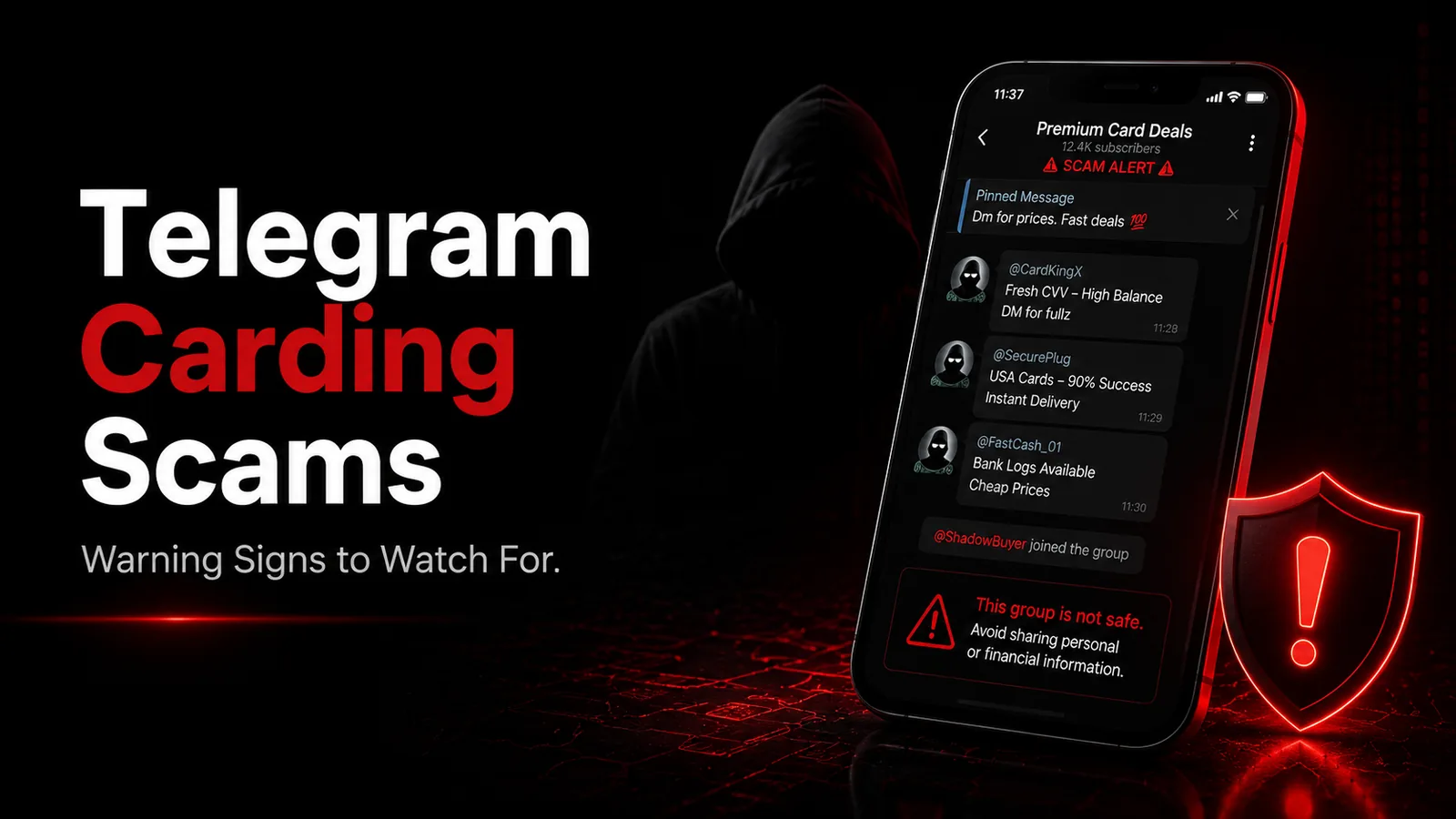
The scammer may run a public channel, private group, bot, or direct-message account that appears to sell illegal data or services.
The victim is then asked to send cryptocurrency, pay a membership or escrow fee, download software, provide account credentials, upload identity documents, or make repeated payments before a supposed withdrawal or service can be released.
The promised product may never have existed. Screenshots, subscriber counts, admin titles, testimonials, and transaction “proof” can all be manufactured or copied.
If an offer depends on stolen financial information or promises guaranteed illegal profit, the safest response is not to verify the seller — it is to leave the conversation and avoid sending money or information.
Why Telegram Is Attractive to Scammers
Messaging apps make it easy for scammers to communicate quickly, operate communities, share media and files, and move conversations into private chats.
The FTC has documented scammers moving prospective victims into Telegram conversations in job-fraud schemes, showing how legitimate messaging tools can be used to create a controlled environment away from the original platform.
Inside that environment, a scammer can present screenshots, voice notes, fake customer feedback, bots, support accounts, and other material with little independent oversight.
The user may also feel that a private conversation is more authentic or exclusive than an ordinary public advertisement.
Privacy and convenience features do not verify whether the person on the other side is honest.
The Carding Scam Funnel
Many Telegram carding scams follow a broad psychological funnel.
First, a social-media post, website, message, or recommendation creates curiosity.
Second, the person is moved into a Telegram channel, group, bot, or direct message.
Third, the scammer builds confidence using screenshots, testimonials, subscriber numbers, fake order updates, or claims of long experience.
Fourth, the victim is asked to send an irreversible payment or reveal sensitive information.
Finally, new fees or problems appear until the victim stops paying.
The important defensive insight is the sequence: curiosity is converted into trust, trust into payment, and payment into pressure for further payments.
Warning Sign 1: Guaranteed Illegal Profit
Claims of guaranteed carding profit are inherently deceptive.
No criminal seller can guarantee that stolen information is genuine, that a payment attempt will succeed, that a bank will not block activity, or that law enforcement will not intervene.
Scammers use words such as “guaranteed,” “100% working,” “risk free,” or “instant profit” because certainty reduces skepticism.
FTC cryptocurrency-scam guidance similarly warns about claims of big returns or money-making opportunities with little or no risk.
An offer does not become credible simply because the promised activity is itself illegal.
Warning Sign 2: Cryptocurrency Is the Only Payment Method
Cryptocurrency is not inherently fraudulent, but scammers often prefer payment methods that are difficult to reverse.
The FTC warns that scammers frequently demand cryptocurrency because once the payment is sent, getting it back can be difficult.
In a Telegram carding scam, the seller may insist that crypto is required for anonymity, membership, activation, escrow, or purchase.
The combination of an unknown identity, an illegal service, and an irreversible payment should be treated as extremely high risk.
Sending cryptocurrency does not create a binding or enforceable purchase agreement.
Warning Sign 3: Upfront 'Verification' or Membership Fees
A channel may demand payment before the user can see supposedly premium information or communicate with vendors.
The fee might be called verification, membership, VIP access, insurance, a security bond, anti-scam protection, or an entry deposit.
The name of the fee is less important than the structure: money must be sent before any independently verifiable benefit exists.
Fake communities can collect many small entry payments and disappear.
Private access is not proof that the private area contains anything real.
Warning Sign 4: Fake Escrow Claims
Some Telegram groups claim that an administrator or bot provides escrow between buyers and sellers.
In legitimate commerce, escrow involves an accountable intermediary governed by law and contract.
In an illegal Telegram market, the “escrow” account may belong to the seller, an accomplice, or an impersonator.
There is no regulator guaranteeing that the intermediary will return funds or resolve disputes fairly.
The word escrow can be typed into a profile or bot description; it is not a security guarantee.
Warning Sign 5: Screenshots as the Main Proof
Screenshots of cryptocurrency balances, card balances, transfers, bank applications, marketplace orders, or customer messages are weak evidence.
Images can be edited, staged, generated, or copied from unrelated sources.
A scammer can create an entire visual history of supposed success without any corresponding financial activity.
If the only verification comes from screenshots supplied by the seller, the seller controls all of the evidence.
Professional-looking images should never substitute for legitimate accountability.
Warning Sign 6: Subscriber Count Used as Proof
A Telegram channel may have a large subscriber count or appear busy.
That does not prove the operator is honest.
Large audiences can contain inactive accounts, bots, curious observers, victims, or people who never purchased anything.
Even genuine popularity would only show that many people joined — not that the illegal service delivers what it promises.
Fraud can scale just as legitimate content can scale.
Warning Sign 7: Endless 'Vouches' and Testimonials
Carding scam channels often rely on apparent customer feedback.
The operator may repost praise, payment screenshots, voice notes, or messages from supposed buyers.
Those testimonials can be created by the operator or coordinated accounts.

A victim cannot independently audit whether the testimonial came from a real person or whether the claimed outcome occurred.
An internal Telegram vouch system has no equivalent to regulated consumer reviews, banking records, or legal accountability.
Warning Sign 8: The Seller Moves You to a Different Account
A scammer may say the public channel is only for advertising and instruct users to contact a specific “admin,” “vendor,” “manager,” or “support” account.
The account can later change, be impersonated, or claim that the original administrator is unavailable.
This makes identity verification extremely difficult.
A scam victim may send money to an impersonator while believing they are dealing with the channel owner.
Moving between multiple aliases is not a sign of professional security; it can be a sign of weak accountability.
Warning Sign 9: Lookalike Admin Usernames
Impersonation is a major risk in communities where participants primarily know one another by usernames.
A scammer can copy a profile photo, display name, biography, and writing style while using a subtly different account.
The victim may believe the message came from an established administrator.
The same principle applies to ordinary phishing: a familiar identity presented on screen does not automatically prove who controls the account.
Never send money or credentials because a display name looks familiar.
Warning Sign 10: The Admin Messages You First
Unexpected direct contact should increase caution.
A scammer may pretend to have noticed that the victim is interested in purchasing, joining, or resolving a problem.
The FTC's broader scam guidance consistently warns consumers about unexpected messages that start a relationship and then create a money request.
An unsolicited private message offering guaranteed financial gain should be treated as a warning sign, especially when the sender claims privileged access or urgency.
Do not allow a direct message to create artificial authority.
Warning Sign 11: Fake Bots and Automated Shops
Telegram bots can automate legitimate services, but a bot interface does not prove that an underground shop is real.
A scam bot can display categories, balances, order numbers, deposit addresses, membership status, and fake transaction history.
Every number on the screen can be controlled by the operator.
A bot can therefore reproduce the appearance of an automated marketplace while doing nothing except collecting deposits.
Automation is a user-interface feature, not evidence of legitimacy.
Warning Sign 12: Fake Balance After Deposit
After sending cryptocurrency, a victim may see a balance appear inside a bot or receive a message saying the account has been credited.
That balance may be purely fictional.
FTC investment-scam guidance describes fraudulent platforms that display fake reports showing supposed profits in order to convince victims to send more money.
The same psychological mechanism can be used in Telegram carding scams.
A balance displayed by the person who received the deposit does not prove that funds are withdrawable or that any real asset exists.
Warning Sign 13: Withdrawal or Activation Fees
A common warning sign appears when the victim tries to receive the promised result.
The scammer suddenly requires a withdrawal fee, activation fee, tax, network charge, insurance payment, wallet synchronization fee, upgrade, or security deposit.
After that payment, another obstacle may appear.
This is a classic advance-fee structure.
FTC scam guidance warns against paying money to get money, and task-scam guidance similarly describes fake earnings that become inaccessible unless victims deposit more.
Do not chase a previous loss with another payment.
Warning Sign 14: 'You Need to Deposit More to Unlock It'
The sunk-cost effect can keep victims paying.
Once a person has already sent money, the scammer claims that only one more payment is necessary to unlock the balance or order.
The victim does not want the first payment to be wasted, so they send more.

This cycle can repeat many times.
The correct decision is based on the new payment's credibility, not on how much has already been lost.
Past losses are not evidence that the next payment will succeed.
Warning Sign 15: Identity Documents Requested
An underground Telegram seller may claim that identity verification is needed before access or withdrawal.
The victim can be asked for a passport, driver's licence, selfie, address, telephone number, or banking document.
Providing those materials creates identity-theft and blackmail risk.
A criminal operator can collect the visitor's money and a verified real-world identity at the same time.
Never upload identity documents to a carding group or other illegal service.
Warning Sign 16: Banking Credentials Requested
A supposed vendor may request online-banking usernames, passwords, one-time codes, or account-recovery information.
No legitimate reason exists to give an underground seller complete access to a real financial account.
The request may simply be credential theft.
If credentials have already been disclosed, contact the financial institution through an official channel and change access information immediately.
Do not rely on the Telegram contact to explain how to secure the account they may be trying to steal.
Warning Sign 17: Reused Passwords
Registration through bots or websites linked from Telegram can expose passwords.
A scammer may not care about the carding purchase at all; the real objective may be to collect email and password combinations.
If a user reuses the same password for email, shopping, cryptocurrency, or social media, one fake underground registration can create several legitimate account compromises.
Use unique passwords and MFA on important lawful accounts.
If a password was entered into a suspicious service, change it anywhere it was reused.
Warning Sign 18: Download This 'Tool'
A channel may distribute an application, archive, browser extension, executable, mobile app, or script advertised as a private carding tool.
The file may actually contain malware designed to steal passwords, cryptocurrency, browser sessions, or other data.
CISA warns that phishing and social-engineering attacks can lead victims to malicious downloads.
A person seeking illegal software is particularly vulnerable because the scammer can claim that antivirus warnings are expected.
Do not disable security protections or install software from criminal groups.
Warning Sign 19: 'Disable Antivirus — It's a False Positive'
This instruction deserves special caution.
Security software frequently blocks known or suspicious malware behavior.
A scammer can dismiss the warning as a false positive in order to persuade the victim to remove the very protection stopping infection.
Legitimate security researchers test suspicious software in isolated labs and do not casually disable protection on personal banking devices.
Never weaken device security because a Telegram stranger tells you to.
Warning Sign 20: Unknown APKs and Mobile Apps
Mobile users may be sent installation files outside official application stores.
These packages can request broad permissions or imitate legitimate wallets, exchanges, browsers, or security tools.
Installing an unknown application can expose SMS messages, notifications, accessibility controls, stored credentials, or other device data depending on the permissions granted.
Use official app stores and verified publishers for legitimate software.
Do not install a financial or security application supplied by an underground group.
Warning Sign 21: Fake CAPTCHA or Security Checks
Scam websites linked through messaging platforms can imitate familiar security checks.
FTC guidance in 2026 warned about fake CAPTCHA scams that direct victims to perform actions that actually install malware.
A page saying “prove you're human,” “verify your device,” or “complete anti-bot security” is not automatically safe.
Do not run operating-system commands, copy unfamiliar instructions into system tools, or install software simply to access an unknown carding site or group.
Legitimate security checks should not require disabling your device protections.
Warning Sign 22: Links to 'Official' Websites
A Telegram channel may provide a website that supposedly proves the business exists.
The website could simply be another part of the same scam.
Fake dashboards, payment pages, customer-support portals, and documentation can all be controlled by the Telegram operator.
HTTPS does not prove that the business is honest.
The FTC's phishing guidance advises people to avoid links in suspicious messages and independently verify organizations through known channels.
An illegal carding service has no lawful independent channel that turns it into a trustworthy merchant.
Warning Sign 23: Urgency
Pressure is a common manipulation tactic.
The seller may claim that a price expires today, only a few slots remain, the channel will become private, accounts will close, or a special batch is nearly gone.
Urgency reduces the time available for skepticism.
CISA phishing guidance highlights urgent or emotionally pressuring messages as common signs of phishing.
A deadline created by an anonymous illegal seller should not determine a financial decision.
Warning Sign 24: 'Only Serious Buyers'
Language about “serious buyers only” can make the victim feel that paying quickly proves sophistication.
The phrase can also discourage questions.
A scammer wants the victim to interpret caution as weakness or inexperience.
Legitimate financial decisions benefit from verification and time.
Anyone telling you not to ask questions before sending irreversible payment is increasing risk, not reducing it.
Warning Sign 25: Threats After You Question the Seller
A scammer may become aggressive when challenged.
They might threaten to ban the user, expose their username, report them, leak messages, or publish identity information.
This can escalate into extortion.
Do not respond to threats by sending more money.
Preserve relevant evidence, secure accounts, and seek appropriate legal or law-enforcement guidance if credible threats or extortion occur.
Warning Sign 26: Blackmail Using Your Own Messages
A fake carding group can collect conversations showing that the victim was seeking illegal services.
The operator may later threaten to publish screenshots unless paid.
That makes Telegram carding scams unusual: the victim's own attempted participation can become leverage.
If this occurs, continuing to pay can increase the scammer's incentive to demand more.

Anyone concerned about legal consequences should seek qualified legal advice rather than negotiating indefinitely with an extortionist.
Warning Sign 27: Fake Law-Enforcement Claims
After stealing money, a scammer may claim that the account has been seized by police or that a law-enforcement officer is now contacting the victim.
The fake officer demands a fine, release fee, or cryptocurrency payment.
Legitimate law enforcement does not close criminal investigations through anonymous Telegram cryptocurrency payments.
Europol has warned about scammers impersonating authorities to obtain money or personal data.
Use official agency contact information if you need to verify a genuine communication.
Warning Sign 28: Recovery Agents Appear After the Loss
Victims who complain publicly may receive messages from supposed recovery specialists.
The person claims they can retrieve the lost cryptocurrency, hack the scammer, reverse a blockchain transfer, or recover an account — for an upfront fee.
The FTC calls this pattern a refund or recovery scam and warns that people who already lost money are often deliberately targeted again.
Do not send more money to a stranger promising guaranteed recovery.
A second scam cannot repair the first.
Warning Sign 29: Deleted Messages or Constantly Changing Stories
A seller who frequently deletes important messages, changes payment addresses without explanation, rewrites rules, or contradicts previous claims creates an accountability problem.
Messaging platforms allow communication to move quickly, which can make it harder for victims to reconstruct what was promised.
Preserve relevant evidence if you believe you have been scammed.
Changing stories should increase skepticism, not encourage another payment.
Warning Sign 30: No Real Way to Resolve a Dispute
In lawful commerce, disputes can involve banks, marketplaces, regulators, courts, and consumer-protection systems.
An underground Telegram group may offer only an administrator whose incentives are unknown.
If the administrator sides with the seller, disappears, or demands another fee, there is no dependable neutral authority.
This lack of recourse is one of the fundamental reasons illegal marketplaces are attractive environments for criminal-on-criminal scams.
The safest solution is not finding a better underground dispute process; it is avoiding the illegal transaction.
Fake Telegram 'Carding Proof' Explained
A collection of evidence inside a Telegram channel can look overwhelming: hundreds of messages, screenshots, crypto transfers, customer names, completed-order posts, videos, and voice notes.
But the operator controls what gets posted, pinned, deleted, forwarded, or highlighted.
A channel is not an independent audit.
The correct question is not “How much proof is posted?” but “Who independently verifies any of it?”
For an illegal service, the answer is usually nobody with legitimate accountability.
Why Voice Notes Are Not Proof
Voice notes may feel more authentic than text because a real person appears to be speaking.
But a voice message proves only that someone recorded audio.
It does not establish that the person bought the advertised service, received stolen data, earned money, or is independent of the operator.
Audio can also be reused or manipulated.
Use of a human voice should not override the underlying lack of lawful verification.
Why Video 'Proof' Is Not Proof
Videos can show a phone, laptop, dashboard, transaction screen, or stack of cards and still be staged.
Screens can be mocked up, recordings edited, and unrelated financial activity presented as evidence of something else.
Synthetic media also makes visual proof increasingly unreliable.
An anonymous Telegram video cannot establish the legitimacy of an illegal marketplace.
The more extraordinary the claim, the stronger independent evidence would need to be — and illegal sellers generally cannot provide that kind of accountable evidence.
Why Older Channel History Does Not Guarantee Safety
An older channel can look more credible than a new one.
But longevity does not create regulation or honesty.
A previously legitimate account can be compromised, an operator can decide to exit scam, or a channel can gradually change its purpose.
Historical darknet markets have operated for extended periods before disappearing or being seized.
Age can be context, but it is not protection.
Why a Private Group Is Not Safer
Private access can make a scam appear exclusive and professional.
It can also reduce scrutiny.
A closed group makes it harder for outsiders, journalists, researchers, security teams, or victims to compare claims.
A private community can contain fake users and fabricated testimonials just like a public channel.
Exclusivity is not authentication.
Why a Paid VIP Group Is Not Safer
Charging money for membership can create the illusion that the group is serious.
In reality, the membership fee itself may be the scam.
After payment, the user may find recycled content, more sales pitches, or demands for higher-tier access.
The pattern resembles fraudulent coaching and money-making schemes in legitimate-looking contexts: the next secret is always behind another payment.
No payment transforms illegal advice into reliable expertise.
Telegram Bots Can Be Used in Legitimate and Illegitimate Ways
Bots are simply automation tools.
Legitimate organizations use bots for notifications, support, moderation, and other functions.
A scammer can use the same technology to automate deposits, fake balances, support responses, or order messages.
The existence of automation therefore says nothing about whether the service is lawful or honest.
Judge the underlying transaction, not the sophistication of the interface.
Could a Real Carding Channel Still Scam You?
Yes.
A channel could be connected to actual cybercrime and still scam participants.
Criminal vendors have no legal duty to deliver, administrators can steal deposits, marketplaces can exit scam, and users can impersonate one another.
This is why the correct distinction is not “fake scam channel versus safe real carding channel.”
There is no regulated safe version of illegal payment-card commerce.
A criminal service can be simultaneously real, illegal, and untrustworthy.
Law-Enforcement Reality
Messaging platforms do not place cybercriminals outside the reach of law enforcement.
In June 2026, the U.S. Justice Department announced the extradition of an alleged cyber-fraud participant and quoted the FBI as emphasizing that cybercriminals cannot assume usernames and encrypted platforms make them immune from identification.
Europol operations have also included action against criminal networks using messaging applications and Telegram accounts.
Historical carding cases likewise show that investigators can follow digital evidence across borders.
The practical lesson is that private messages, aliases, cryptocurrency, and international location do not guarantee permanent anonymity.
Recent Example: Telegram Accounts in a 2026 Europol Operation
In June 2026, Europol reported an operation against a cryptocurrency-laundering network used by ransomware gangs and fraud schemes.
Among the disruption measures, Europol said Telegram accounts used by the network were blocked, alongside domain takedowns, server seizures, arrests, and cryptocurrency seizures.
This was not a carding-channel case specifically, but it demonstrates a broader point: criminal use of Telegram can become part of coordinated law-enforcement action.
The messaging account is one component of a larger digital and financial evidence trail.
Why Telegram Does Not Make Cryptocurrency Anonymous
A Telegram username and a cryptocurrency address may appear disconnected from a legal identity.
But investigations can combine many evidence sources: exchange records, blockchain transactions, devices, IP information, communications, seized servers, and other accounts.
The exact level of traceability depends on the circumstances.
The important point is that neither Telegram nor cryptocurrency automatically erases evidence.
Public enforcement actions repeatedly include cryptocurrency tracing and seizures.
What to Do If You Sent Cryptocurrency to a Telegram Scammer
Stop sending additional funds.
Preserve transaction hashes, wallet addresses, usernames, messages, screenshots, and dates.
If you used a legitimate cryptocurrency exchange, contact its support or fraud team through the official website or application and explain what happened.

Report the scam through the appropriate fraud or cybercrime channel in your jurisdiction.
Be skeptical of anyone who contacts you afterward promising guaranteed recovery for another upfront payment.
The FTC specifically warns that recovery scammers target people who have already lost money.
What to Do If You Shared a Password
Change the password immediately on any legitimate service where it was used.
If you reused the same password elsewhere, change those accounts too.
Prioritize email, financial accounts, cryptocurrency exchanges and wallets, cloud services, shopping accounts, and social media.
Enable multi-factor authentication.
Review active sessions, recovery information, and recent login alerts.
Do these actions through official services, not links sent by the scammer.
What to Do If You Shared Card or Bank Details
Contact the bank or card issuer through a known official channel.
Explain that financial information may have been disclosed to a fraudulent Telegram contact.
Review transactions and enable alerts.
Follow the institution's advice regarding card replacement, account restrictions, or credential resets.
If a one-time authentication code was also shared, tell the bank because broader account-security action may be necessary.
What to Do If You Uploaded ID Documents
Treat the information as potentially compromised.
Secure email and financial accounts and watch for identity-related phishing.
Depending on the documents and jurisdiction, consider available identity-theft protections.
In the United States, IdentityTheft.gov provides official recovery guidance.
Expect follow-up scams: a person with your identity documents may impersonate a bank, exchange, employer, delivery company, or government agency more convincingly.
What to Do If You Installed a File or App
Treat the device as potentially compromised.
Stop using it for sensitive financial activity until it has been assessed.
Use reputable security software or qualified technical support.
Change critical passwords from a known-clean device if malware is suspected.
Review legitimate accounts for unauthorized sessions or transactions.
Do not install a second “cleanup” tool supplied by the same Telegram group.
What to Do If You Are Being Blackmailed
Do not assume that paying once will end the demands.
Preserve the threats and relevant account information.
Secure compromised accounts and identity information.
Use your jurisdiction's legitimate reporting channels for extortion or cybercrime.
If the situation creates concern about your own legal exposure, obtain qualified legal advice.
Continued negotiation through the scammer's preferred channel gives the extortionist more control.
How to Report a Telegram Scam
Use Telegram's available in-app reporting and blocking functions for suspicious accounts, channels, groups, or messages.
Report financial fraud to the appropriate national fraud or cybercrime authority.
In the United States, consumers can report scams to the FTC through ReportFraud.ftc.gov.
Europol provides links to national cybercrime-reporting channels for European countries.
If a bank, card issuer, cryptocurrency exchange, or legitimate company was impersonated, notify that organization through its official fraud channel as well.
Do not rely on a supposed Telegram administrator to investigate another Telegram scammer.
How Parents and Educators Can Address Telegram Carding Content
Some carding content is marketed as entertainment, hacker culture, or easy income rather than serious financial crime.
Young users may join channels out of curiosity and then be targeted with paid courses, tools, cryptocurrency offers, or recruitment.
Education should explain both risks clearly: payment-card fraud is illegal, and many of the people advertising it are themselves scammers.
Technical curiosity can be redirected toward authorized cybersecurity labs, capture-the-flag competitions, programming, fraud detection, and ethical security research.
Learning cybersecurity does not require contact with stolen payment data.
What Businesses Should Know About Telegram Fraud Claims
A Telegram seller may claim to possess stolen information from a particular company.
The claim could be real, recycled from an old breach, exaggerated, or completely fabricated.
Businesses should validate claims through incident-response teams, payment partners, professional threat-intelligence providers, and law enforcement rather than communicating casually with criminal vendors.
Credible evidence of exposure should trigger proper investigation.
A screenshot posted in a Telegram channel is not sufficient on its own to establish the scope or authenticity of a breach.
Safer Ways to Learn About Carding and Cybercrime
There is no need to join criminal Telegram groups for fraud education.
Authoritative information is available from the FTC, CISA, Europol, FBI, DOJ, PCI Security Standards Council, payment networks, universities, and reputable cybersecurity researchers.
These sources allow students, consumers, and professionals to understand criminal ecosystems without sending money to unknown actors or exposing devices to illegal content.
For hands-on cybersecurity practice, use synthetic data and authorized lab environments.
Defensive knowledge does not require participation.
Common Myths About Telegram Carding Scams
Myth: A large subscriber count means the channel is trusted. Reality: popularity does not prove that an illegal seller delivers anything.
Myth: Screenshots prove previous buyers got paid. Reality: images can be staged, copied, or edited.
Myth: A Telegram bot proves the marketplace is automated and real. Reality: bots can display completely fictional balances and orders.
Myth: Escrow makes the transaction safe. Reality: underground escrow can be controlled by the same criminals.
Myth: Private or invite-only groups are safer. Reality: restricted access provides no regulated accountability.
Myth: Cryptocurrency protects both sides. Reality: irreversible crypto payments can make scam losses harder to recover.
Myth: Antivirus warnings are normal for carding tools. Reality: the downloaded file may simply be malware.
Myth: A real carding channel would not scam customers. Reality: illegal services can be both real and dishonest.
Myth: Telegram makes criminals anonymous. Reality: law-enforcement investigations can combine communications, devices, financial records, infrastructure, and cryptocurrency evidence.
Conclusion
Telegram carding scams work because messaging creates immediacy, privacy, community, and apparent personal access to an “expert.”
A scammer can combine those qualities with fake screenshots, large channels, automated bots, cryptocurrency deposits, supposed escrow, testimonials, and promises of guaranteed illegal profit.
None of those features creates real accountability.
The victim may discover the deception only after the first payment, when another fee appears, a withdrawal is blocked, the seller disappears, malware is installed, or identity information is used for blackmail.
The central warning is simple: there is no safe underground marketplace hidden behind the right Telegram username.
A carding channel can be completely fake, or it can be connected to real criminal activity and still steal from its own participants.
For consumers and students, the safer route is authoritative fraud education and authorized cybersecurity practice.
For anyone who already interacted with a suspicious channel, stop paying, secure exposed accounts and devices, preserve evidence, and use legitimate reporting or legal channels rather than trusting another Telegram stranger to fix the problem.