
Featured Snippet Answer
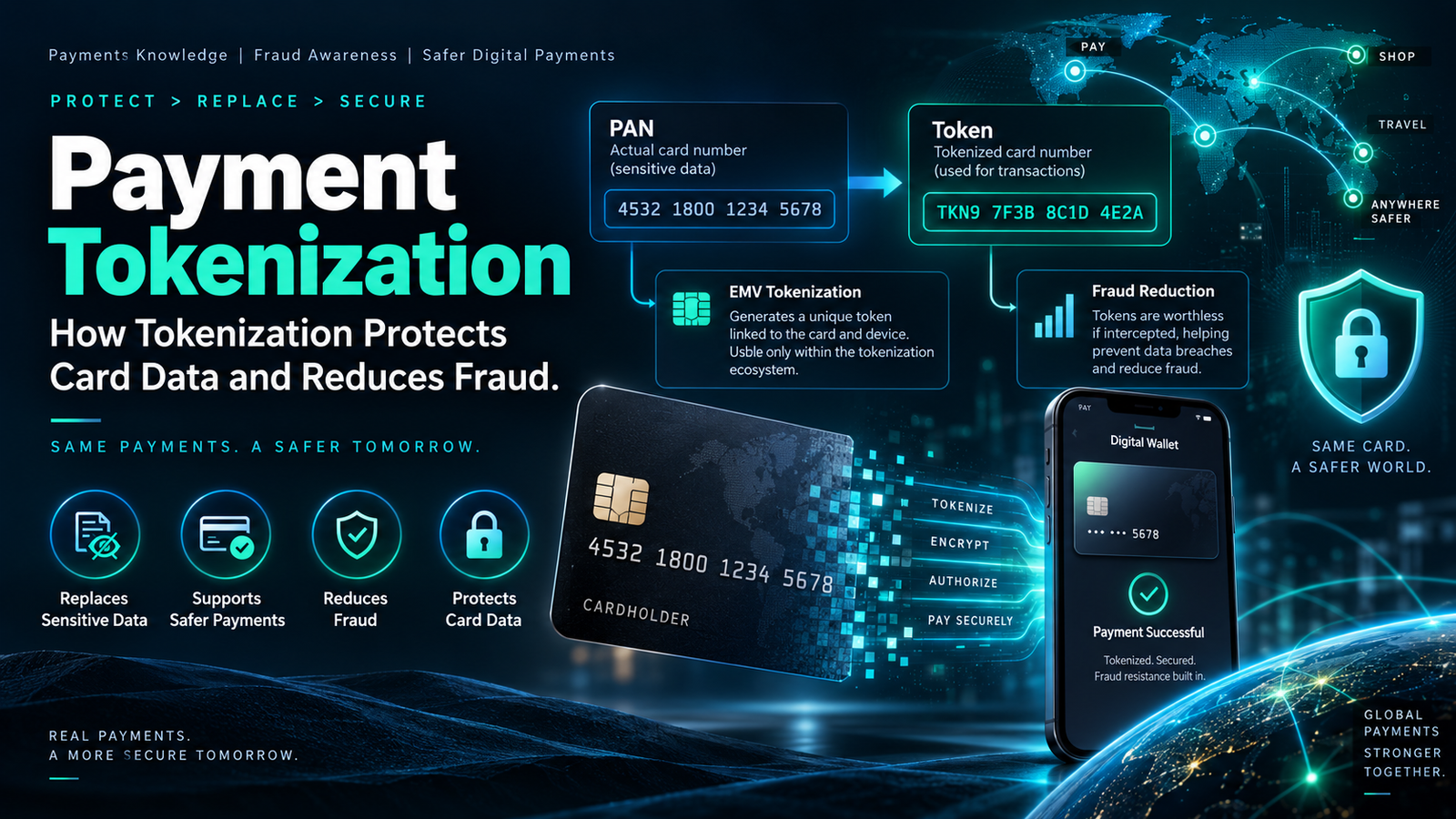
Payment tokenization is the process of replacing a sensitive payment card number, or primary account number (PAN), with a substitute digital value called a token. The token can be used to process authorized payments without exposing the underlying PAN. EMV payment tokens can also be restricted to a specific merchant, device or payment scenario, which helps make stolen payment credentials less useful to fraudsters.
Every card payment depends on sensitive account information moving through a chain of systems: a merchant, payment gateway, processor, card network and issuing bank. The most important identifier in that chain is the primary account number, or PAN - the long number associated with a payment card. If that PAN is exposed in a breach, copied from an insecure database or intercepted in a compromised payment flow, it can create serious fraud and data-security risk.
Payment tokenization changes that risk model. Instead of allowing the real PAN to appear throughout every system and transaction, tokenization substitutes the PAN with another value. The merchant or application can then use the token for approved payment activity while reducing how often the original card number must be stored, transmitted or exposed.
That basic idea is why payment tokenisation has become a core security technology for digital wallets, e-commerce, in-app payments, recurring billing and card-on-file transactions. Modern EMV tokenization goes further by making tokens usable only within defined domains, such as a specific device, merchant or payment scenario. This limits the usefulness of stolen credentials and gives the payment ecosystem more control over where a credential can be used.
What Is Payment Tokenization?
Payment tokenization is a security process in which sensitive payment card data - most commonly the PAN - is replaced with a non-sensitive or differently controlled substitute value called a token. The token represents the underlying card account for a permitted payment purpose, but the token itself is not simply the original PAN hidden with a mask.
In a well-designed tokenization system, knowing the token alone should not allow an attacker to derive the original PAN. The mapping between the token and the PAN is protected by a token service, token vault or payment network infrastructure, depending on the type of tokenization being used.
For the shopper, tokenization is usually invisible. A customer may save a card in a digital wallet, click 'remember this card' at checkout, or make a recurring subscription payment without seeing any change. Behind the scenes, however, the merchant or wallet may be using a token instead of repeatedly handling the customer's real account number.
What Does Payment Tokenisation Mean?
Payment tokenisation is simply the British-English spelling of payment tokenization. The two terms describe the same concept. Searchers in the United Kingdom, Europe and other markets often use 'tokenisation', while 'tokenization' is common in the United States and in many technical documents. A comprehensive article should naturally use both spellings because they represent the same search intent.
The most important concept is replacement. The PAN is replaced by a surrogate payment credential. The real card number remains protected in the appropriate secure environment, while the token is used in payment messages or merchant systems according to the rules of that tokenization model.
What Is a PAN in Card Payments?
PAN stands for Primary Account Number. It is the card-account number used to identify the cardholder's payment account for authorization, clearing and settlement. Because the PAN can be valuable to attackers, reducing unnecessary exposure of PAN data is a major objective of payment security.
PAN tokenization therefore means replacing the primary account number with a token so downstream systems can complete supported payment functions without needing the original PAN in every location. This can reduce the number of systems that directly handle cardholder data and can limit the consequences of certain types of data compromise.
How Payment Tokenization Works: Step by Step
- The customer provides payment credentials. A shopper enters a card at checkout, adds it to a wallet, or presents an already stored payment credential.
- The payment environment sends the PAN to an authorized tokenization service. Depending on the model, this may be a merchant's tokenization provider, an acquirer, a payment network or an EMVCo-registered Token Service Provider (TSP).
- A token is created or retrieved. The service associates the PAN with a substitute credential that can be used for the permitted payment context.
- The merchant or wallet uses the token instead of the PAN. Subsequent transactions can use the token without repeatedly exposing the original account number to the merchant-facing environment.
- The payment network and issuer process the transaction. For EMV payment tokens, the token is routed through the payment ecosystem and the relevant token controls are validated as part of the transaction.
- The token can be managed throughout its lifecycle. It may be activated, suspended, replenished, updated or deleted according to the token service and payment use case.
The exact technical flow varies between merchant tokens, network tokens, digital-wallet tokens and other tokenized-payment models. The security principle is the same: the real PAN is kept out of as many everyday payment interactions as possible.
A Simple Payment Tokenization Example
Imagine a shopper saves a card with an online retailer. The retailer does not need to display or reuse the shopper's real PAN every time the customer returns. Instead, the payment provider can return a token such as TOKEN-A7F9-42XQ or a payment-network token that resembles the format of a card number. The retailer stores the token reference and uses it for later authorized purchases.

If the retailer's application database is later exposed, an attacker may obtain the token rather than the underlying card number. Whether that stolen token can be abused depends on the token type and controls. EMV payment tokens are designed to be constrained to defined usage domains and are used with additional transaction security controls, which substantially reduces the value of the exposed credential outside its intended context.
What Is Payment Card Tokenization?
Payment card tokenization is the broad term for replacing sensitive card credentials with tokens across payment systems. It includes several implementations, and those implementations should not be treated as identical.
Main Types of Payment Tokens
Token type | Who typically creates it | Typical use | Key characteristic |
|---|---|---|---|
Merchant/acquiring token | Merchant, acquirer or service provider | Card-on-file, recurring billing, internal merchant systems | Usually proprietary; commonly maps back to a PAN in a secured token vault. |
EMV payment/network token | EMVCo-registered Token Service Provider / payment network ecosystem | Digital wallets, e-commerce, in-app, card-on-file and other tokenized payments | Can be domain-restricted and used in lieu of PAN in payment transactions. |
Issuer token / virtual card number | Card issuer | Commercial or consumer virtual-card use cases | Issuer-generated substitute credential designed for a defined use case. |
What Is EMV Tokenization?
EMV tokenization usually refers to EMV Payment Tokenisation, the global framework maintained by EMVCo for replacing a PAN with an EMV Payment Token. EMVCo says the goal is to enhance the security of digital payments by reducing the risk associated with compromised, unauthorized or fraudulent use of PANs.
An EMV Payment Token is not merely a random substitute stored by a merchant. It is a payment credential designed to work through the existing payment ecosystem. The token can be constrained to a particular merchant, device or payment scenario. Those restrictions are important because a stolen token may be useless outside the domain for which it was provisioned.
As of 2026, EMVCo lists Payment Tokenisation Specification - Technical Framework version 2.4, published in July 2026. The framework defines roles, functions and requirements for introducing EMV payment tokens into the payment ecosystem. This makes EMV tokenization especially relevant to current discussions of network tokenization, digital wallets and secure card-on-file payments.

EMV Tokenization vs Merchant Tokenization
Merchant tokenization and EMV payment tokenization solve related problems, but they operate differently. A merchant token is often an internal reference created after a customer's PAN is received by a merchant, acquirer or service provider. It is useful for storing a payment method without retaining the clear PAN in the merchant's main application.
An EMV payment token, by contrast, is a payment credential defined under the EMVCo framework and created within the token-service-provider ecosystem. It can travel through supported payment authorization flows in place of the PAN and can have domain restrictions. PCI Security Standards Council guidance distinguishes these payment tokens from proprietary acquiring tokens and issuer-generated virtual card numbers.
What Is PAN Tokenization?
PAN tokenization is the specific process of substituting the Primary Account Number with a token. It is one of the clearest ways to describe why tokenization matters: the sensitive card number is removed from systems that do not need to see it and replaced with a reference or payment credential that is safer to use for the intended workflow.
A properly designed tokenization architecture can therefore reduce unnecessary PAN storage. For example, a customer-support system might only need a token reference and the last four digits for identification, while the full PAN remains within a protected payment environment.
How Tokenization Protects Card Data
Tokenization protects card data primarily by reducing exposure. If the PAN is not stored in dozens of merchant databases, analytics tools and application components, there are fewer places where the raw card number can be stolen.
- It substitutes the PAN. Systems can work with a token instead of the original card number.
- It limits the usefulness of exposed credentials. EMV payment tokens can be tied to specific merchants, devices or payment scenarios.
- It reduces unnecessary card-data storage. Merchants can retain a token for supported recurring or card-on-file use cases rather than keeping the PAN in general application databases.
- It separates payment identity from merchant data. A compromised merchant database can contain token references without directly exposing the same reusable card credential found on the physical card.
- It supports lifecycle management. Network-token ecosystems can manage a token separately from the underlying card account, helping maintain a controlled credential over time.
How Payment Tokenization Helps Reduce Fraud
Tokenization does not make fraud impossible, but it can reduce several important fraud risks. The biggest benefit is that compromised payment information becomes less reusable. A stolen PAN may be attempted at unrelated merchants or channels. A domain-restricted payment token is designed to work only in its approved context.
For EMV payment-token transactions, security can also include a dynamic token cryptogram or other sufficient domain controls. These additional controls help the payment ecosystem determine whether the token is being used in the expected transaction context. That makes simple credential theft less valuable than stealing an unrestricted reusable PAN.
Tokenization can also reduce the impact of merchant data breaches. If a merchant stores tokens rather than PANs in systems that do not need cardholder data, a database compromise may expose less immediately exploitable payment information. Fraud prevention still requires additional layers - authentication, risk scoring, device intelligence, velocity controls, AVS, CVV handling, 3D Secure and issuer authorization all remain important.
Payment Tokenization and Card-Not-Present Fraud
Card-not-present (CNP) transactions are a major use case for tokenization because the physical card is not presented to the merchant. E-commerce and in-app payments often depend on stored credentials, and stored PANs can become attractive targets if they are retained across many systems.
Tokenized card-on-file payments reduce the need to keep raw PAN data in the merchant's everyday environment. Network tokens can also provide stronger domain controls and credential lifecycle capabilities than a static stored card number. This is one reason tokenization has become closely associated with digital-wallet and modern e-commerce security.
Payment Tokenization vs Encryption
Tokenization and encryption are both important security technologies, but they are not the same.
Feature | Tokenization | Encryption |
|---|---|---|
Basic idea | Replaces sensitive data with a substitute token. | Transforms data into ciphertext using a cryptographic algorithm and key. |
Relationship to original PAN | Usually requires a protected mapping or token-service process; EMV payment tokens follow network token rules. | Authorized systems with the correct key can decrypt ciphertext to recover the original data. |
Typical payment use | Stored credentials, digital wallets, recurring payments, network tokenization, merchant systems. | Protecting data in transit and at rest across systems. |
Can they be combined? | Yes. Tokenization systems still rely on encryption and other controls to protect sensitive environments. | Yes. Encryption is often part of a broader tokenization architecture. |
The safest payment architectures often use both. Tokenization minimizes where sensitive PAN data appears, while encryption protects sensitive information and communications where card data must still exist.
Payment Tokenization vs Masking and Truncation
Masking hides part of a card number when it is displayed, such as showing only the last four digits. Truncation permanently removes a portion of the PAN in a stored or displayed representation. Neither process is the same as tokenization.
A token can stand in for a payment credential in supported workflows. A masked PAN is still fundamentally a display treatment of the PAN, while an appropriately truncated PAN is incomplete by design. Organizations should follow current PCI DSS and payment-brand rules for any PAN display, storage, truncation or tokenization implementation.
Does Tokenization Reduce PCI DSS Scope?
Tokenization can help reduce the amount of cardholder data present in a merchant environment, which may reduce the number of systems that fall within PCI DSS scope. But tokenization does not automatically eliminate PCI DSS responsibilities.

PCI SSC states that PCI DSS still applies wherever account data is stored, processed or transmitted, and connected systems may also remain in scope. For properly implemented EMV Payment Tokens outside the Token Service Provider's token data environment, PCI SSC says those payment tokens are not considered Account Data. The exact scope depends on the architecture and should be validated rather than assumed.
Where Payment Tokenization Is Used
- Digital wallets: a device or wallet can use tokenized payment credentials instead of exposing the physical card PAN.
- E-commerce checkout: network or merchant tokens can support safer stored-card payments.
- Card-on-file services: merchants can store token references for returning customers.
- Recurring subscriptions: a token can represent the payment credential for authorized repeat billing.
- In-app payments: mobile applications can process payments without retaining a clear PAN in the app's general data layer.
- Connected devices: domain-restricted tokens can support payment credentials tied to specific devices or payment scenarios.
- Omnichannel commerce: tokenized credentials can help businesses reduce PAN exposure across multiple customer touchpoints.
What Is Network Tokenization?
Network tokenization is commonly used to describe payment tokens provisioned within the card-network token ecosystem. Rather than a merchant creating a purely internal database reference, the network-token credential can be recognized throughout the supported authorization flow and mapped to the underlying account by the token service infrastructure.
Network tokens are especially useful for digital wallets and card-on-file payments because they can be controlled by domain and lifecycle rules. The merchant can use the tokenized credential while the underlying PAN remains protected from routine exposure.
What Is a Token Service Provider (TSP)?
A Token Service Provider manages key tokenization functions such as token issuance, provisioning, lifecycle management and the relationship between the token and the underlying PAN. Under the EMVCo framework, TSPs that create EMV Payment Tokens are registered within the EMVCo token ecosystem.
The TSP is security-critical because it operates the environment in which token data and underlying account data are associated. PCI SSC publishes additional security requirements for Token Service Providers handling EMV Payment Tokens in addition to normal PCI DSS obligations for relevant account-data environments.
Are Tokenized Card Numbers Safe?
Tokenized payment credentials are designed to be safer than exposing a reusable PAN, but 'safe' should not be interpreted as invulnerable. Token security depends on implementation quality, domain controls, token-service security, merchant architecture, authentication and fraud monitoring.
A token may still be sensitive within the context where it is authorized to operate. Businesses should therefore protect token systems, access controls, APIs, signing keys, transaction data and token-management interfaces. Tokenization is a risk-reduction layer, not permission to ignore application security.
What Happens if a Payment Token Is Stolen?
The outcome depends on the token type. A merchant's proprietary token may be useless outside that merchant's payment environment because an unrelated business has no way to redeem it. An EMV payment token can be constrained by device, merchant or payment scenario and is used with additional controls. Those restrictions make broad reuse more difficult than with an unrestricted PAN.
However, if an attacker compromises the exact environment in which the token is valid, fraud may still be possible. This is why tokenization should be combined with strong authentication, secure APIs, transaction monitoring and risk-based controls.
Tokenization and Digital Wallets
Digital wallets are one of the most visible examples of payment tokenization. When a compatible card is provisioned to a wallet, the payment ecosystem can use a tokenized credential associated with that wallet or device instead of presenting the physical card PAN directly in every transaction.
This provides two security advantages: the underlying PAN is less exposed, and the payment credential can be tied to a particular domain. A compromised merchant does not necessarily receive the same credential printed on the customer's physical card.
Tokenization for Recurring Payments and Cards on File
Subscription businesses, marketplaces and online retailers often need a way to recognize a customer's payment method for future authorized charges. Storing raw PAN data creates unnecessary risk and compliance burden. Tokenization provides a better pattern: store a token or payment-method reference, while the sensitive account credential remains with the appropriate secure provider.

Network-token lifecycle capabilities can also help when a card is replaced or account credentials change, depending on issuer and network support. This can reduce payment disruption while keeping the merchant separated from the raw PAN.
Benefits of Payment Tokenization for Merchants
- Lower PAN exposure: fewer merchant systems need to store or process the real card number.
- Reduced breach value: stolen merchant data may contain controlled tokens rather than broadly reusable PANs.
- Stronger fraud controls: network tokens can include domain restrictions and dynamic transaction security.
- Safer stored credentials: useful for subscriptions, returning customers and one-click checkout.
- Potentially simpler PCI DSS scoping: properly implemented tokenization can reduce the number of components handling account data, though compliance responsibilities remain.
- Improved credential lifecycle management: supported network-token models can manage tokenized credentials without requiring merchants to expose the PAN.
- Better customer experience: security can happen in the background without forcing customers to repeatedly enter card details.
Limitations and Common Misunderstandings
- Tokenization does not stop every type of fraud. Account takeover, social engineering and authorized push-payment scams require different controls.
- A token is not automatically harmless. A token that is valid in a compromised domain can still be abused if other controls fail.
- Tokenization is not the same as encryption. Both technologies serve different security functions and are often used together.
- Tokenization does not automatically make a merchant PCI DSS compliant. Scope and obligations depend on the full architecture.
- Not every EMV-capable payment uses an EMV Payment Token. Chip acceptance and tokenization are separate concepts.
- Merchant tokens and network tokens are not interchangeable terms. Their issuance, portability and security characteristics differ.
How Tokenization Works With Other Fraud-Prevention Controls
The strongest payment-security strategy uses layers. Tokenization protects the credential itself, while other controls help verify the transaction and the person or device using it.
- Strong Customer Authentication (SCA) helps confirm the payer using independent authentication factors where required.
- 3D Secure can provide risk-based authentication for card-not-present payments.
- AVS compares address information in supported markets and can add a useful fraud signal.
- CVV/CVC checks can help confirm possession of card details during certain CNP transactions, subject to payment rules and storage restrictions.
- Device intelligence and behavioral analytics can identify suspicious payment patterns.
- Velocity controls can flag repeated attempts, unusually fast purchases or abnormal transaction sequences.
- Issuer authorization remains the final decision point for whether a card transaction is approved.
Payment Tokenization in 2026: What Has Changed?
Payment tokenization is no longer limited to a niche merchant-vault technique. It is now central to digital wallets, network token services, e-commerce credentials and modern card-on-file strategies. EMVCo's July 2026 publication of Payment Tokenisation Specification - Technical Framework version 2.4 shows that the standard continues to evolve as tokenized payment use cases expand.
For businesses, the practical direction is clear: design payment systems so the real PAN appears only where it is genuinely required. Use reputable payment providers and token services, understand whether you are using merchant tokens or network/EMV payment tokens, and combine tokenization with authentication and transaction-risk controls.
Frequently Asked Questions About Payment Tokenization
What is payment tokenization?
Payment tokenization replaces sensitive card data, usually the PAN, with a substitute digital value called a token. The token can be used for supported payment activity without exposing the underlying card number throughout every merchant system.
What is payment card tokenization?
Payment card tokenization is the broader practice of replacing card credentials with tokens for use in digital wallets, e-commerce, recurring payments, card-on-file systems and other payment environments.
What is EMV tokenization?
EMV tokenization refers to the EMVCo Payment Tokenisation framework, in which a PAN is replaced by an EMV Payment Token that can be constrained to specific merchants, devices or payment scenarios.
What is PAN tokenization?
PAN tokenization replaces the Primary Account Number with a token so applications can perform supported payment functions while reducing exposure of the original card number.
Does tokenization prevent credit card fraud?
Tokenization can reduce fraud risk by making stolen payment credentials less useful and reducing PAN exposure, but it does not prevent every type of fraud. It should be combined with authentication, transaction monitoring and secure payment architecture.
Is tokenization the same as encryption?
No. Encryption transforms data into ciphertext that can be decrypted with the right cryptographic key. Tokenization replaces sensitive data with a separate substitute value. Modern payment systems often use both.
Can a token be converted back to a card number?
In many merchant tokenization systems, an authorized token service or secure vault maintains the protected mapping to the PAN. EMV payment tokens are managed by token-service infrastructure; knowing the token by itself should not allow someone to derive the underlying PAN.
Does tokenization reduce PCI DSS scope?
It can reduce the number of systems that store, process or transmit PAN data, which may reduce PCI DSS scope, but it does not automatically remove all PCI DSS obligations.
What is a network token?
A network token is a tokenized payment credential provisioned within the payment-network token ecosystem and used in supported payment authorization flows in place of the underlying PAN.
Are digital-wallet payments tokenized?
Many major digital-wallet payment flows use tokenized payment credentials. The exact implementation depends on the wallet, issuer, network and device.
Conclusion
Payment tokenization is one of the most important changes in modern card security because it tackles a basic problem: too many systems historically needed access to the same reusable card number. By replacing PAN data with purpose-controlled tokens, businesses can reduce raw card-data exposure, make compromised credentials less valuable and build safer digital payment experiences.
PAN tokenization, merchant tokenization and EMV payment tokenization are related but distinct approaches. Understanding those differences helps merchants choose the right architecture and explains why network tokens, digital wallets and card-on-file systems can provide security benefits beyond simply storing an encrypted card number.
Tokenization is not a complete fraud-prevention strategy on its own. Its real strength appears when it is combined with SCA, 3D Secure, AVS, secure APIs, device intelligence and transaction monitoring. Used as part of a layered security model, tokenization helps protect payment credentials while preserving the fast, low-friction checkout experiences customers expect in 2026.
Authoritative References for Editorial Fact-Checking
- EMVCo - EMV Payment Tokenisation
- EMVCo - Specifications (Payment Tokenisation Technical Framework v2.4, July 2026)
- PCI SSC FAQ 1326 - How PCI DSS applies to EMVCo Payment Tokens
- PCI SSC FAQ 1384 - Acquiring tokens, issuer tokens and Payment Tokens
- PCI SSC - PCI DSS
- Visa - What is tokenisation?
- Visa Developer - Token Service Provisioning