
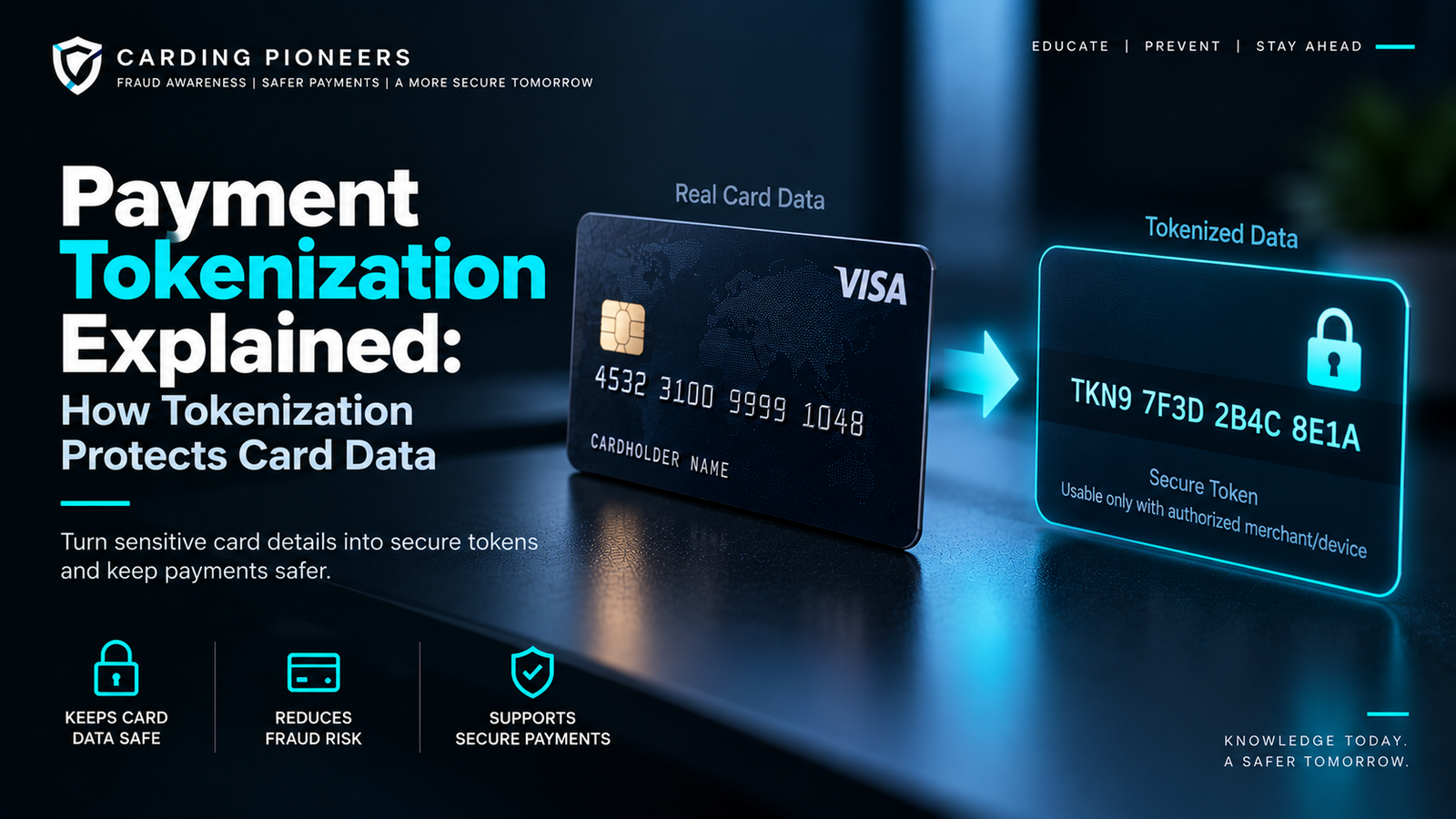
Payment tokenization is a security technique that replaces sensitive card information with a substitute value called a token. Instead of exposing the real Primary Account Number (PAN) throughout a digital payment flow, a token can be used to represent that account in a more controlled way.
The goal is not to make payment information disappear. It is to reduce the value of information that could be exposed if a merchant system, application or transaction channel is compromised.
EMVCo describes payment tokenisation as replacing the PAN with a unique alternative value that can be restricted to a particular merchant, device or payment scenario. This means a stolen token may have far less usefulness outside the environment for which it was issued.
Quick answer: Payment tokenization protects card data by replacing the real card number with a token that represents it during payment processing. The underlying account remains usable, but the merchant or payment application can often process transactions without repeatedly exposing the original PAN.
What Is Payment Tokenization?
Payment tokenization is the process of substituting sensitive payment credentials - most commonly the Primary Account Number - with a different value that can be used in an approved payment context.
A token is not simply an encrypted display of the card number. In a properly designed tokenization system, the token acts as a reference or payment credential while the underlying account information is protected within trusted payment infrastructure.
EMV Payment Tokenisation is the industry framework used for many modern network-token use cases. EMVCo's current Payment Tokenisation Specification describes a payment token as a substitute for a PAN and supports token use across ecommerce, mobile, in-app and other payment environments.
What Is a PAN?
PAN stands for Primary Account Number. It is the payment-card account number associated with a credit, debit or other eligible payment card.
The PAN contains issuer-identification information as well as account-specific digits. Because it is a core payment credential, reducing unnecessary exposure of the PAN is an important payment-security objective.
Tokenization allows systems to use a substitute credential instead of repeatedly storing, displaying or transmitting the original PAN.
How Does Payment Tokenization Work?
The exact technical implementation varies by payment network, token service provider, wallet, gateway and merchant platform, but the high-level concept is straightforward.
1. A payment credential is enrolled
The cardholder or merchant provides the payment account through a legitimate payment service, digital wallet or checkout process.
2. A token is created
Trusted tokenization infrastructure generates or assigns a token that represents the underlying PAN.
3. The token is associated with approved use
The token may be restricted to a particular merchant, device, payment scenario or other domain.
4. The token is used for payment
The merchant or application can submit the token through supported payment rails instead of exposing the original PAN in the same way.
5. The payment ecosystem resolves the token securely
Authorized network and issuer systems can associate the token with the correct underlying account for authorization.
A Simple Tokenization Example
Imagine a customer saves a payment card with an online service. Without tokenization, the merchant might need to handle the real card number whenever the stored credential is used.
With tokenization, the merchant can instead retain a token that represents the payment account. When a later legitimate payment occurs, the token is submitted through the supported payment system and the protected payment infrastructure handles the connection to the underlying account.
If the merchant's stored token is exposed, its usefulness can be limited because the token may be restricted to that merchant, device or payment scenario.
Why Does Tokenization Protect Card Data?
The strongest security benefit is that tokenization reduces the amount of valuable card data exposed in ordinary payment workflows.
- The real PAN does not need to be displayed or reused in every supported payment interaction.
- A compromised token may be restricted to a specific merchant, device or payment scenario.
- Sensitive payment credentials can remain within trusted payment infrastructure instead of being widely distributed.
- Merchants can reduce the consequences of certain data exposures because a token is not necessarily reusable like the underlying PAN.
- Token lifecycle controls can allow credentials to be updated or managed without repeatedly asking a customer to re-enter card data.
Payment Tokenization vs Encryption
Tokenization and encryption both help protect sensitive data, but they work differently.
Feature | Tokenization | Encryption |
|---|---|---|
Core idea | Replace sensitive data with a substitute token | Transform data into an unreadable form using cryptography |
Original data in normal workflow | Often removed from merchant-facing use | Still exists as encrypted data |
How protected value is used | Token represents the account in approved contexts | Encrypted value must be decrypted by an authorized system when plaintext is needed |
Payment role | Common for stored credentials, wallets and network-token payments | Common for protecting data in transit and at rest |
The two technologies are not competitors. Secure payment systems commonly use tokenization and encryption together.
What Is Network Tokenization?
Network tokenization replaces a card PAN with a payment token issued or managed through payment-network token infrastructure.
EMVCo's payment-token framework allows tokens to be constrained to particular domains, such as a merchant, device or payment scenario. This helps limit where the credential can be used.
Visa Token Service, for example, replaces Visa card numbers with digital tokens and supports token use across online, in-store and mobile payment channels.
What Is Merchant or Gateway Tokenization?
Merchants and payment gateways may also use tokenization to reduce their direct handling of raw card data. In this model, a payment provider stores sensitive credentials in protected infrastructure and returns a token or reference that the merchant can use for later authorized payments.
This can be useful for subscriptions, saved payment methods, customer accounts and other legitimate recurring or card-on-file use cases.
Network Tokenization vs Stored-Credential Tokens
The term 'token' can describe more than one payment architecture, so merchants should understand which type their provider uses.
Area | Network token | Merchant/gateway token |
|---|---|---|
What it represents | A payment-network credential replacing the PAN | A provider-specific reference to stored payment data |
Where it is managed | Network/token-service infrastructure | Merchant, gateway or payment-service-provider environment |
Domain controls | Can be limited to merchant, device or payment scenario | Depends on provider architecture |
Common uses | Wallets, ecommerce, in-app and network-token payments | Card-on-file, subscriptions and merchant vaulting |
What Is a Tokenized Card Number?
A tokenized card number is a substitute credential used instead of the original PAN. Depending on the tokenization system, the token may be formatted so that payment-processing systems can handle it similarly to a conventional card number.
Visa's Token Service documentation explains that its generated token can have the same length and format as the original PAN, allowing existing payment-processing systems and databases to handle it without treating the token as ordinary exposed account data.
Can a Token Be Used Everywhere?
Not necessarily. One of the advantages of modern payment tokenization is that tokens can be restricted.
- A token can be associated with a specific merchant.
- A token can be associated with a specific device.
- A token can be limited to a defined payment scenario or channel.
- Token controls can help make a compromised credential less useful outside its intended context.
This concept is sometimes described as domain restriction or domain controls. The exact rules depend on the token service and payment ecosystem.
How Tokenization Helps Reduce Card-Not-Present Fraud
Card-not-present payments rely on digital credentials rather than a physical card being presented to a merchant. That makes protection of stored and transmitted payment data especially important.
Tokenization can reduce the value of compromised payment information because the merchant or application can use a restricted token instead of exposing the underlying PAN.
It does not eliminate card-not-present fraud by itself. Merchants still need authorization, authentication, fraud monitoring and secure account controls.
Tokenization and Digital Wallets
Digital wallets are one of the most familiar consumer examples of payment tokenization. A supported card can be provisioned into a wallet, after which the wallet uses a tokenized credential for eligible payments rather than exposing the original card number in the same way.

This allows payment credentials to be linked to the digital-payment experience while preserving stronger separation between the merchant-facing payment credential and the underlying PAN.
Tokenization and Card-on-File Payments
Tokenization is also useful when a customer legitimately saves a payment method with a merchant.
Instead of keeping the real PAN available to ordinary merchant systems, a payment provider can return a token that the merchant uses for future authorized transactions. This can reduce exposure of sensitive payment data and simplify credential management.
What Happens When a Physical Card Is Replaced?
One advantage of network-token ecosystems is that tokenized credentials can sometimes be updated when the underlying card changes, depending on issuer, network and provider support.
This can reduce payment interruptions for legitimate recurring services because the token relationship can be managed without requiring the customer to manually re-enter the replacement card in every supported service.
Does Tokenization Replace Strong Customer Authentication?
No. Tokenization and Strong Customer Authentication solve different security problems.
- Tokenization protects payment credentials by reducing exposure of the PAN.
- Strong Customer Authentication helps verify that the person performing an applicable payment or account action is the legitimate customer.
- 3-D Secure can support authentication for ecommerce card payments.
- AVS and CVV provide additional verification or risk signals in relevant payment contexts.
A secure ecommerce strategy can use several of these controls together.
Does Tokenization Mean a Merchant Never Has PCI DSS Responsibilities?
No. Tokenization can reduce exposure to account data, but it does not automatically remove every PCI DSS responsibility.
A merchant's exact PCI DSS scope depends on how its payment environment is designed, which systems can access account data, how the tokenization service is implemented and which responsibilities are handled by service providers.
Merchants should use PCI Security Standards Council guidance and their acquiring or payment partners when determining compliance scope rather than assuming that simply using the word 'tokenization' makes an environment out of scope.
Can Tokenization Prevent Every Payment Data Breach?
No. Tokenization significantly reduces certain data-exposure risks, but payment security still depends on secure applications, access controls, patching, authentication, monitoring, fraud detection and properly configured payment infrastructure.
Tokenization should be considered one layer of defense rather than a replacement for a complete security program.
Benefits of Payment Tokenization for Consumers
- Less exposure of the underlying card number in supported digital-payment flows.
- Safer saved-card and digital-wallet experiences.
- Reduced usefulness of certain compromised payment credentials.
- Potentially smoother recurring-payment credential updates where network support exists.
- Security that can operate with little or no additional checkout friction.
Benefits of Payment Tokenization for Merchants
- Reduced direct exposure of sensitive card numbers.
- Safer support for stored payment credentials.
- Improved security for ecommerce, in-app and other digital payment experiences.
- Better credential lifecycle management through supported providers.
- Compatibility with broader fraud-prevention and authentication controls.
Common Misunderstandings About Payment Tokenization
- Myth: A token is just an encrypted card number. Reality: tokenization and encryption are different protection methods.
- Myth: A token can always be used anywhere the card can. Reality: payment tokens may be restricted to a merchant, device or payment scenario.
- Myth: Tokenization authenticates the shopper. Reality: it protects payment credentials; authentication is a separate security function.
- Myth: Tokenization makes fraud impossible. Reality: it reduces certain risks but must be combined with other security controls.
- Myth: Every tokenization system works the same way. Reality: network tokens and merchant/gateway tokens can have different architectures and capabilities.
Frequently Asked Questions
What is payment tokenization?
Payment tokenization replaces sensitive payment information, usually the PAN, with a substitute token that can represent the account in an approved payment context.

What does tokenized card mean?
It means a payment system is using a tokenized credential instead of exposing the original card number in the same way.
Is tokenization the same as encryption?
No. Encryption mathematically transforms data so authorized systems can decrypt it. Tokenization substitutes the sensitive value with another value or reference.
Can a payment token be stolen?
Any digital credential can potentially be exposed, but a properly designed payment token can be restricted so its usefulness outside the intended merchant, device or payment context is limited.
Does tokenization hide the card number from the merchant?
In many implementations, the merchant can process supported payments using a token or provider reference without needing ordinary access to the original PAN.
What is network tokenization?
Network tokenization uses payment-network token infrastructure to issue and manage payment tokens that replace the underlying PAN for supported transactions.
Do digital wallets use tokenization?
Many modern digital-wallet payment systems use network-tokenized credentials so merchants do not need to receive the underlying card number in the same way.
Does tokenization prevent card-not-present fraud?
It can reduce the value of compromised card data and therefore lower certain risks, but it does not replace authentication, authorization or fraud monitoring.
Does tokenization remove PCI DSS requirements?
Not automatically. Scope depends on the merchant's architecture and how account data and tokenization services are handled.
Final Thoughts
Payment tokenization is one of the most important technologies used to protect modern digital payments because it reduces unnecessary exposure of the Primary Account Number.
Instead of repeatedly using the real card number, a merchant, wallet or payment application can use a token that represents the account and can be restricted to approved payment contexts.
The result is a safer payment architecture: compromised data can be less valuable, merchants can reduce direct handling of card numbers, and consumers can use digital wallets and stored payment methods with stronger protection.
Tokenization is not a complete fraud-prevention system, however. The strongest payment environments combine tokenization with secure authorization, Strong Customer Authentication where applicable, 3-D Secure, fraud monitoring, AVS/CVV checks where relevant and sound cybersecurity practices.
Authoritative References
- EMVCo - EMV Payment Tokenisation
- EMVCo - The What, Why and How of EMV Payment Tokenisation
- Visa - What Is Tokenisation?
- Visa Developer - Visa Token Service Provisioning and Credential Management
- Visa - Tokenization Solutions
- PCI Security Standards Council
Editorial note: This article is educational and focused on payment security and fraud awareness. Tokenization implementations vary by payment network, processor and service provider.