
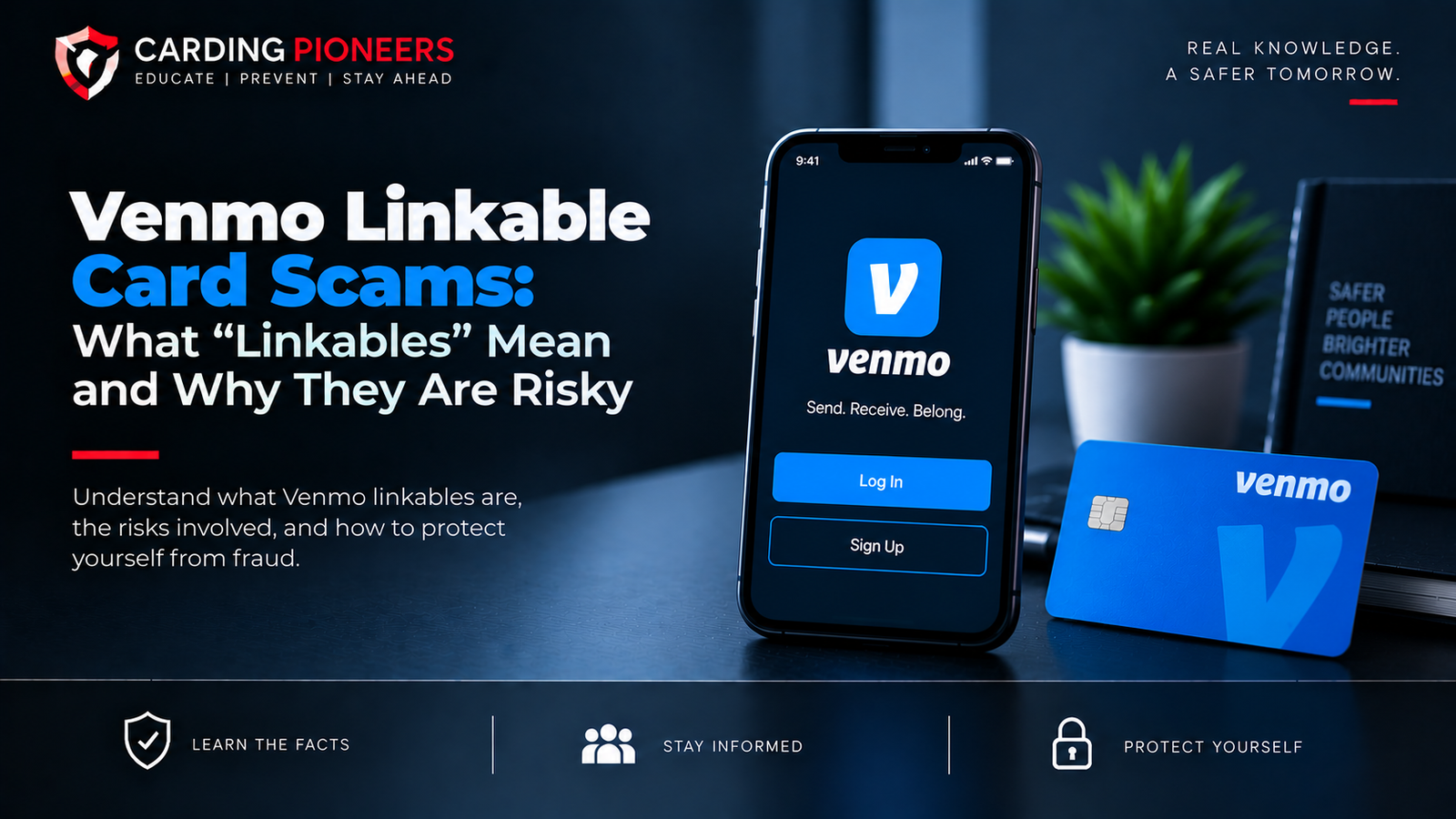
“Venmo linkables” or “Venmo linkable cards” are underground fraud terms, not official Venmo product categories. In scam and carding discussions, the words are commonly used to suggest that a payment card can be added or “linked” to a Venmo account and then used as a funding source.
The dangerous part is the implication behind the slang. Fraud sellers may advertise supposedly “linkable” cards as if successful linking proves that a card is valid, safe to use or unlikely to trigger fraud controls. None of those conclusions is reliable.
Venmo's official documentation simply describes supported cards and bank accounts as payment methods. Venmo says cards can be declined by the issuer or Venmo for funds-availability or fraud-prevention reasons, and its current User Agreement says a payment method may need to be confirmed so Venmo can verify that it is valid and belongs to the user.
Quick answer: “Venmo linkable” is fraud slang for a card that someone claims can be added to Venmo as a payment method. It is not an official Venmo label, does not prove ownership, does not guarantee a payment will work, and does not make the card legitimate to use.
Safety scope: This article explains the terminology for fraud awareness. It does not provide card sources, card-selection criteria, card-testing steps, ways to bypass card verification, or instructions for using stolen cards on Venmo.
What Does “Linkable” Mean on Venmo?
In normal Venmo terminology, a user can link a supported debit card, credit card or U.S. bank account to their Venmo account as a payment method.
In criminal slang, “linkable” turns that ordinary feature into a supposed fraud characteristic: a seller claims a particular card can be attached to Venmo without immediate rejection.
That underground use of the word is misleading because adding a payment method is only one part of a much larger risk and authorization process.

What Venmo Actually Says About Linking Cards
- Venmo allows supported payment cards registered under the user's name to be added to an account.
- Supported networks can include Visa, Mastercard, Discover and American Express, subject to current Venmo rules.
- Some cards may require address or ZIP-code information.
- Cards can be declined by the issuer or by Venmo for funds-availability or fraud-prevention reasons.
- Venmo can require confirmation of a payment method so it can verify that the method is valid and belongs to the user.
Why the Term “Linkable” Is Misleading
Fraud claim | What it actually proves | Why the claim is unreliable |
|---|---|---|
“It links, so the card is good.” | Only that the card was not immediately rejected at that moment | Later payments can still be declined, reversed or investigated |
“Linkable means verified.” | Nothing about legitimate ownership | Venmo and the issuer can apply additional checks |
“Linkable means safe from fraud detection.” | Nothing | Risk systems evaluate more than whether a card can be added |
“A linked card will stay usable.” | Nothing about future status | The real cardholder can report theft, the issuer can block it, or Venmo can restrict activity |
Linking a Card Is Not the Same as Authorizing a Payment
Adding a card to an account and successfully completing a payment are different events.
Venmo's User Agreement says that each time a payment is made, the selected funding method is charged for that specific transaction. The payment can still be declined, reversed, disputed or treated as unauthorized even if the card was previously added to the account.
Why Stolen Cards Can Appear to Work Temporarily
A stolen card may not be reported immediately. The legitimate cardholder may discover suspicious activity hours or days later, and the issuer may then block or replace the card.
This time gap helps explain why criminals may falsely present temporary success as evidence that a card is “linkable.” It does not mean the card is legitimately authorized for use.
What Happens When a Stolen Card Is Linked to Venmo?
The exact outcome depends on Venmo, the card issuer, the account, the transaction and the available risk signals.
- The card may be rejected immediately.
- The account may be asked to confirm the payment method.
- A later payment may be declined by the issuer or Venmo.
- The real cardholder can report unauthorized charges.
- A successful card-funded payment can later be disputed or reversed.
- The Venmo account may face limitations or investigation when suspicious activity is detected.
Why Sellers Can Be Hurt by Stolen-Card Payments
A seller can receive a Venmo payment that appears genuine and still face a later problem if the payment was funded by stolen card or bank information.

Venmo warns sellers that scammers may pay using stolen credit-card or bank information. If the legitimate owner reports the activity as unauthorized, money can be removed from the recipient's Venmo account.
The Connection Between “Linkables” and Carding Fraud
Carding fraud involves the unauthorized use, testing or trafficking of stolen payment-card information. “Linkable” claims fit into that broader fraud vocabulary because they attempt to classify stolen cards according to whether criminals believe they can be attached to a payment service.
For defensive education, the key point is that these labels are created by fraud communities. They are not security classifications used by card networks, banks or Venmo.
The Connection Between Linkables and Account Takeover
A stolen card and a stolen Venmo account are different assets. One is a compromised funding source; the other is compromised account access.
Fraud can overlap when a criminal controls a Venmo account and also attempts to attach unauthorized payment methods. But account takeover remains distinct from card theft.
Venmo Linkables vs “Bank Linkables”
Fraud communities may also use “linkable” language for bank accounts or other payment services. Again, the slang implies that stolen financial information can be attached to a platform.
Venmo's legitimate terminology is simply a linked payment method, and ownership or authorization remains essential.
Venmo Linkable Cards vs Prepaid Cards
Venmo says some prepaid cards may be accepted if they are supported and registered under the user's name. That does not make “linkable prepaid cards” a special fraud category.
Any card still needs to comply with Venmo, issuer and card-network requirements.
Why Fraud Sellers Advertise “Linkables”
The term creates a marketing shortcut inside illegal marketplaces. It makes a stolen credential sound tested, ready or higher quality.
- To make a listing sound more valuable
- To imply a higher probability of temporary acceptance
- To create urgency around a supposedly tested product
- To distinguish one fraudulent listing from another
- To justify higher prices in underground markets
Those claims can themselves be scams. A supposed “linkable” card can be invalid, already blocked, fabricated, recycled or sold to multiple buyers.
Why “Verified Linkable” Claims Are Not Trustworthy
- The seller may fabricate screenshots.
- A card's status can change after it is advertised.
- The legitimate owner can freeze or replace the card.
- A card can be valid but not authorized for the person attempting to use it.
- Venmo and the issuer can make different decisions on different transactions.
- Underground sellers have no legitimate external audit or consumer-protection system.
Fake Linkable-Card Vendors and Buyer Scams
People attempting to buy stolen cards can themselves become scam victims. Underground sellers can take payment and deliver nothing, recycle dead credentials or distribute malware disguised as account tools.

This does not reduce the harm to the original cardholder; it shows that criminal marketplaces often contain fraud-on-fraud as well as theft from ordinary victims.
What Victims May Notice
Warning sign | What it may indicate |
|---|---|
Unexpected Venmo charge | A Venmo transaction appears on the card or bank statement even though the person did not use Venmo. |
Venmo account activity | A linked card or bank shows transactions the account holder did not authorize. |
Issuer fraud alert | The bank or card issuer flags a Venmo charge as suspicious. |
Card decline or replacement | The issuer restricts the card after detecting suspicious use. |
Unrecognized digital-wallet or payment-service activity | A payment service appears in transaction history without a known reason. |
What to Do If You See an Unauthorized Venmo Charge
- Contact the card issuer or bank using the official number on the card, statement or banking app.
- Review recent and pending transactions.
- Report unauthorized activity promptly.
- Follow the issuer's instructions for locking or replacing the card.
- If you have a Venmo account, review linked payment methods and account activity.
- If the Venmo account itself may be compromised, contact Venmo Support through official channels.
What If You Do Not Have a Venmo Account?
Venmo says that if a person sees a Venmo charge on their bank or card statement but does not have a Venmo account, they should first verify that no authorized person used the card or bank account.
If the activity is unauthorized, the bank or card issuer should be contacted promptly, because the underlying financial information may have been compromised.
How Venmo Limits Payment-Method Abuse
Venmo publishes several controls around payment methods, although its internal fraud-detection rules are not public.
- Payment methods may need to be confirmed.
- Cards may be declined by the issuer or Venmo for fraud-prevention reasons.
- Venmo limits how many cards can be added over a rolling period.
- Suspicious or illegal activity can result in account limitations or other action under the User Agreement.
- Venmo prohibits activity that it or card networks reasonably believe is abuse of the card system.
Why Exact Card-Linking Fraud Rules Are Not Public
Payment companies generally do not publish detailed fraud thresholds or decision logic. That confidentiality is itself a security control because exact thresholds would help criminals tune attempts to avoid detection.
For this reason, claims that a seller has discovered a permanent 'linkable method' should be treated skeptically.
How Consumers Can Reduce the Risk
- Enable card and bank transaction alerts.
- Review statements and pending activity regularly.
- Use unique passwords for Venmo, email and banking accounts.
- Never share verification codes.
- Use the official Venmo app or Venmo.com.
- Remove old payment methods you no longer use.
- Contact your issuer quickly if a card may be compromised.
How Sellers Can Reduce the Risk
- Verify incoming payments in the official Venmo app rather than screenshots.
- Treat unfamiliar buyers and unusual payment stories cautiously.
- Use eligible purchase transactions and understand Venmo Purchase Protection requirements.
- Keep valid shipment or delivery evidence for legitimate sales.
- Do not treat a successful payment as proof that the funding source could never be disputed.
Frequently Asked Questions
What does a Venmo linkable card mean?
It is underground fraud slang for a card that someone claims can be added to Venmo as a payment method. It is not an official Venmo category.
Does linkable mean the card is verified?
No. Successful addition does not prove legitimate ownership or guarantee future transactions.
Does Venmo allow cards to be linked?
Yes. Venmo legitimately allows supported debit and credit cards to be added as payment methods.
Can Venmo reject a card even if the card is valid?
Yes. Venmo says cards may be declined by the issuer or Venmo for funds-availability or fraud-prevention reasons.
Can a linked card later stop working?
Yes. The issuer can block it, the real owner can report it, or Venmo can apply additional controls.

Can a stolen card payment be reversed?
Yes. Unauthorized card-funded transactions can be disputed or reversed after the legitimate cardholder reports them.
Are 'verified Venmo linkables' trustworthy?
No. The phrase is an underground seller claim, not an independent certification.
Can a seller lose money after receiving a Venmo payment?
Yes. Venmo warns that a fraudulent payment funded with stolen card or bank information can later be removed or reversed.
What should I do if I see Venmo on my card statement unexpectedly?
Contact the card issuer or bank promptly and report unauthorized activity through official channels.
Is buying or using stolen linkable cards legal?
No. Buying or using stolen payment credentials can involve serious fraud and identity-theft offenses.
Final Thoughts
“Venmo linkables” is criminal-market slang built around an ordinary feature: linking a payment method to a Venmo account.
The slang is misleading because adding a card does not establish lawful ownership, does not guarantee a payment will be approved, and does not protect the transaction from later disputes, reversals or fraud detection.
For consumers and sellers, the practical lesson is to focus on authorization and account security rather than underground labels. Monitor transactions, protect credentials, verify payments through official channels and report suspicious activity quickly.
Authoritative References
- Venmo - Adding a Payment Method
- Venmo - Bank Accounts & Cards FAQ
- Venmo - Current User Agreement
- Venmo - Common Scams on Venmo
- Venmo - Unauthorized Charge on My Account
- Venmo - What Is Venmo?
Editorial note: This article is educational and defensive. It explains the meaning and risks of 'linkable' card claims without providing stolen-card sources, card-selection criteria, verification bypasses, testing methods or unauthorized-payment techniques.