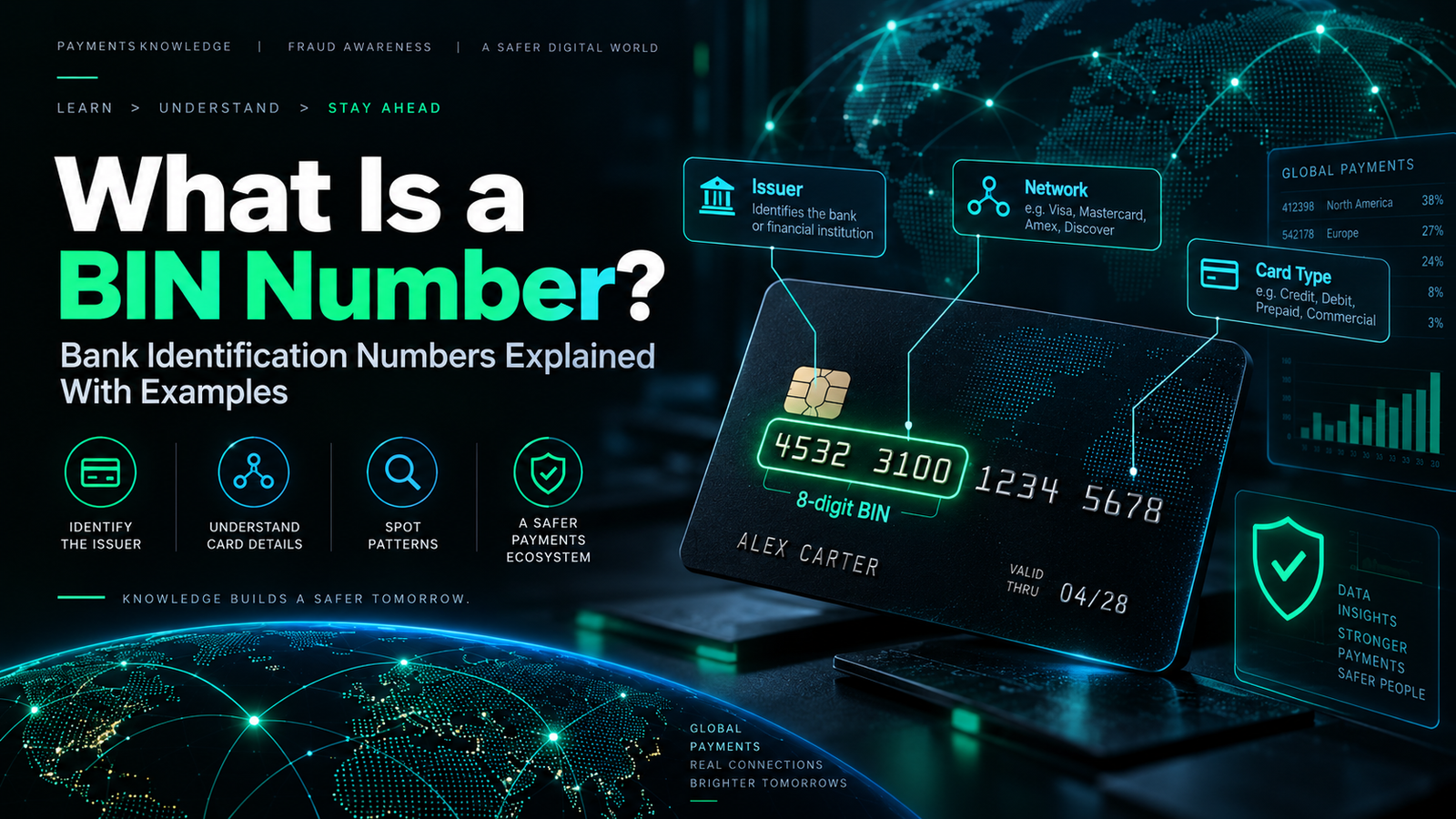


A BIN number, or Bank Identification Number, is the opening sequence of digits on a payment-card account number that helps identify the institution and card programme associated with the card. In modern payment systems, BINs may be six or eight digits long, depending on the network and programme.
Although the term “Bank Identification Number” remains widely used, the international standard uses the term Issuer Identification Number, or IIN. In everyday payments language, BIN and IIN are often used to describe the same identifying portion at the beginning of a payment-card number.
BIN information helps payment networks, issuers, acquirers, processors and merchants understand where a card belongs in the payments ecosystem. It can support transaction routing, product identification, fraud controls and payment processing, but it is not the same thing as a bank account number or a complete card number.
Quick definition: A BIN is the first 6 or 8 digits of a payment-card account number used to identify the card issuer or issuing programme and related payment attributes.
What Does BIN Stand For?
BIN stands for Bank Identification Number. It is a commonly used payments-industry term for the identifying digits at the beginning of a card number. You may also see the term IIN, which stands for Issuer Identification Number.
Visa describes a BIN as a unique 6- or 8-digit number used in the interchange process and notes that it is also known as an IIN. ISO/IEC 7812 is the international standard that defines the numbering system for issuer identification numbers and primary account numbers.
BIN Number at a Glance
Question | Answer |
|---|---|
What does BIN mean? | Bank Identification Number. |
How many digits is a BIN? | Typically 6 or 8 digits in modern card-payment systems. |
Where is the BIN? | At the beginning of the payment-card account number. |
What does it identify? | The issuing institution or programme and related network/product attributes. |
Is a BIN the whole card number? | No. It is only the identifying prefix of the card number. |
Is BIN the same as IIN? | The terms are commonly used interchangeably; IIN is the term used by the ISO standard. |
Where Is the BIN Number on a Card?
The BIN appears at the beginning of the cardholder account number. If a payment card has a 16-digit Primary Account Number (PAN), the BIN is contained within the first six or eight digits of that PAN, depending on the card programme.
For example, consider a fictional card number shown only for illustration:
4532 10XX XXXX 1048
In a six-digit BIN environment, “453210” could represent the identifying prefix. In an eight-digit environment, two additional digits would form part of the BIN. This example is fictional and is not intended to represent a real issuer or usable payment credential.

What Information Can a BIN Identify?
BIN data can be associated with several attributes used by participants in the payment chain. The exact information available depends on the payment network and the authorised data service being used.
- The card network or payment scheme associated with the account range.
- The financial institution or issuing programme responsible for the card.
- The issuer country or licensed country in many network data services.
- Product or funding attributes, such as whether a credential belongs to a credit, debit or prepaid programme, where that attribute is supplied.
- Other programme-level information used by processors, merchants or acquirers for routing and payment operations.
A BIN does not reveal a cardholder’s complete account number, current balance, PIN, password or authentication credentials. It identifies a card range or programme, not the individual person using the card.
How Do BIN Numbers Work in a Payment?
When a customer presents a payment card or card credential, the payment system needs to know which network and issuer should receive the authorization request. BIN and account-range data help payment infrastructure classify the credential and route the transaction through the appropriate path.
- A customer presents a payment credential to a merchant or payment service.
- The payment processor reads the relevant card data, including the identifying prefix.
- Network and account-range information helps determine the appropriate payment route and issuer context.
- The authorization request is sent through the payment network to the issuing side.
- The issuer evaluates the transaction and returns an approval or decline response.
The BIN is therefore a routing and identification component of the larger card-payment process. It does not itself approve a transaction and does not determine whether money is available.
What Is the Difference Between BIN and IIN?
BIN and IIN are closely related terms. IIN means Issuer Identification Number and is the terminology used in ISO/IEC 7812. BIN, or Bank Identification Number, remains extremely common in payment-network, merchant and processor documentation.
The word “bank” can be slightly misleading because a card issuer does not always have to be a traditional retail bank. Depending on the programme, the issuing relationship can involve regulated financial institutions, card networks, programme managers and other authorised participants. That is one reason “Issuer Identification Number” is the more general standards-based term.
Why Did BINs Expand From 6 Digits to 8 Digits?
The payments industry historically relied heavily on six-digit BINs. As card programmes, digital payments, tokenization and other payment products expanded, the industry needed a larger supply of issuer-identification values.
ISO expanded the IIN standard from six digits to eight digits. Visa and Mastercard subsequently implemented support for 8-digit BINs, with major network changes taking effect in 2022. Visa states that it now assigns 8-digit BINs for new payment credentials, while payment systems still need to support both 6- and 8-digit BIN structures where applicable.
The change did not mean card numbers suddenly became longer. Instead, more of the existing PAN prefix can be used as the issuer-identification portion.

How Many Digits Is a BIN Number?
A BIN can be six or eight digits in current card-payment environments. Older explanations often say a BIN is always the first six digits, but that is no longer a complete description of the modern standard.
For SEO and consumer education, the most accurate short answer is:
A modern BIN is generally the first 6 or 8 digits of a payment-card account number, depending on the network and card programme.
What Is an Account Range?
A BIN may identify a broad issuing programme, while networks can use more detailed account ranges within that BIN to distinguish specific card products or processing attributes. This is especially important as the industry supports both six- and eight-digit BIN structures.
Account-range information is mainly an operational concept for issuers, acquirers, processors and payment-service providers. Consumers usually do not need to know the exact account range associated with their card.
Common Uses of BIN Information
BIN information has several legitimate uses across the payments ecosystem.
1. Payment routing
BIN and account-range information help payment systems identify where an authorization request should be sent and which network rules apply.
2. Issuer identification
Merchants and processors can use authorised BIN data to understand the institution or programme associated with the payment credential.
3. Fraud prevention and risk controls
Payment providers may compare card-country, issuer and transaction context as one input into broader fraud-detection systems. BIN data should be one signal among many rather than a stand-alone fraud decision.
4. Checkout and payment optimization
Some payment platforms use BIN attributes to tailor routing, supported payment methods or customer messaging.
5. Card-programme management
Issuers and programme managers use BINs as part of the infrastructure required to issue and manage payment credentials.
6. Reporting and reconciliation
Payment organisations can use network and issuer attributes to organise transaction reporting and investigate operational differences across programmes.
What a BIN Number Does Not Tell You
A BIN can be useful, but it has important limitations. It does not provide everything needed to understand a payment or a cardholder.
- It does not reveal the complete card number.
- It does not reveal the cardholder’s PIN or account password.
- It does not prove that a card is active or that a transaction will be approved.
- It does not show a customer’s current account balance.
- It does not prove that the person presenting a credential is the legitimate cardholder.
- It should not be treated as a substitute for authentication, authorization or fraud screening.
BIN Number vs Card Number
The BIN is only one part of a payment-card number. The complete Primary Account Number includes the BIN or IIN plus additional digits that identify the individual account and a final check digit used to help detect certain data-entry errors.

This distinction is important because a merchant may need limited programme-level information without needing to expose or store the full PAN. Payment security standards encourage organisations to minimise their handling and storage of sensitive card data.
BIN Number vs Bank Account Number
A BIN is not a customer’s bank account number. It identifies the issuer or payment-card programme associated with a range of cards. A bank account number identifies a particular deposit or financial account within a banking system.
A single financial institution can issue many cards under one or more BINs while maintaining completely separate bank-account numbering systems for customers.
BIN Number vs Routing Number
A routing number is used in bank-transfer systems to identify a financial institution or processing destination. A BIN is used in payment-card systems to identify a card issuer or issuing programme. They belong to different payment infrastructures and should not be confused.
BIN Number vs SWIFT/BIC Code
A SWIFT/BIC code identifies financial institutions within international financial messaging and cross-border banking contexts. A BIN/IIN identifies card issuers or card programmes in the payment-card ecosystem. A bank can therefore have both SWIFT/BIC identifiers and one or more BINs.
What Is BIN Sponsorship?
BIN sponsorship is an arrangement in which an appropriately regulated or network-licensed institution enables another business or card programme to issue payment credentials under an authorised BIN relationship. This model is common in modern fintech and embedded-finance programmes.
The sponsor typically provides or supports network access and regulatory responsibilities, while the programme may work with additional processors, technology providers and programme managers. The exact responsibilities vary by jurisdiction, network and contract.
Are BIN Lookup Tools Always Accurate?
Not necessarily. Public BIN lookup websites can be incomplete, outdated or based on old six-digit assumptions. Modern networks use six- and eight-digit BIN structures and more granular account ranges, so an unofficial database may return inaccurate issuer, country or product information.
Businesses that rely on BIN data for payment operations should use authorised information from their acquirer, processor, payment service provider or network rather than treating an arbitrary public lookup website as authoritative.
Can BIN Information Help Prevent Fraud?
BIN information can contribute to fraud prevention, but it should not be used by itself to decide whether a payment is trustworthy. For example, a payment provider may compare issuer country with other transaction signals, detect unusual patterns, or apply issuer-specific risk rules.

Effective fraud prevention normally combines multiple signals, such as account history, device information, behavioral patterns, transaction velocity, authentication results and merchant-specific risk context. BIN data is one piece of that broader picture.
Frequently Asked Questions
What is a BIN number?
A BIN, or Bank Identification Number, is the identifying prefix at the beginning of a payment-card account number. Modern BINs are generally six or eight digits and identify an issuer or card programme.
What does BIN stand for in banking?
BIN stands for Bank Identification Number. In international standards, the related term IIN, or Issuer Identification Number, is used.
How many digits is a BIN number?
A BIN can be six or eight digits in modern card-payment systems.
Is a BIN the first six digits of a card?
Sometimes, but not always. Six-digit BINs still exist, while modern payment systems also support eight-digit BINs.
What information does a BIN identify?
Depending on the authorised data source, a BIN can be associated with the issuer, payment network, issuer country, product and other programme-level attributes.
Is a BIN the same as a card number?
No. A BIN is only the beginning portion of the complete Primary Account Number.
Is BIN the same as IIN?
The terms are commonly used interchangeably in the payments industry. IIN is the standards-based term meaning Issuer Identification Number.
Can a BIN tell whether a payment will be approved?
No. Authorization depends on the issuer and many transaction/account factors. BIN data alone cannot determine whether a payment will be approved.
Can I find a bank account number from a BIN?
No. A BIN identifies a card issuer or programme, not an individual customer bank account.
Why are some BINs eight digits?
The international standard expanded issuer-identification numbers to eight digits to increase the available number space for a growing payments ecosystem.
Final Thoughts
A BIN number is one of the basic building blocks of card payments. It identifies the card issuer or issuing programme at the beginning of a payment-card account number and helps payment systems classify and route transactions correctly.
The most important points are simple: BIN stands for Bank Identification Number, modern BINs can be six or eight digits, and the standards-based term IIN means Issuer Identification Number. A BIN can provide useful issuer and programme context, but it does not reveal a customer’s complete account details and cannot by itself authenticate a user or predict whether a transaction will be approved.
Understanding BINs also makes other payment-security concepts easier to understand, including card-not-present fraud, tokenization, AVS, Strong Customer Authentication and merchant fraud controls.
Authoritative References
- ISO - ISO/IEC 7812-1:2017, Identification of issuers numbering system
- Visa Developer - Glossary: Bank Identification Number (BIN)
- Visa - 8-digit BIN Industry Change
- Visa - BIN Attribute Sharing Service
- Mastercard - 8-Digit BIN Expansion and PCI Standards
- Stripe Documentation - BIN Setup
Editorial note: This article is educational. Payment-network terminology and programme attributes can vary by network, issuer and jurisdiction.