
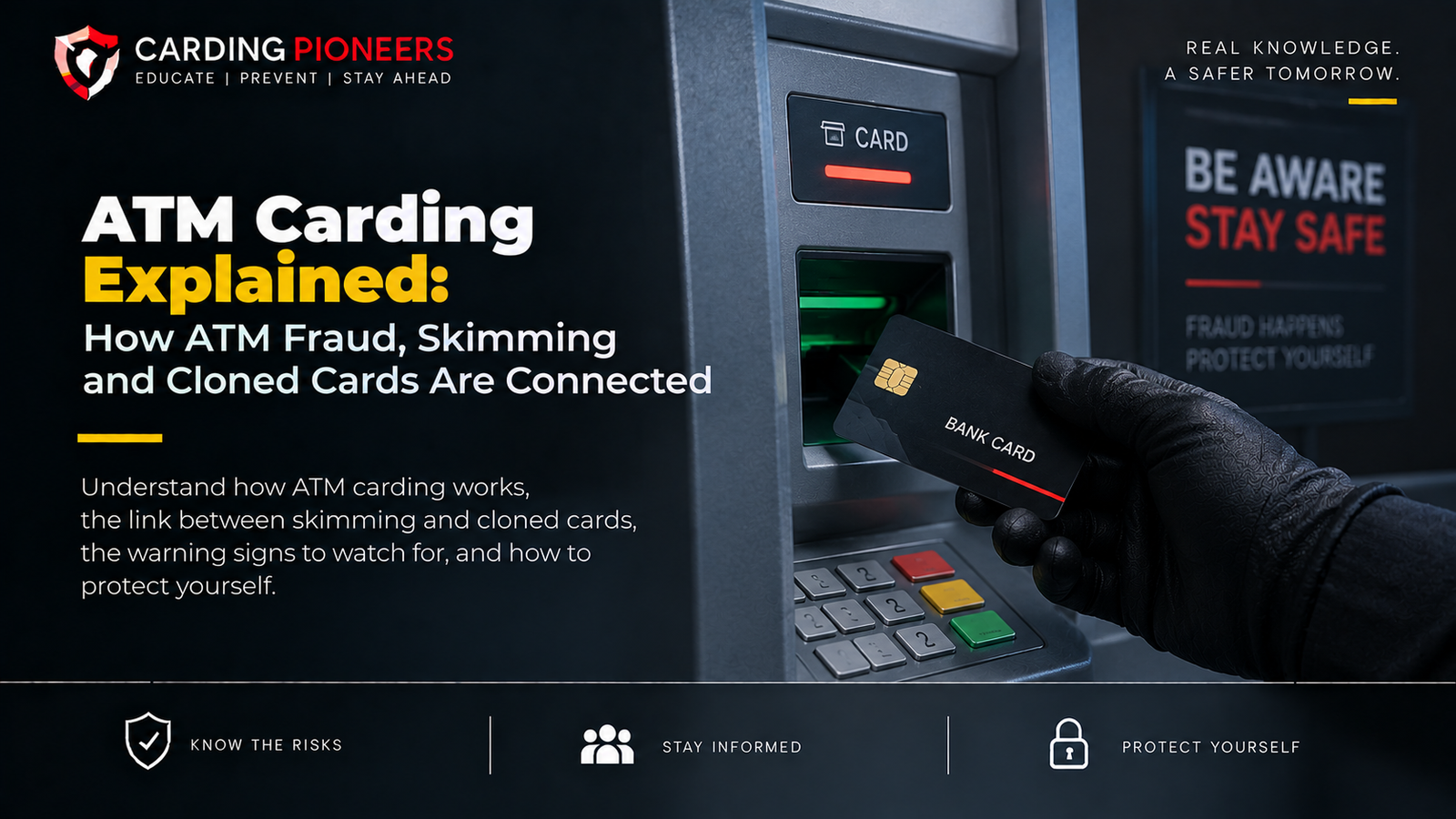
“ATM carding” is informal fraud slang rather than a formal banking term. It is generally used to describe card fraud involving stolen debit- or credit-card data, compromised PINs, counterfeit cards and unauthorized ATM withdrawals.
The strongest connection between ATM carding, skimming and cloned cards is the theft of magnetic-stripe data. The FBI says skimming occurs when illegal devices installed on or inside ATMs, point-of-sale terminals or fuel pumps capture card data and, in many cases, cardholders' PIN entries.
Criminals can then misuse the stolen data to create counterfeit payment cards or carry out unauthorized transactions. The U.S. Secret Service likewise warns that skimming groups may re-encode stolen card data onto another magnetic-stripe card for fraudulent ATM withdrawals or purchases.
Quick answer: ATM skimming steals card data, often together with a PIN. A cloned card is a counterfeit card carrying copied magnetic-stripe data. ATM carding is the broader fraud activity in which stolen card information or counterfeit cards are used for unauthorized withdrawals or other card fraud.
Safety scope: This article explains ATM fraud defensively. It does not provide skimmer-building instructions, cloning procedures, PIN-capture methods, blank-card encoding steps, ATM exploitation techniques or cash-out guidance.
What Is ATM Carding?
ATM carding is an informal label for fraud in which stolen card information is connected to an ATM or cash-withdrawal scheme. Depending on the incident, it may involve a lost or stolen genuine card, skimmed magnetic-stripe data, a compromised PIN or a counterfeit card.
Europol separates payment-card fraud into card-not-present fraud and card-present fraud. ATM fraud falls mainly into the card-present category because a physical card or counterfeit card is presented to the ATM.
ATM Carding vs Skimming vs Cloned Cards
Term | What it describes | How it relates |
|---|---|---|
ATM carding | Broad informal fraud activity involving stolen card data and ATM abuse | Can include skimming, counterfeit cards and unauthorized withdrawals |
Skimming | Theft of card data using an illegal device on or inside a card reader | Provides stolen magnetic-stripe data that may later be misused |
Cloned card | A counterfeit card carrying copied payment-card data | May be created from skimmed magnetic-stripe information |
PIN theft | Unauthorized capture or disclosure of a cardholder's PIN | Can make stolen card data more useful for ATM withdrawals |
How ATM Skimming Works at a High Level
ATM skimming is a data-theft attack against the card-reading process. The FBI says illegal devices can be inserted into a card reader, placed over the legitimate reader, or installed elsewhere in an ATM or terminal.
The purpose is to capture information from a card's magnetic stripe. Criminals may also try to obtain the PIN through a concealed camera or a fraudulent keypad overlay.
The important defensive point is that a skimmer does not need to steal the physical card. The victim may leave with the card still in their possession while the underlying payment data has already been copied.
Why the PIN Matters
Magnetic-stripe data alone and magnetic-stripe data plus a PIN create different risk profiles. For ATM cash withdrawals, a correct PIN can be an important part of the authorization process.

That is why law-enforcement guidance repeatedly tells ATM users to cover the keypad while entering a PIN. The FBI notes that hidden cameras and keypad overlays have been used to capture PIN entries.
How Cloned Cards Are Connected to Skimming
A cloned card is a counterfeit physical card that carries payment data copied from another card. In classic magnetic-stripe skimming schemes, stolen stripe data can be transferred to another magnetic-stripe card and then used for unauthorized transactions.
The FBI says skimming data is used to create fake payment cards, while the Secret Service says criminals can re-encode skimmed debit or credit card data onto another card with a magnetic stripe.
This is the connection: skimming is the theft stage, cloning is one way the stolen data can be represented on a counterfeit card, and unauthorized ATM use is one possible fraud outcome.
Does a Cloned Card Copy the Chip?
Modern EMV chip technology is designed to make simple card cloning much harder than copying a magnetic stripe.

The FBI says embedded microchips secure payments far better than magnetic stripes and notes that there are fewer devices in the United States that steal chip data than magnetic-stripe data.
However, many chip cards still carry a magnetic stripe for compatibility, so the stripe can remain a target even when the chip itself is more secure.
Magnetic Stripe vs Chip Security
Feature | Magnetic stripe | EMV chip |
|---|---|---|
Data behavior | Stores static card data | Uses chip-based security designed to make counterfeit use harder |
Skimming risk | Higher because stripe data can be copied | Lower for simple cloning, though fraud can still occur through other methods |
ATM relevance | Still used in some fallback or legacy scenarios | Preferred where chip-enabled ATM support is available |
Best user practice | Avoid unnecessary swiping when safer options exist | Use chip or contactless functionality where supported |
Other ATM Fraud That Is Not Skimming
Not every ATM fraud incident involves copied card data. Consumers may also encounter physical tampering or social engineering around an ATM.
- Card retention or trapping: the card is not returned normally, which should be treated as a warning sign.
- Shoulder surfing: another person watches the PIN entry.
- Impersonation: someone nearby pretends to help with an ATM problem and asks for the card or PIN.
- Account takeover: stolen online-banking credentials are used to change settings or support later financial fraud.
These risks are related to ATM security but should not be confused with the specific act of skimming.
Warning Signs of a Possible ATM Skimmer
Warning sign | Why it matters |
|---|---|
Loose or crooked card reader | A foreign overlay or tampered component may be present. |
Damaged or scratched terminal | Visible tampering can indicate that the machine was modified. |
Unusual keypad appearance | A keypad overlay may not match the rest of the ATM. |
Adhesive or tape residue | A device may have been recently attached or removed. |
Card is not returned | A foreign object or trapping device may be interfering with the reader. |
Unexpected bank alert after ATM use | Card data or account credentials may have been compromised. |
How to Check an ATM Before Using It
- Look at the card slot, keypad and surrounding surfaces before inserting your card.
- Avoid a reader that looks loose, crooked, damaged or different from the rest of the machine.
- Use ATMs inside financial institutions or well-lit indoor locations when practical.
- Cover the keypad fully with your other hand when entering the PIN.
- If anything looks wrong, cancel the transaction and use another ATM.
Why Indoor Bank ATMs Can Be Safer
Both the FBI and Secret Service recommend using ATMs in well-lit or indoor locations when possible.
No ATM is immune to tampering, but machines inside financial institutions typically have more staff presence, surveillance and restricted physical access than unattended outdoor terminals.
What to Do If the ATM Keeps Your Card
The FBI advises consumers to contact their financial institution immediately if the ATM does not return the card after the transaction is ended or canceled.
- Do not accept help from an unknown bystander.
- Do not re-enter your PIN because someone nearby tells you to.
- Contact the card issuer or bank using a trusted number.
- Lock or freeze the card through the official banking app if available.
- Use a different trusted device to review account activity.
What to Do After an Unauthorized ATM Withdrawal
1. Contact the bank or card issuer immediately.
Report the withdrawal as unauthorized and ask that the card and account be secured.
2. Lock or replace the card.
Use the issuer's official process and follow its instructions.
3. Change the PIN.
Do this through a trusted banking channel if the issuer advises it.

4. Review recent transactions.
Look for additional withdrawals, purchases or balance inquiries you do not recognize.
5. Preserve records.
Keep alerts, receipts, ATM location details and transaction times.
6. Report the skimming incident when appropriate.
In the United States, the FBI directs victims to IC3.gov for skimming reports; local police or the financial institution may also need the details.
Transaction Alerts Can Reduce Detection Time
The FBI recommends routinely monitoring bank and card accounts and, when available, enabling email or text alerts for transactions.
Alerts do not prevent a skimmer from capturing data, but they can shorten the time between an unauthorized transaction and the cardholder's response.
Can Contactless Payments Reduce Skimming Risk?
For payment terminals that support it, the FBI recommends tap-to-pay instead of swiping or inserting at fuel pumps because contactless transactions are less likely to be compromised by traditional skimming.
ATM support for contactless transactions varies, so users should follow the options their bank and ATM provide.
ATM Skimming vs Card-Not-Present Fraud
ATM skimming is primarily a card-present threat because criminals use stolen data in connection with physical cards or terminals.
Card-not-present fraud happens when stolen card information is used online, by phone or in another setting where the physical card is not presented. The same compromised payment data may sometimes be abused in more than one channel.
ATM Skimming vs Account Takeover
Skimming steals card data from a physical payment interaction. Account takeover steals access to an online banking or financial account.
An ATM fraud investigation can involve both if criminals obtain card data and separately compromise the victim's online banking or recovery channels.
Why EBT and Magnetic-Stripe Cards Are Frequent Targets
The FBI and Secret Service have both highlighted skimming against EBT cards that lack chip technology.
Without an embedded chip, these cards rely more heavily on magnetic-stripe data, making copied stripe information more useful to criminals. This is one reason chip migration has been an important fraud-reduction measure.
How Financial Institutions Fight ATM Fraud
- Monitoring unusual withdrawal behavior
- Detecting transactions inconsistent with the cardholder's normal activity
- Blocking or challenging suspicious transactions
- Using chip-based authorization where supported
- Reviewing compromised ATM locations and affected cards
- Sending real-time transaction alerts to customers
Exact fraud thresholds and detection rules are intentionally confidential because publishing them could help criminals evade controls.
Frequently Asked Questions
What is ATM carding?
It is informal fraud slang for ATM-related abuse involving stolen card information, compromised PINs, counterfeit cards or unauthorized withdrawals.
What is ATM skimming?
Skimming is the theft of card data using an illegal device installed on or inside an ATM or other card reader.

What is a cloned card?
A cloned card is a counterfeit card carrying payment data copied from another card, traditionally from magnetic-stripe information.
How are ATM skimming and cloned cards connected?
Skimming can capture magnetic-stripe data, and that copied data can be used to create a counterfeit magnetic-stripe card.
Can a skimmer steal my PIN?
The card-data skimmer itself is only part of the scheme; criminals may also use hidden cameras or fraudulent keypad overlays to capture PIN entries.
Can EMV chip cards be cloned the same way as magnetic-stripe cards?
Simple magnetic-stripe copying does not reproduce the security of an EMV chip. The FBI says chip technology is substantially more secure than magnetic stripes.
What should I do if an ATM does not return my card?
Contact the card issuer immediately through a trusted number and lock or freeze the card if your bank provides that feature.
What should I do after an unauthorized ATM withdrawal?
Report it to the bank immediately, secure the card, review the account and preserve transaction details.
How can I reduce ATM skimming risk?
Inspect the ATM, cover the keypad, favor well-lit indoor bank ATMs and monitor account activity.
Does tapping a card prevent all fraud?
No. Contactless payment can reduce exposure to traditional skimming at supported terminals, but no payment method eliminates every form of fraud.
Final Thoughts
ATM carding, skimming and cloned cards are connected by one central idea: stolen payment data can be turned into unauthorized financial activity.
Skimming is the theft mechanism, cloning is one way copied magnetic-stripe data can be placed onto a counterfeit card, and ATM carding is the broader fraud context in which criminals attempt withdrawals or other unauthorized card activity.
Consumers can reduce risk by inspecting ATMs, covering PIN entry, preferring secure indoor machines, using chip or contactless options where available, enabling transaction alerts and reporting unfamiliar withdrawals immediately.
Authoritative References
- FBI - Skimming
- FBI - ATM Skimming: Beware of Skimmers
- U.S. Secret Service - ATM & POS Terminal Skimming Public Advisory
- U.S. Secret Service - Operation Targets EBT Fraud
- Europol - Fraud Against Payment Systems
Editorial note: This article is educational and defensive. It explains ATM card fraud, skimming, cloned-card risk, warning signs and victim response without providing skimmer construction, PIN-capture procedures, card-cloning instructions, magnetic-stripe encoding steps, ATM exploitation methods or cash-out guidance.