


Introduction
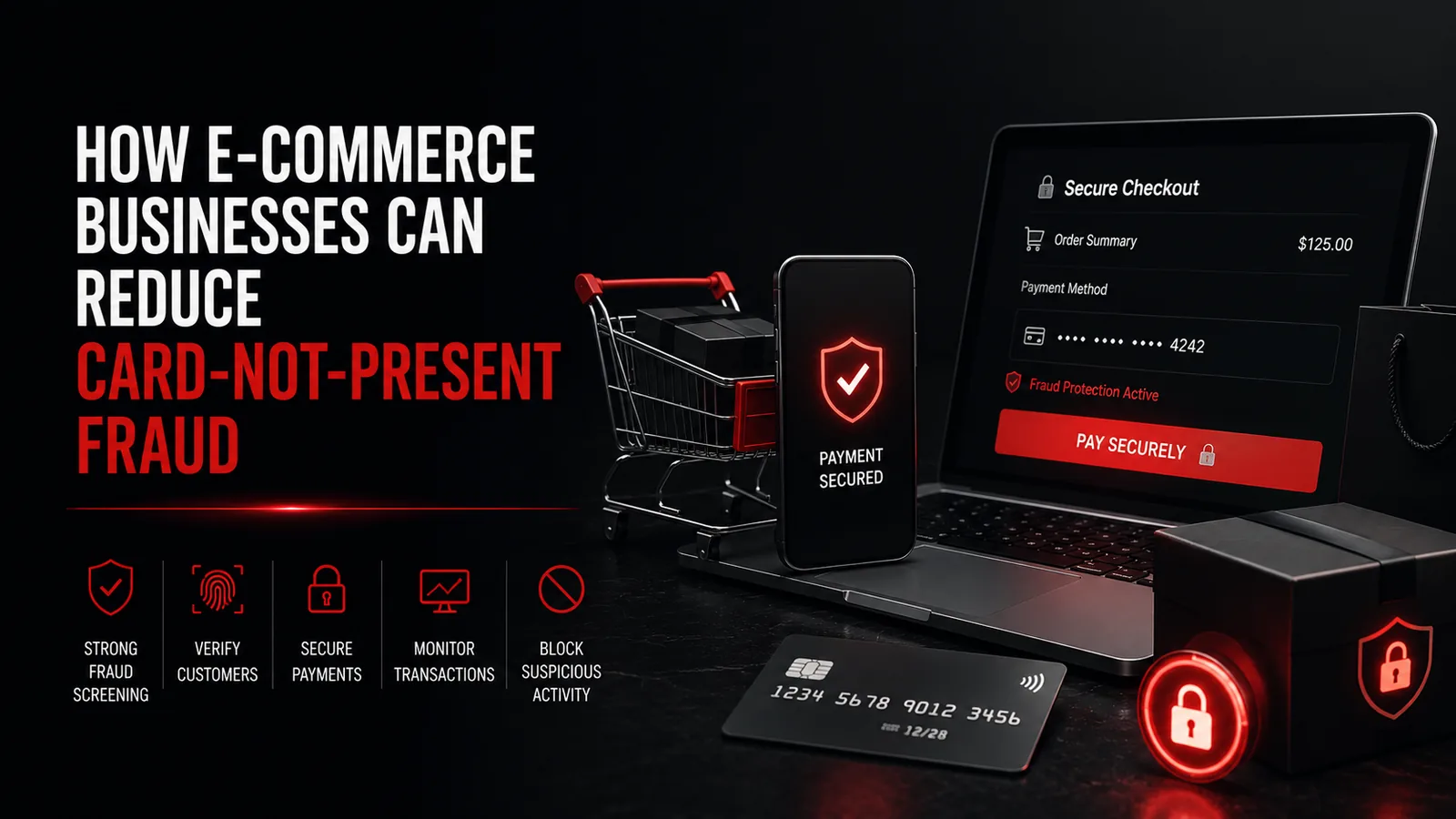
Card-not-present fraud is one of the central security challenges of e-commerce because the merchant cannot physically inspect the card or the person presenting it. A fraudster may possess a stolen card number, account credentials, or identity information while shopping from a device thousands of miles from the legitimate cardholder.
The answer is not to decline every unusual transaction. Excessive friction and false declines can damage revenue, customer trust, and conversion just as surely as fraud losses can.
Modern CNP fraud prevention therefore depends on layered controls: issuer authentication through EMV 3-D Secure, tokenization, authorization signals, AVS and card-security-code checks, account and device context, behavioral and velocity analysis, machine-learning risk models, manual review, payment-page security, and post-transaction monitoring.
EMVCo says EMV 3-D Secure is designed specifically to help issuers and merchants prevent card-not-present fraud and increase e-commerce payment security. Visa and Mastercard likewise emphasize the combination of authentication, tokenization, risk scoring, and identity signals for digital commerce.
At the same time, merchants must protect the checkout itself. PCI SSC's current e-commerce guidance focuses on preventing e-skimming by controlling payment-page scripts, validating their integrity, and detecting unauthorized changes.
This guide explains a defensive merchant strategy without publishing exact risk thresholds, model weights, decline rules, retry limits, or other details that could help criminals tune transactions against fraud controls.
Quick Answer: The Best Way to Reduce CNP Fraud
The strongest approach is layered and adaptive.
Authenticate higher-risk customers with EMV 3-D Secure.
Use tokenized payment credentials where supported.
Evaluate AVS, CVV/CVC, authorization responses, account history, device context, order behavior, and fulfillment risk together rather than as isolated pass/fail rules.
Protect customer accounts with MFA and strong recovery controls.
Protect the checkout page from e-skimming and unauthorized scripts.
Use velocity and anomaly detection without publishing fixed thresholds.
Route ambiguous transactions to step-up authentication or manual review rather than automatically declining every unusual order.
Feed confirmed fraud and chargeback outcomes back into risk models.
Measure false declines as carefully as fraud losses.
What Is Card-Not-Present Fraud?
Card-not-present fraud occurs when payment credentials are used without the physical card being presented to the merchant.
Typical CNP environments include web checkout, mobile commerce, card-on-file payments, subscriptions, mail order, and telephone order.
Visa describes CNP broadly as transactions where the card number is provided without face-to-face card presentation.
The risk is fundamentally different from traditional card-present fraud because the merchant cannot rely on chip interaction or physical inspection.
The transaction must instead be evaluated through digital authentication, authorization, identity, device, account, and behavioral signals.
Why CNP Fraud Is Difficult
A fraudulent order can look superficially similar to a legitimate one.
A criminal may know the correct card number, expiration date, billing address, email address, and other personal information.
At the same time, legitimate customers travel, use new devices, ship gifts to different addresses, place unusually large orders, and fail authentication for ordinary reasons.
This overlap makes simple binary rules unreliable.
Merchants need risk systems that distinguish unusual behavior from genuinely suspicious combinations of signals.
The Goal Is Not Maximum Declines
A fraud system that rejects every uncertain order can produce impressive-looking fraud rates while destroying legitimate sales.
False declines can frustrate customers, increase abandonment, damage brand trust, and push buyers toward competitors.
Visa's current e-commerce fraud guidance explicitly frames the challenge as reducing fraud and chargebacks while also cutting false declines and protecting revenue.
A successful CNP program therefore optimizes both fraud loss and legitimate approval performance.
The objective is selective friction: stronger verification where risk is higher and minimal disruption where confidence is strong.
Control 1: Use EMV 3-D Secure
EMV 3-D Secure is one of the most important tools available for authenticating cardholders in e-commerce.
EMVCo says EMV 3DS helps issuers and merchants prevent CNP fraud while improving e-commerce payment security.
Modern 3DS supports data-rich risk assessment. Lower-risk transactions can often proceed through a frictionless flow, while transactions needing stronger verification can be challenged by the issuer.
This is preferable to forcing every customer through the same authentication experience.
Merchants should work with their payment provider and acquirer to implement supported 3DS flows correctly and monitor authentication outcomes.
Do Not Treat 3-D Secure as an All-or-Nothing Tool
A common mistake is assuming every transaction should always receive a visible challenge.
Modern EMV 3DS is designed around risk-based authentication.
Frictionless authentication can allow the issuer to assess the transaction without interrupting the shopper.
A visible challenge is used when additional assurance is needed.
The merchant should focus on correct data quality and appropriate orchestration rather than maximizing the number of challenges.
Too much friction can increase abandonment without proportionate fraud benefit.
Provide Good Data Into 3DS
Authentication quality depends partly on the information available to the issuer.
EMVCo's documentation describes 3DS as a data-rich protocol intended to improve risk assessment and support frictionless authentication.
Merchants should provide accurate transaction and customer information through their supported payment integration.
Incomplete or inconsistent data can reduce the quality of issuer risk decisions.
Do not fabricate fields or use inaccurate customer information merely to influence an authentication outcome.
Understand Liability Shift Carefully
3-D Secure can affect fraud liability for qualifying transactions, but liability treatment depends on network rules, transaction status, geography, merchant category, and specific program conditions.
Visa's merchant guidance notes that 3DS can provide liability shift for qualifying fraud-coded chargebacks.
Merchants should not assume that every authenticated transaction automatically eliminates chargeback exposure.
Work with the acquirer or payment processor to understand the exact rules that apply.
Fraud prevention remains necessary even when a liability shift may exist.
Control 2: Use Payment Tokenization
Tokenization replaces a reusable primary account number with a substitute payment token in supported payment flows.
A token can be restricted to a merchant, device, or payment context.
This reduces the value of stolen credentials outside the context for which the token was created.
Network tokenization can also improve lifecycle management for card-on-file payments by helping legitimate credentials remain current without repeatedly exposing raw PAN data.
Tokenization does not eliminate fraud, but it reduces unnecessary circulation of reusable card numbers and can improve both security and approval performance.
Tokenize Stored Cards
Card-on-file environments deserve particular attention because returning customers expect convenience while stored credentials can become an attractive target.
Use supported tokenization rather than retaining reusable raw card numbers whenever possible.
Mastercard's secure-card-on-file guidance emphasizes tokenized credentials as a way to reduce fraud risk while helping maintain legitimate recurring and returning-customer payments.

Merchants should minimize direct storage of cardholder data and rely on validated payment providers where appropriate.
Reducing the amount of sensitive payment data under merchant control reduces breach impact.
Control 3: Use AVS as a Risk Signal
Address Verification Service compares selected billing-address information submitted by the customer with data held by the issuer.
A mismatch can increase risk, but it should not automatically mean fraud.
Legitimate customers can mistype addresses, recently move, use corporate cards, or have issuer records formatted differently.
AVS is most useful when combined with other signals such as account history, device context, authorization response, fulfillment pattern, and 3DS result.
Treat AVS as evidence, not a verdict.
Control 4: Use CVV/CVC Correctly
Card-security-code validation can help confirm that the customer possesses information printed on or associated with the card.
Mastercard identifies CVC2 validation as an online transaction control that can help mitigate CNP fraud.
A successful CVV/CVC result does not prove that the person is the legitimate cardholder because criminals may also steal the code.
A mismatch can indicate error or risk.
Do not store prohibited sensitive authentication data after authorization, and follow PCI DSS and network rules for handling security codes.
Control 5: Evaluate Authorization Responses
Authorization is a critical issuer-side decision.
Merchants should respect issuer declines and avoid repeatedly forcing the same transaction through in ways that create unnecessary retry behavior.
Authorization responses can provide context for fraud systems and customer messaging.
Do not expose internal issuer-response interpretation or retry logic publicly.
When a transaction fails, provide customers with safe, neutral guidance rather than revealing how fraud controls were triggered.
Control 6: Build Device Context
Device information can help distinguish a familiar returning customer from a new or unusual environment.
Useful categories may include whether the device has been seen before, whether account history is consistent, whether the session behaves normally, and whether multiple customer accounts appear associated with the same environment.
Device context should be treated probabilistically rather than as a permanent identity.
Legitimate customers replace phones, use work computers, travel, clear cookies, and switch browsers.
Do not automatically decline every new device.
Control 7: Use Customer Account History
Returning-customer history is one of the strongest contextual signals available to merchants.
A long-standing account with consistent legitimate purchases can reasonably be treated differently from a brand-new account created immediately before a high-risk order.
Review order history, prior disputes, login history, saved addresses, payment history, and previous successful authentication where appropriate.
Account age alone is not proof of legitimacy because established accounts can be taken over.
Combine history with signs of recent account change or unusual behavior.
Control 8: Protect Against Account Takeover
Card-not-present fraud increasingly overlaps with account takeover.
A criminal may compromise a customer's shopping account and use saved payment methods or loyalty value.
Protect customer accounts with MFA where practical, strong password policies, secure session management, bot defense, and careful account-recovery controls.
Pay special attention to risky changes shortly before checkout, such as password resets, new devices, address changes, or new payment instruments.
Do not rely solely on static personal questions for account recovery.
Control 9: Secure Password Reset and Account Recovery
A strong login system can still be undermined by a weak recovery process.
Fraudsters may use stolen personal information to persuade customer support to change an email address, reset MFA, or alter a delivery address.
Require appropriate verification for high-risk account recovery and sensitive profile changes.
Train support agents not to bypass controls simply because a caller knows biographical information.
Record and monitor high-risk account changes so checkout risk systems can incorporate them.
Control 10: Monitor Velocity
Velocity analysis looks for patterns of activity occurring unusually quickly or repeatedly.
Examples can include many payment attempts, repeated account creation, rapid changes in delivery details, or multiple orders associated with related risk signals.

The exact thresholds should be based on the merchant's normal customer behavior, product type, geography, and risk appetite.
Do not publish fixed cutoffs because attackers can tune their behavior around known rules.
Use adaptive thresholds and combinations rather than a single universal number.
Control 11: Detect Repeated Declines and Payment Cycling
A cluster of failed payment attempts can be suspicious, but merchants should interpret the pattern carefully.
Legitimate customers can mistype card details or try a second card after a decline.
Risk rises when repeated payment failures appear together with other anomalies such as rapid account changes, inconsistent identity data, automation signals, or unrelated cards.
Use rate limits and risk controls without revealing exact retry allowances.
Customer-facing error messages should avoid telling an attacker which credential field passed or failed.
Control 12: Use Bot and Automation Detection
Automated abuse can increase the scale of CNP fraud.
Bots may attempt account creation, credential stuffing, checkout abuse, or other high-volume activity.
Merchants should use modern bot-management, rate limiting, behavioral analysis, and application-security controls.
The goal is to distinguish legitimate automation and accessibility needs from malicious abuse.
Avoid relying only on static CAPTCHA challenges because attackers adapt and legitimate customers can be harmed by excessive friction.
Control 13: Analyze Order Context
Order details can help determine whether a transaction fits the customer's normal behavior.
Useful context may include order value, product mix, shipping method, purchase frequency, account history, and whether the order is unusually different from prior legitimate activity.
A high-value order is not automatically fraudulent.
A small order is not automatically safe.
Combine order context with authentication, account, device, authorization, and fulfillment signals.
Control 14: Evaluate Fulfillment Risk
Fraud prevention should continue beyond payment authorization.
Shipping changes, unusually urgent delivery, inconsistent customer communication, or last-minute rerouting can increase risk depending on the business model.
Do not publicly describe specific combinations that guarantee a hold or decline.
High-risk orders can be routed to review before irreversible fulfillment.
Digital goods and instant-delivery products require especially fast fraud decisioning because recovery after delivery may be difficult.
Control 15: Treat Guest Checkout Carefully — Not Automatically as Fraud
Guest checkout can reduce friction for legitimate buyers and improve conversion.
It also provides less historical account information.
That does not mean guest orders should automatically be declined.
Use stronger transaction, device, payment, and fulfillment context where customer history is unavailable.
Offer account creation after purchase rather than forcing every buyer to create an account solely for fraud purposes.
Control 16: Apply Behavioral Analytics
Behavioral signals can help distinguish normal customer interaction from unusual automated or scripted behavior.
Examples may include session consistency, navigation patterns, account interaction history, and whether behavior resembles known legitimate customers.
Behavioral models should be privacy-conscious and tested for bias and false positives.
No single behavior should be treated as proof of fraud.
The strongest value comes from combining behavioral context with payment and identity signals.
Control 17: Use Risk Scoring
Risk scoring combines multiple signals into a unified assessment.
A score can incorporate payment, device, identity, account, order, behavioral, network, and historical fraud information.
Mastercard describes real-time transaction fraud monitoring as using risk evaluation to support payment decisioning.
The merchant should define different outcomes for different risk bands, such as approve, authenticate, review, or decline.
Exact score thresholds and model weights should remain internal and should be reviewed regularly.
Control 18: Use Machine Learning as Part of a System
Machine learning can identify relationships across large volumes of transaction data that are difficult to express as simple rules.
Visa and Mastercard both describe AI and advanced analytics as important components of modern e-commerce fraud defense.
Machine learning should not operate without governance.
Models need quality labels, monitoring, retraining, explainability appropriate to the decision, and measurement of false positives.
Rules, models, authentication, manual review, and issuer decisions should reinforce one another rather than compete.
Control 19: Use Manual Review Strategically
Human review is useful for ambiguous, high-value, or high-impact transactions.
Reviewers can consider customer history and context that automated systems may not fully understand.
Manual review is expensive and slow, so it should not become the default for every uncertain order.
Give reviewers structured evidence and clear escalation policies.
Do not encourage reviewers to use informal internet searches that expose sensitive customer information unnecessarily.
Control 20: Use Step-Up Verification Instead of Immediate Decline
When risk is elevated but not conclusive, additional verification can preserve legitimate revenue.
EMV 3DS challenge flows are one example.
Other merchant-controlled account verification may also be appropriate depending on the business and regulatory environment.
The objective is to increase assurance without exposing customers to phishing-like experiences.
Verification should occur through trusted, clearly branded channels and should never ask for prohibited secrets such as PINs.
Control 21: Watch for Recent Account Changes Before Checkout
A high-risk transaction immediately following a password reset, delivery-address change, email change, or device enrollment may deserve more scrutiny than the same transaction from an unchanged long-standing account.
This is especially relevant to account-takeover detection.
The exact weighting belongs inside the fraud model.

Do not publish deterministic rules such as 'address changed within X minutes equals fraud.'
Use the combination of account change and transaction context to inform risk.
Control 22: Protect Gift Cards, Loyalty Points, and Store Credit
CNP fraud is not limited to ordinary card purchases.
Criminals may target stored value, loyalty balances, promotional credits, or gift cards.
Protect redemption and transfer flows with account security, rate controls, anomaly detection, and appropriate authentication.
Be cautious when allowing rapid conversion between payment cards and transferable stored value.
The same fraud engine can often evaluate both payment transactions and abuse of non-cash value.
Control 23: Protect Buy Online, Pick Up In Store
BOPIS combines online payment risk with physical fulfillment.
The merchant should align digital fraud controls with store pickup procedures.
High-risk orders may require appropriate customer verification before release.
Do not create pickup procedures that expose full payment data or rely on easily stolen static information alone.
Store staff need simple, privacy-conscious instructions that do not reveal fraud rules to customers.
Control 24: Monitor Refund and Return Abuse
Post-purchase fraud can include fraudulent refund requests, return abuse, and manipulation of customer-service processes.
Link refund decisions to the original transaction and account history.
Protect support agents from social engineering.
Use appropriate approval controls for high-risk refund destinations or unusual refund patterns.
Do not expose exact internal thresholds for refund review.
Control 25: Feed Chargeback Outcomes Back Into Detection
Chargebacks provide valuable labels for fraud systems when interpreted carefully.
Merchants should distinguish confirmed unauthorized fraud from customer disputes, merchant errors, subscription confusion, and friendly fraud.
A poorly classified chargeback dataset can train the wrong model.
Use reason codes, internal evidence, and processor information to improve future decisioning.
The fraud team and chargeback team should share data rather than operate as separate silos.
Control 26: Track False Declines
Merchants should measure how often legitimate customers are incorrectly blocked.
Useful indicators include approval rates, authentication abandonment, manual-review acceptance, customer complaints, repeat purchase behavior, and recovered legitimate orders.
A fraud rule that reduces chargebacks but causes a large fall in good approvals may not be economically successful.
Review performance by customer segment, market, payment method, and device type.
Optimization should balance fraud, conversion, and customer experience.
Control 27: Segment Risk Instead of Using One Global Rule Set
A digital-goods merchant faces different fraud patterns from a grocery retailer, luxury seller, subscription platform, or B2B business.
Risk also differs by geography, payment method, product type, customer tenure, and fulfillment speed.
Use segmentation so controls reflect actual business behavior.
Avoid hard-coded assumptions that one country, device type, or customer demographic is inherently fraudulent.
Risk systems should evaluate behavior and context rather than stereotypes.
Control 28: Protect the Payment Page From E-Skimming
Transaction fraud controls are useless if attackers can silently steal legitimate customer card data from the checkout page.
PCI SSC's 2025 payment-page guidance focuses on preventing e-skimming through controls around scripts and page integrity.
PCI DSS Requirement 6.4.3 addresses authorization, justification, and integrity of scripts on payment pages.
Requirement 11.6.1 addresses detection of unauthorized changes to payment pages and security-impacting HTTP headers.
Merchants should know which scripts run on checkout, why they are there, who supplies them, and whether changes are detected.
Control 29: Maintain a Payment-Page Script Inventory
Third-party JavaScript can provide analytics, chat, advertising, accessibility, fraud prevention, and payment functionality.
Every script with access to or influence over checkout increases supply-chain exposure.
Maintain an inventory of authorized payment-page scripts and document their business purpose.
Remove scripts that are no longer necessary.
Review changes through controlled deployment processes rather than allowing ad hoc insertion into production checkout pages.
Control 30: Monitor Payment-Page Integrity
E-skimming can occur when authorized pages are modified so payment information is captured by malicious code.
PCI SSC's current guidance emphasizes integrity checking and tamper detection.
Monitoring should be able to identify unauthorized changes in the page or relevant headers, including changes that affect what the customer browser receives.
Do not assume server-side malware scanning alone protects the browser-side payment experience.
Client-side security needs explicit ownership.
Control 31: Reduce Third-Party Checkout Risk
A merchant may depend on payment processors, tag managers, analytics providers, chat tools, and other third parties.
Third-party compromise can affect the merchant even if its own application code was not directly breached.
Use vendor-risk management, least privilege, controlled script deployment, and contractual security expectations.
Minimize the number of third parties able to influence payment pages.
Review integration changes before deployment and after major vendor updates.
Control 32: Use Hosted Payment Fields or Outsourced Payment Components Where Appropriate
Merchants can reduce direct exposure to raw card data by using validated payment-provider components such as hosted fields or appropriately designed hosted checkout flows.
Outsourcing payment capture does not eliminate merchant responsibility for the surrounding page or account environment.
PCI SSC's 2025 SAQ A updates emphasize that even merchants using outsourced payment pages must address the possibility that their own site scripts could affect payment security.
Choose architecture based on PCI scope, user experience, fraud needs, and the security capabilities of the payment provider.
Do not assume 'we do not store cards' means the website cannot be used to steal them.
Control 33: Keep PCI DSS Scope and Validation Current
PCI DSS establishes baseline technical and operational requirements for protecting payment-account data.
Merchants should determine the correct validation method with their acquirer or qualified adviser.
PCI SSC updated SAQ A eligibility criteria in 2025 for e-commerce merchants, emphasizing that the merchant site must not be susceptible to script-based attacks that could affect the payment system.
Compliance is not the same as fraud prevention, but weak payment-data security can feed the very stolen-card ecosystem merchants are trying to defend against.
Treat PCI DSS as a baseline, not a complete fraud strategy.

Control 34: Protect Administrative Accounts
Checkout compromise often begins with access to content-management systems, cloud consoles, code repositories, tag managers, or merchant administration panels.
Require MFA for privileged access.
Use least privilege and separate administrator roles.
Monitor unusual administrator logins and sensitive configuration changes.
Remove access promptly when staff or vendors no longer need it.
A fraud-prevention program must protect both transactions and the systems that control transactions.
Control 35: Patch and Maintain E-Commerce Platforms
Outdated commerce software, plugins, libraries, and administrative tools can increase compromise risk.
Maintain supported versions and security patches.
Track third-party components and remove abandoned plugins.
Test updates in a controlled process but avoid delaying critical security fixes indefinitely.
Application security directly affects fraud because compromised checkout infrastructure can become a source of stolen credentials.
Control 36: Secure APIs and Mobile Commerce
Modern commerce often spans web, mobile apps, APIs, wallets, and third-party integrations.
Fraud controls should not exist only on the browser checkout.
Protect APIs with strong authentication, authorization, rate controls, monitoring, and secure software-development practices.
Use consistent risk context across channels where possible.
A criminal blocked on the website should not be able to bypass the same control through an unprotected API or mobile endpoint.
Control 37: Protect Customer-Support Channels
Fraudsters may contact customer support to change addresses, reset credentials, remove authentication, or accelerate fulfillment.
Train agents to recognize social engineering.
Use structured verification for sensitive account changes.
Avoid relying on static personal information that may have been exposed in breaches.
Fraud operations should monitor support-driven changes as part of account and transaction risk.
Control 38: Build an Incident-Response Plan for Payment Fraud
Merchants need a documented response for both transaction fraud and payment-system compromise.
Define who can pause risky fulfillment, engage the processor, investigate checkout changes, contact the acquirer, preserve evidence, notify security teams, and communicate with customers.
Run exercises before an incident.
Fast coordination matters because fraud can scale quickly in digital channels.
Keep incident response separate from public disclosure decisions until facts are verified.
Control 39: Share Intelligence With Payment Partners
Merchants should use information available from acquirers, processors, card networks, fraud vendors, and legitimate threat-intelligence providers.
No merchant sees the entire payment ecosystem.
Network and consortium intelligence can reveal patterns that a single business would miss.
Use lawful, privacy-conscious information sharing.
Do not attempt to buy stolen credentials or interact casually with criminal sellers to gather intelligence.
Control 40: Review Fraud Controls Continuously
Fraud patterns change as merchants change checkout flows and criminals adapt.
A rule that worked last year can become ineffective or overly aggressive.
Review fraud losses, approval rates, authentication rates, chargebacks, false declines, manual-review outcomes, and customer complaints.
Test control changes gradually and measure results.
The best fraud program is operational discipline, not a one-time software installation.
How to Build a Layered CNP Decision Flow
A practical merchant decision flow can begin with basic transaction validity and authorization, then combine account, device, payment, identity, behavioral, and fulfillment context.
Low-risk transactions can proceed with minimal friction.
Moderate-risk transactions can receive stronger issuer authentication or structured review.
High-confidence fraud can be declined or held before irreversible fulfillment.
Post-authorization monitoring and chargeback outcomes then feed the next round of decisions.
The exact thresholds and model weights should remain confidential and merchant-specific.
What Not to Publish About Your Fraud Controls
Do not publish the exact number of retries allowed before blocking.
Do not disclose risk-score thresholds.
Do not publish which AVS or CVV outcomes automatically pass.
Do not expose model weights or combinations that guarantee approval.
Do not identify specific high-value products as easier or harder to approve.
Do not reveal manual-review shortcuts or customer-support override procedures.
Public fraud education should explain control categories, not the precise boundaries attackers can optimize against.
Common Mistakes in CNP Fraud Prevention
Relying on AVS alone.
Treating CVV match as proof of legitimacy.
Challenging every customer with 3DS instead of using risk-based flows.
Declining every new device.
Using fixed global velocity thresholds forever.
Ignoring account takeover and focusing only on payment fields.
Failing to secure password reset and support workflows.
Keeping too many third-party scripts on checkout.
Assuming outsourced payment capture eliminates e-skimming risk.
Optimizing only for chargeback rate while ignoring false declines and lost conversion.
How Smaller Merchants Can Start
A small merchant does not need an enormous in-house fraud team to improve CNP defenses.
Start with a reputable payment provider that supports 3DS, tokenization, fraud scoring, AVS/CVV, alerts, and clear dispute data.
Protect administrator accounts with MFA.
Keep the commerce platform patched.
Reduce payment-page scripts.
Review higher-risk orders before irreversible fulfillment.
Enable transaction and chargeback reporting.
Measure approval rates and fraud outcomes.
Add specialized fraud tooling as transaction volume and risk justify it.
How Larger Merchants Can Mature the Program
Larger merchants can develop centralized fraud data, cross-channel identity graphs, machine-learning models, dedicated manual-review operations, chargeback intelligence, account-takeover detection, bot mitigation, and experimentation frameworks.
Fraud, payments, security, identity, customer support, and fulfillment teams should share signals.
Governance becomes increasingly important as models influence more customers.
Document model ownership, change control, monitoring, fairness considerations, and incident escalation.
Scale should create better context, not simply more complex rules.
Conclusion
E-commerce businesses reduce card-not-present fraud most effectively when they stop looking for one perfect fraud rule.
The modern defense is layered: secure the customer account, authenticate the transaction, protect the payment credential, understand the device and order context, monitor behavior, protect checkout code, and continue evaluating the order after authorization.
EMV 3-D Secure helps merchants and issuers add data-rich authentication without forcing every shopper through the same friction.
Tokenization reduces exposure of reusable card numbers.
PCI DSS payment-page controls help prevent the merchant's own checkout from becoming a source of stolen credentials.
Fraud analytics, manual review, bot defense, fulfillment controls, and chargeback feedback then help determine which transactions deserve confidence and which deserve additional scrutiny.
The strongest system is not the one that blocks the most orders. It is the one that lets legitimate customers buy smoothly while making fraud difficult, expensive, detectable, and hard to scale.