
Featured-Snippet Answer
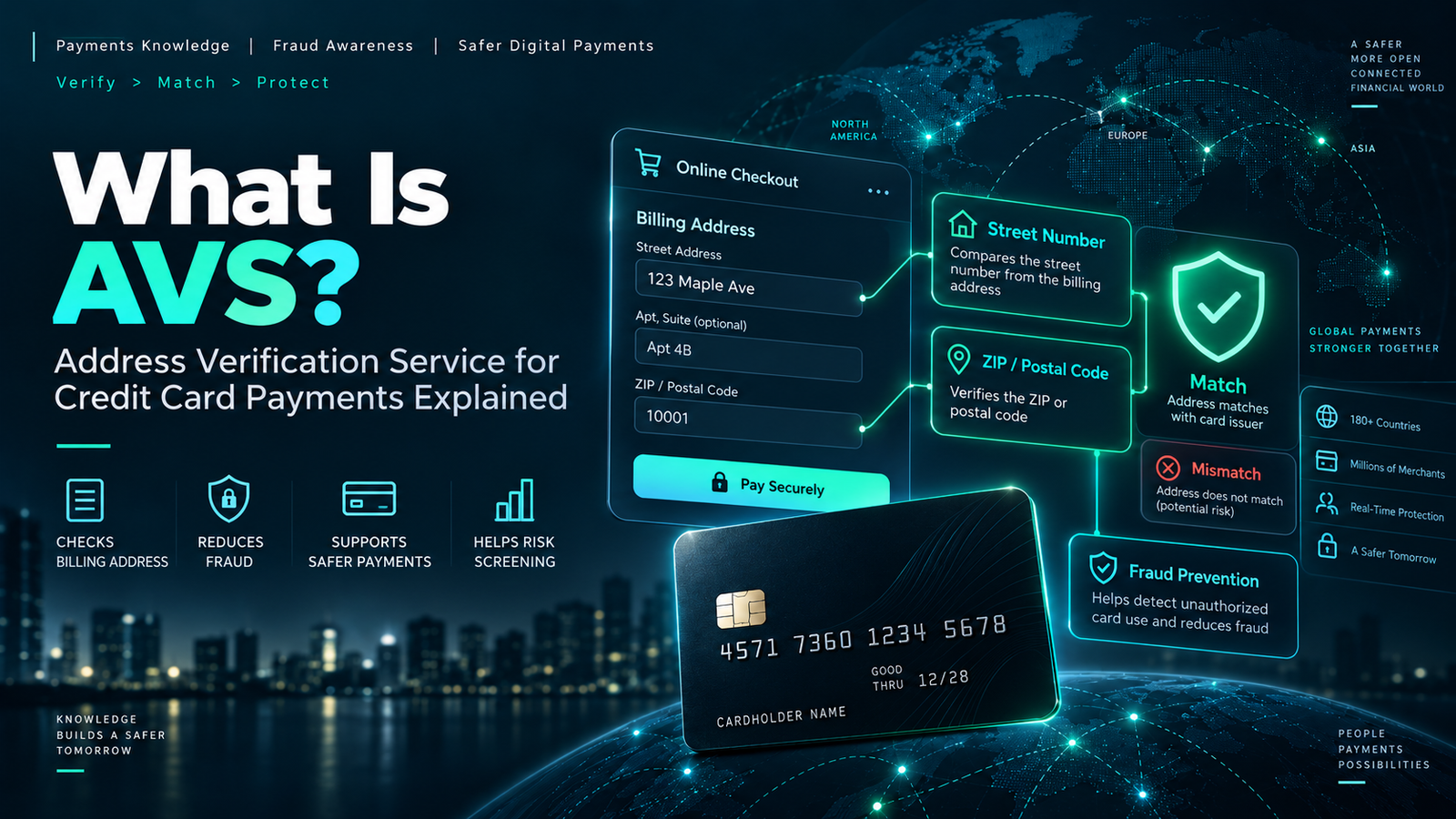
AVS stands for Address Verification Service (also called Address Verification System). An AVS check compares billing-address information submitted during a card payment—commonly the street address and postal or ZIP code—with the information held by the card issuer. The issuer returns an AVS result such as a full match, partial match, no match, unsupported, or unavailable. Merchants can use that result as one fraud-risk signal alongside CVV, 3D Secure, device data, and transaction behavior. |
|---|
What Is AVS?
AVS is a payment-security tool used to compare a customer's billing address with the address information held by the bank or financial institution that issued the payment card. If you have searched for “what is AVS,” “AVS meaning,” or “what does AVS stand for,” the short answer is that AVS stands for Address Verification Service. You may also see the phrase Address Verification System used for the same concept.
An AVS check is most relevant to card-not-present transactions, such as ecommerce purchases, phone orders, and other payments where the merchant cannot physically inspect the card. During authorization, billing-address data can be sent through the payment processor and card network to the issuer. The issuer compares the submitted information with its records and sends back an AVS response.
That response does not prove by itself that a customer is legitimate or fraudulent. Instead, it gives the merchant an additional risk signal. A full match can add confidence, while a mismatch or unavailable result may justify extra checks, depending on the merchant's risk rules and the rest of the transaction context.
What Does AVS Stand For?
AVS stands for Address Verification Service. Some payment providers use the phrase Address Verification System, but both expressions generally refer to the billing-address comparison performed during card authorization.
The term can be confusing because AVS is not a general-purpose address-validation tool. It does not primarily ask whether a street exists, whether a package can be delivered there, or whether a shipping address is formatted correctly. Its payment-security purpose is narrower: compare billing-address information supplied during a payment with billing information associated with the card account.
What Is an AVS Check?
An AVS check is the actual comparison step. When a customer enters a card and billing address, the payment flow can send the relevant address fields to the issuer for verification. The issuer then returns an AVS result code indicating how closely the information matched.
Depending on the processor, card network, issuer, and country, the comparison may focus on the numeric portion of the street address, the postal or ZIP code, or both. This is why a transaction can receive a partial match—for example, the postal code may match while the street address does not, or the reverse.
How Address Verification Service Works
The basic AVS flow can be understood in five steps:
- 1. The customer enters card details and a billing address during checkout.
- 2. The merchant or payment service provider sends the authorization request, including supported AVS address data.
- 3. The card network routes the request to the issuing bank or financial institution.
- 4. The issuer compares the submitted billing-address information with the address associated with the card account.
- 5. The issuer returns an AVS response code through the payment network and processor. The merchant's fraud rules can then accept, review, request additional authentication, or decline based on the total risk picture.
The entire process normally happens as part of the near-real-time payment authorization flow. Importantly, authorization approval and AVS results are related but distinct signals. A merchant can receive an authorization response along with an AVS result and then apply its own risk policy.
What Information Does AVS Compare?
AVS typically works with billing-address data. In many implementations, the most important fields are:
- Street-address information, often with emphasis on the numeric portion of the address.
- ZIP or postal code.
- Sometimes additional address or cardholder-name signals, depending on the network, processor, and card type.
The exact implementation is not identical everywhere. That matters when interpreting AVS results: a code may mean full match, partial match, unsupported, or unavailable depending on the processing environment.

AVS Meaning in Credit Card Payments
In credit card payments, the meaning of AVS is simple: it is a way to ask whether the billing address supplied by the shopper is consistent with the billing address known to the card issuer. The goal is to make stolen-card use harder without requiring the merchant to know the customer's private banking records.
For a legitimate cardholder, the billing address is information they are expected to know. A fraudster who only obtained a card number may not have the correct address information. That makes AVS useful as one layer of card-not-present fraud prevention.
AVS Response Codes Explained
After the issuer performs the comparison, it returns an AVS response code. Merchants normally see the code through their payment processor or gateway. Networks and processors can use different code sets, so businesses should always interpret codes according to the documentation for their own payment stack.
At a high level, AVS outcomes usually fall into these categories:
Result category | Typical meaning | Merchant interpretation |
|---|---|---|
Full match | Street address and postal/ZIP information match the issuer’s records. | Generally lower address-related risk, but not proof that the transaction is legitimate. |
Partial match | One component matches while another does not or cannot be verified. | Use context: customer history, CVV, 3D Secure, device and order behavior. |
No match | The submitted address information does not match the issuer’s records. | Higher-risk signal; may justify review, step-up authentication, or a decline under merchant rules. |
Unavailable / system issue | The issuer or AVS system could not perform the comparison. | Do not automatically treat as fraud; evaluate other risk signals. |
Unsupported | AVS is not supported for the issuer, card type, processor, or transaction. | Rely on other fraud controls and authentication signals. |
Common AVS Codes: A, N, Y, Z, R and More
In U.S.-oriented processing environments, you may encounter familiar letter codes such as Y, N, A, Z, R, S, or U. For example, processor documentation commonly maps Y to a strong address-and-postal-code match, N to no match, A to a street-address match with a postal-code mismatch, and Z to a postal-code match with a street-address mismatch. Other codes can indicate unsupported or unavailable verification.

Do not build universal logic around a code table copied from another provider. AVS codes can vary by network, region, card type, and processor mapping. The safe approach is to use your payment provider's current documentation and map the raw response into clear internal categories such as match, partial match, no match, unavailable, and unsupported.
What Is an AVS Mismatch?
An AVS mismatch occurs when the billing-address information provided with the payment does not match the information the issuer has on file, either fully or partially. Common causes include:
- A legitimate customer recently moved and has not updated the billing address with the card issuer.
- The shopper accidentally typed the wrong street number or postal code.
- Formatting differences or incomplete address data affected the comparison.
- A business card uses a billing address different from the employee's delivery address.
- A fraudulent user has the card details but not the correct billing address.
Because legitimate purchases can fail AVS, a mismatch should usually be treated as a risk signal rather than a standalone proof of fraud. Merchants with aggressive AVS rules can create false declines if they automatically reject every partial or unavailable result.
What Does “AVS Rejected” Mean?
The phrase “AVS rejected” is commonly used by payment platforms when an address check did not satisfy a configured rule. Depending on the processor, this can mean the issuer returned a mismatch or the merchant's own fraud settings decided not to accept the result. The exact meaning should be checked in the gateway or processor documentation rather than assumed from the label alone.
For consumers, the practical response is usually to verify that the billing address matches the address registered with the card issuer. For merchants, the better response is to inspect the AVS category together with authorization status, CVV result, authentication data, customer history, and other fraud signals.
AVS vs CVV: What Is the Difference?
AVS and CVV both support card-not-present fraud screening, but they test different information.
Security check | What it verifies | Best used as |
|---|---|---|
AVS | Billing-address information associated with the card account. | An address-consistency and fraud-risk signal. |
CVV/CVC | The security code printed or displayed with the card credentials. | Evidence that the shopper has access to the card security code. |
3D Secure / SCA | Cardholder authentication performed through issuer-supported authentication flows. | A stronger identity/authentication layer for eligible online payments. |
The strongest fraud strategy combines multiple independent signals. A full AVS match does not make CVV or 3D Secure unnecessary, and a CVV match does not make address verification irrelevant.
AVS vs 3D Secure
AVS verifies address consistency; 3D Secure is an authentication framework. With 3D Secure, the issuer can assess the cardholder and, when needed, request an additional authentication step. AVS does not authenticate the user in the same way. It simply compares billing-address information and returns a result.
For merchants, these tools complement each other. AVS can help identify address inconsistencies while 3D Secure can provide stronger authentication and additional issuer-side risk analysis.
Where Is AVS Used?
AVS is especially associated with card-not-present transactions and is commonly used in markets such as the United States, Canada, and the United Kingdom. Support outside those markets varies by issuer, network, processor, and local payment practices. That is why international merchants should expect some transactions to return unsupported or unavailable responses even when the customer is legitimate.
Merchants should avoid assuming that lack of AVS support means elevated fraud by itself. International payment acceptance works best when AVS is one input among several rather than a universal gatekeeper.
Why Merchants Use Address Verification Service
AVS is attractive to merchants because it adds a useful fraud signal with relatively little checkout friction. The customer is already accustomed to entering a billing address, and the merchant receives a machine-readable result that can be incorporated into fraud rules.
Common benefits include:
- Detecting suspicious billing-address inconsistencies before fulfillment.
- Supporting risk scoring for card-not-present transactions.
- Reducing reliance on any single fraud-control method.
- Providing additional context for manual review teams.
- Helping merchants create different rules for full matches, partial matches, and no matches.
- Working alongside CVV, 3D Secure, device intelligence, velocity checks, customer history, and behavioral analytics.
Limitations of AVS
AVS is useful, but it is not a complete fraud-prevention system. Understanding its limitations prevents both missed fraud and unnecessary customer declines.
- A fraudster may possess the correct billing address along with stolen card details.
- A legitimate cardholder may fail AVS because of a recent move, typo, outdated issuer record, or formatting difference.
- AVS availability and response behavior can vary internationally.
- A full match verifies address consistency, not the shopper's identity by itself.
- Some issuers or transaction types may return unsupported or unavailable results.
- Shipping-address risk is a separate issue; AVS is primarily about the cardholder's billing address.
How Merchants Should Use AVS Without Creating Too Many False Declines
A good AVS policy is risk-based rather than binary. Merchants should avoid a simplistic rule where every mismatch is automatically rejected. A safer approach is to combine the AVS result with transaction context.
- 1. Treat a full match as a positive signal, not a guarantee.
- 2. Treat partial matches as context-dependent rather than automatic fraud.
- 3. Give more weight to a no-match result when other risk signals are also suspicious.
- 4. Use CVV/CVC results, 3D Secure, device reputation, velocity, order value, customer history, and geolocation alongside AVS.
- 5. Separate unsupported or unavailable results from true no-match results.
- 6. Review false-decline data regularly and adjust rules by market, card type, and customer segment.
- 7. Keep processor-specific AVS code mappings documented so fraud teams interpret results consistently.
AVS Examples
Example 1: Full AVS Match
A returning customer enters the same billing street and postal code that the issuer has on file. The issuer returns a full match. The merchant also sees a normal device, a matching CVV result, and typical order behavior. The AVS result supports a lower-risk decision.

Example 2: Postal Code Matches, Street Does Not
A customer enters the correct postal code but a street value that does not match the issuer's record. This is a partial AVS match. The merchant might allow the payment, ask for additional authentication, or review the order depending on order value and other signals.
Example 3: No Match Plus Other Risk Signals
A new customer places an unusually high-value order, AVS returns no match, CVV also fails, and the device has suspicious velocity. None of those signals alone tells the entire story, but together they create a much stronger reason for review or rejection.
Example 4: AVS Unavailable on an International Card
A legitimate international customer uses a card whose issuer does not provide a usable AVS result. The merchant should not automatically label the transaction fraudulent. Instead, it can rely more heavily on authentication, device, behavioral, and customer-history signals.
AVS for Ecommerce and Card-Not-Present Fraud
AVS is especially valuable in ecommerce because the merchant cannot compare the shopper with a physical card. Card-not-present fraud therefore depends heavily on digital signals. Address Verification Service gives merchants one more way to test whether the payment details are consistent with the account information known to the issuer.
For higher-risk ecommerce businesses, AVS becomes more powerful when paired with 3D Secure, CVV, fraud scoring, account-age data, device fingerprinting, velocity controls, and post-payment monitoring. The goal is not to collect as many checks as possible; it is to combine signals intelligently so genuine customers face less friction while suspicious transactions receive more scrutiny.
Is AVS the Same as Billing Address Validation?
Not exactly. Address validation can mean checking whether an address is syntactically valid, deliverable, standardized, or known to a postal database. AVS is specifically a payment-card verification process that compares billing-address information with data held by the card issuer.
This distinction is important for both consumers and merchants. A shipping address can be perfectly deliverable and still fail AVS if it is not the billing address associated with the card. Likewise, a billing address can pass AVS without proving that a shipping destination is safe.
Does AVS Prevent Chargebacks?
AVS can help reduce fraud risk, which can indirectly reduce fraud-related chargebacks, but it does not guarantee chargeback protection. A successful AVS result does not prove that the cardholder authorized the transaction, and the treatment of AVS evidence can vary by network, dispute type, processor, and merchant program.
Merchants should view AVS as part of a layered fraud and dispute strategy rather than a standalone chargeback solution.
Frequently Asked Questions About AVS
What is AVS?
AVS is Address Verification Service, a payment-security check that compares billing-address information submitted during a card transaction with information held by the card issuer.
What does AVS stand for?
AVS stands for Address Verification Service. You may also see it called Address Verification System.
What is an AVS check?
An AVS check is the billing-address comparison performed during or alongside card authorization. The issuer returns a response indicating a match, partial match, no match, unsupported result, or unavailable result.
What is AVS meaning on a credit card payment?
It means the merchant or payment processor requested billing-address verification from the issuer as part of the payment-risk process.
What does AVS mismatch mean?
An AVS mismatch means some or all submitted billing-address information did not match the issuer’s record.

Does an AVS mismatch always mean fraud?
No. Legitimate customers can produce mismatches because of typos, moves, outdated issuer records, formatting issues, or business-card billing arrangements.
What is the difference between AVS and CVV?
AVS checks billing-address information. CVV/CVC checks the card security code. They are separate fraud signals.
Does AVS check the shipping address?
AVS is primarily designed to compare the billing address associated with the payment card, not to validate whether a shipping destination is safe or deliverable.
Is AVS available worldwide?
Availability varies. It is commonly used in markets such as the U.S., Canada, and the U.K., while issuer and processor support can differ in other countries.
Should merchants decline every AVS failure?
Usually not as a blanket rule. AVS works best when evaluated with authentication, CVV, device, behavioral, customer-history, and transaction-risk signals.
Key Takeaways
- AVS stands for Address Verification Service and is also called Address Verification System.
- An AVS check compares billing-address data submitted during a card payment with issuer-held address information.
- Results can be full match, partial match, no match, unsupported, or unavailable.
- An AVS mismatch is a fraud signal, not proof of fraud.
- AVS is most useful for card-not-present and ecommerce payments.
- Merchants should combine AVS with CVV, 3D Secure, device intelligence, velocity rules, and customer history.
- Processor-specific AVS codes should be interpreted using the merchant's own current documentation.
Conclusion
For anyone asking “what is AVS?” or searching for AVS meaning, the core idea is straightforward: Address Verification Service helps payment systems compare the billing address supplied during checkout with address information held by the card issuer. The returned AVS result gives merchants additional context about whether the transaction looks consistent.
AVS is valuable because it is fast, familiar to customers, and easy to combine with other controls. But it should never be treated as a perfect identity check. The most effective approach is layered: AVS for billing-address consistency, CVV for card-security-code verification, 3D Secure for stronger authentication, and behavioral and device signals for broader fraud detection.
For Carding Pioneers, this topic is an important cornerstone of a wider payment-security content cluster. It connects naturally to guides on Strong Customer Authentication, card-not-present fraud, 3D Secure, CVV/CVC, BIN/IIN numbers, tokenization, and ecommerce fraud prevention.
Fact-Check Sources
Stripe — “What is address verification service (AVS)?” (updated Aug. 21, 2026): stripe.com/resources/more/what-is-address-verification-service
Cybersource — AVS Codes documentation: developer.cybersource.com/docs/cybs/en-us/avs-codes
Visa — Billing Address Verification with AVS (card-absent acceptance guidance): usa.visa.com — AVS guidance