

Featured-snippet answer
Credit card skimming is a form of payment-card theft in which an unauthorized device captures card information when a person uses an ATM, fuel pump, point-of-sale terminal, or other card reader. Skimming most often targets data from a card's magnetic stripe and may be combined with attempts to capture a PIN. The safest response is to inspect card readers, prefer chip or contactless payments when available, cover the keypad when entering a PIN, use trusted terminals, and monitor account activity for unauthorized transactions.
What Is Credit Card Skimming?
Credit card skimming is a type of payment fraud in which criminals secretly capture information from a payment card while the cardholder is using what appears to be a normal card reader. The compromised reader may be an ATM, fuel pump, payment terminal, self-service kiosk, or another device that accepts a physical card.
The goal of a skimming attack is to collect payment-card data without the cardholder realizing it. In some cases, criminals also try to obtain the cardholder's PIN by using a concealed camera or a fraudulent keypad overlay. The stolen information may then be used in unauthorized transactions or other forms of payment fraud.
The FBI describes skimming as the use of devices illegally installed on or inside ATMs, point-of-sale terminals, or fuel pumps to capture card data and, in some cases, record PIN entries. The agency estimates that skimming costs financial institutions and consumers more than $1 billion each year. Skimming therefore remains an important fraud-awareness topic for consumers, merchants, banks, and payment-security teams.
What Does Credit Card Skimming Mean?
In simple terms, credit card skimming means copying payment-card information during a legitimate transaction without the cardholder's permission. The customer may believe they are using a genuine terminal, but a hidden or altered component captures information as the card is inserted or swiped.
Skimming is different from phishing, where a person is tricked into voluntarily entering card details into a fake website or message. It is also different from e-skimming, which targets online checkout pages or web applications. Physical card skimming focuses on real-world card readers and terminals.
How Do Credit Card Skimmers Work?
A credit card skimmer works by intercepting card information during an otherwise normal-looking payment interaction. The exact device can vary, but the basic pattern is the same: the legitimate terminal continues to process the customer's transaction while an unauthorized component secretly captures information.

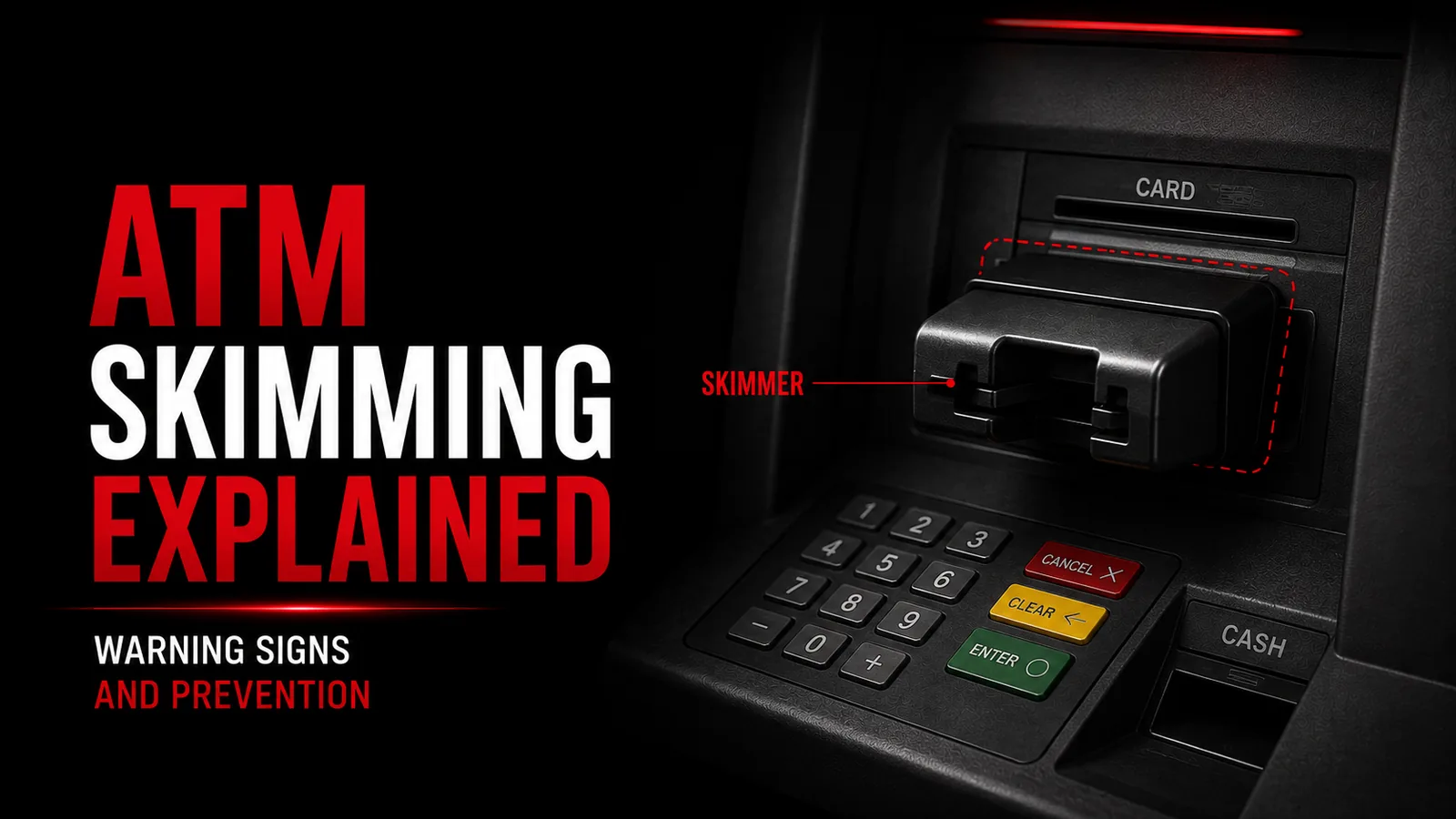
Some skimming devices are placed over an existing card slot. Others may be concealed inside a compromised terminal or fuel pump. The FBI also warns that criminals may pair skimming with hidden cameras or false keypad covers to capture PIN entries. These methods are designed to blend into the payment environment, which is why a skimmer may not be obvious at first glance.
For consumer safety, the important point is not the construction of the device but the warning signs around the terminal: anything loose, crooked, damaged, unusually bulky, poorly aligned, scratched, or inconsistent with nearby machines should be treated with caution.
Where Does Card Skimming Commonly Happen?
- ATMs, especially unattended or poorly monitored machines.
- Fuel pumps, where payment hardware may be outdoors and accessible for long periods.
- Point-of-sale terminals in stores, restaurants, convenience shops, and other retail environments.
- Self-service payment kiosks and ticketing machines.
- Other card readers in locations where physical supervision is limited.
A terminal in a busy or familiar location is not automatically safe, so basic inspection habits are worthwhile wherever you use a physical card.
Types of Card Skimming Consumers Should Know About
ATM skimming
ATM skimming involves tampering with an ATM card reader so that card information is captured when a customer inserts or swipes a card. A separate attempt may be made to observe or record the PIN. Indoor ATMs in controlled locations may be less exposed to tampering than unattended machines, although no terminal should be assumed to be completely risk-free.
Fuel-pump skimming
Fuel pumps are another common skimming target. Some devices may be hidden inside compromised pump hardware, which means there may be no obvious attachment on the outside. The FBI recommends choosing pumps that are close to the store and within clear view of attendants, and using tap-to-pay when available.

Point-of-sale skimming
Retail payment terminals can also be altered or covered with fraudulent hardware. A cardholder may notice a keypad that feels different, a reader that moves when touched, or a terminal whose appearance does not match other terminals nearby. If anything seems unusual, use another payment method or ask the merchant to inspect the device.
Internal or concealed skimming
Not every skimming device is visible from the outside. Some compromised machines may contain unauthorized components within the terminal. This is one reason consumer protection should not depend solely on visually spotting a skimmer. Safer payment methods, transaction alerts, and regular account monitoring remain important even when a terminal looks normal.
What Information Can a Skimmer Capture?
Traditional skimming attacks primarily target information stored on a card's magnetic stripe. Depending on the attack, criminals may also try to capture a PIN separately. A skimmer does not automatically reveal every security element associated with a modern chip transaction, which is one reason chip and contactless technologies provide stronger protection than older magnetic-stripe payments.
It is important to distinguish between card data and authentication information. A payment card number, expiration details, a PIN, a dynamic chip cryptogram, and a contactless transaction code are not the same thing. Modern payment systems intentionally use layers of security so that stealing one piece of information is less useful on its own.
Can Chip Cards Be Skimmed?
Chip-enabled cards significantly reduce the usefulness of data captured from traditional magnetic-stripe skimming because chip transactions generate transaction-specific security information rather than relying only on static stripe data. However, many physical cards still include a magnetic stripe for compatibility, and that stripe can remain vulnerable if it is swiped on a compromised reader.
The FBI specifically advises consumers to use debit and credit cards with chip technology when possible, while noting that the magnetic stripe on the back of the same card can still be targeted. This is why inserting the chip or tapping the card is generally preferable to swiping when a secure terminal supports those options.
Can Contactless Cards Be Skimmed?
Contactless payments use different security controls from magnetic-stripe transactions. Visa explains that contactless transactions generate a one-time, transaction-specific code and that the card or payment-enabled device must be very close to the terminal for a transaction to occur. This makes contactless payment data substantially harder to reuse for fraudulent purchases than static magnetic-stripe information.
No payment technology eliminates every form of fraud, but tap-to-pay is generally a safer choice than swiping a magnetic stripe at an unfamiliar terminal. Consumers should still monitor their accounts and use device or account security features when available.
Credit Card Skimming vs Other Payment Fraud
Fraud type | Where it happens | What is targeted |
|---|---|---|
Physical card skimming | ATM, fuel pump, POS terminal | Card data captured from a compromised physical reader |
Phishing | Email, SMS, fake login or payment page | Information the victim is tricked into entering |
E-skimming / digital skimming | Compromised online checkout or website | Payment data entered into a web form |
Card-not-present fraud | Online, app, phone, remote order | Stolen card details used without the physical card |
How to Spot a Possible Card Skimmer
A skimmer is designed to look ordinary, so there is no single visual sign that guarantees a terminal is safe or compromised. Still, several warning signs can justify choosing another machine.
- The card slot looks loose, crooked, damaged, or different from nearby terminals.
- The keypad appears unusually raised, thick, misaligned, or inconsistent in color or material.
- Parts of the terminal move when lightly touched.
- There are unexplained scratches, adhesive residue, tape, or damage around the card slot.
- The machine behaves unusually or fails to return your card.
- A fuel-pump security seal appears broken or altered, where such seals are used.
If you notice anything suspicious, do not use the reader. Inform the business, bank, or terminal operator and choose another payment option.
How to Protect Your Credit or Debit Card From Skimming
- 1. Inspect the card reader and keypad before use. Look for loose, damaged, crooked, or unusually bulky components.
- 2. Prefer chip or contactless payments instead of swiping the magnetic stripe when the terminal supports them.
- 3. Cover the keypad with your other hand whenever you enter a PIN. This can help prevent a hidden camera from recording the entry.
- 4. Use ATMs in well-lit, monitored, or indoor locations when practical.
- 5. At fuel stations, consider using a pump closer to the store or paying inside if anything about the pump looks suspicious.
- 6. Turn on transaction alerts from your bank or card issuer so you can spot unexpected charges quickly.
- 7. Review card and bank statements regularly instead of waiting for a monthly statement.
- 8. Use card-freezing or account-lock features when your bank offers them and you do not need the card for a period of time.
- 9. Contact your card issuer immediately if a terminal keeps your card, you notice suspicious activity, or you believe your card data has been compromised.
Is Debit Card Skimming More Dangerous?
Debit-card skimming can be especially disruptive because unauthorized transactions may affect money directly in a deposit account. If a PIN is also compromised, the risk may include unauthorized withdrawals or purchases. The exact consumer protections and timing requirements depend on the country, account type, issuer, and circumstances, so suspicious activity should be reported immediately.

The FBI advises consumers to avoid using a debit card where compromise could expose linked accounts and suggests considering a credit card instead in higher-risk situations. Regardless of card type, fast reporting gives the issuer the best opportunity to block further misuse.
What to Do If You Think Your Card Was Skimmed
- 1. Contact the bank or card issuer using the number on the official app, website, or back of the card.
- 2. Ask the issuer to block, freeze, or replace the card if compromise is suspected.
- 3. Review recent transactions and report any unauthorized activity promptly.
- 4. Change your PIN if the affected card uses one and the issuer recommends doing so.
- 5. Update any recurring payments after receiving a replacement card if necessary.
- 6. Continue monitoring the account for additional unauthorized transactions.
- 7. If you discovered a suspicious skimmer on a public terminal, notify the terminal owner and the appropriate local authorities or fraud-reporting service.
How Merchants Can Reduce Card-Skimming Risk
Skimming prevention is not only a consumer responsibility. Merchants and terminal operators can reduce risk by controlling physical access to payment devices, training employees to recognize tampering, regularly inspecting terminals, maintaining inventories of approved hardware, securing unattended terminals, and responding quickly when a device looks different from its expected configuration.
Merchants should also keep payment hardware and software supported, use modern chip and contactless acceptance technologies, and follow the security requirements of their payment processor and applicable PCI standards. A strong physical-security process complements digital fraud controls such as tokenization, transaction monitoring, and card-not-present fraud detection.
Does Skimming Still Matter in 2026?
Yes. Although chip and contactless technologies have strengthened in-person payment security, skimming has not disappeared. The FBI's current skimming guidance continues to warn about compromised ATMs, point-of-sale terminals, and fuel pumps, and its skimming page lists recent enforcement cases from 2025 and 2026. The practical lesson is that older magnetic-stripe data and poorly protected terminals can still create opportunities for fraud.
At the same time, payment security has become more layered. Chip technology, contactless payments, transaction alerts, account controls, tokenization, stronger authentication, and fraud analytics all reduce the value of relying on a single defense. Consumers and merchants benefit most when several protections are used together.
Credit Card Skimming FAQ
What is credit card skimming?
Credit card skimming is the unauthorized capture of payment-card information from a compromised physical card reader such as an ATM, fuel pump, or point-of-sale terminal.
What is a card skimmer?
A card skimmer is an unauthorized device or component designed to capture payment-card data when a card is used at a compromised reader.

How do credit card skimmers work?
They intercept card information during what appears to be a normal transaction. Some attacks also attempt to capture a PIN separately.
How can I tell if an ATM has a skimmer?
Look for loose, crooked, damaged, unusually bulky, or mismatched components around the card slot and keypad. If anything looks suspicious, do not use the machine.
Can a chip card be skimmed?
Chip transactions are more resistant to traditional skimming because they use transaction-specific security data, but the magnetic stripe on many chip cards can still be vulnerable if it is swiped.
Is tap-to-pay safer than swiping?
Contactless transactions use transaction-specific security information and are generally more resistant to traditional magnetic-stripe skimming than swiping.
What should I do after suspected skimming?
Contact your card issuer immediately, block or replace the card if advised, review recent transactions, report unauthorized activity, and continue monitoring the account.
What is the difference between skimming and e-skimming?
Physical skimming targets card readers in the real world. E-skimming targets payment data entered into compromised online checkout pages or web applications.
Conclusion
Credit card skimming is a physical payment-fraud technique that targets card information at ATMs, fuel pumps, point-of-sale terminals, and other readers. Modern chip and contactless payments make many traditional skimming attacks less useful, but magnetic-stripe data and compromised terminals still create risk.
The most effective habits are simple: inspect readers, prefer chip or contactless payments, cover the keypad when entering a PIN, use monitored terminals, enable transaction alerts, and report suspicious activity quickly. For merchants, physical terminal security should be combined with modern payment technology and continuous fraud monitoring.
Authoritative Sources for Fact-Checking and External References
- FBI - Skimming: https://www.fbi.gov/how-we-can-help-you/common-frauds-and-scams/skimming
- FBI - ATM Skimming: https://www.fbi.gov/news/stories/atm-skimming
- Visa - Tap to Pay / Contactless Payments: https://usa.visa.com/pay-with-visa/contactless-payments/contactless-payments.html
Editorial note: This article is written for fraud awareness, consumer protection, and payment-security education. It explains skimming at a defensive level without providing instructions for building, installing, or operating skimming devices.