

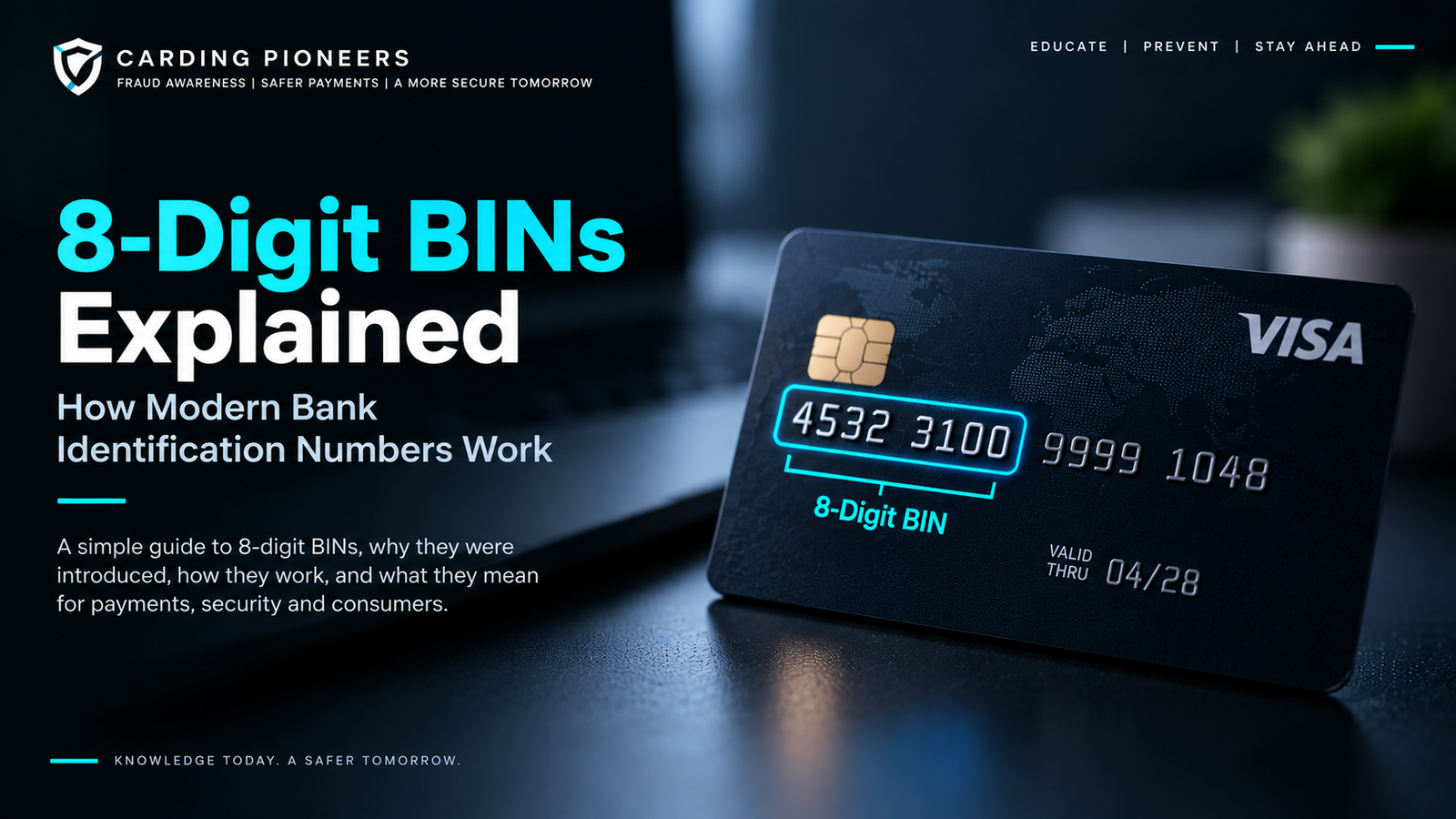
For decades, people working with card payments commonly described the first six digits of a payment card number as the Bank Identification Number, or BIN. That convention changed when the international numbering standard was expanded to support eight-digit Issuer Identification Numbers.
Today, an 8-digit BIN - more formally called an 8-digit Issuer Identification Number (IIN) under ISO/IEC 7812 - helps identify the institution or issuing entity associated with a payment card. The expansion gives the global payments ecosystem far more identifier capacity while allowing modern card products and payment programs to keep growing.
Quick answer: An 8-digit BIN/IIN is the first eight digits of a card's Primary Account Number (PAN) used to identify the card issuer under the modern ISO/IEC 7812 numbering system. The industry expanded from six to eight digits because the supply of available issuer identifiers was becoming increasingly constrained.
The change does not mean every payment card suddenly received a longer card number, nor does it mean a BIN reveals the customer's full account. It is an issuer-identification component within the wider card-number structure.
What Is an 8-Digit BIN?
An 8-digit BIN is the first eight digits of a payment card's account number used to identify the issuing institution or issuer allocation. In formal standards language, the correct term is Issuer Identification Number (IIN). The term BIN remains extremely common in banking, payments, merchant systems and industry documentation.
The American Bankers Association, which serves as the Registration Authority for ISO/IEC 7812, describes ISO/IEC 7812 as the international standard for the 8-digit IIN and notes that IIN is sometimes referred to as a BIN.
Why Did BINs Expand From 6 Digits to 8 Digits?
The expansion was primarily about capacity. As electronic payments, card products, financial institutions and new payment programs grew globally, the industry needed more issuer-identification numbers.
ISO announced the change after the payments industry identified a future shortage of available six-digit IINs. Expanding the identifier by two digits greatly increased the number of possible allocations without requiring the entire card-numbering system to be replaced.
- More card issuers and payment programs could be supported.
- Existing issuer-identification structures could continue to evolve.
- Payment networks and processors could distinguish more issuer allocations.
- The industry could avoid exhausting the limited pool of six-digit identifiers.
When Did 8-Digit BINs Become the Modern Standard?
ISO/IEC 7812-1:2017 introduced the updated eight-digit IIN structure. ISO states that the 2017 edition remains the current standard after being reviewed and confirmed in 2022.
Payment networks then implemented the change across their own ecosystems. Visa, for example, required acquirers and processors to support the eight-digit issuing BIN standard with its April 2022 business release and stated that newly requested Visa issuing BINs would be assigned as eight digits.

That industry transition is why modern payment documentation increasingly refers to eight-digit BINs or IINs, even though historical six-digit BIN terminology still appears in software, reports and older merchant systems.
How Does an 8-Digit BIN Fit Into a Card Number?
A payment card number is known as a Primary Account Number, or PAN. The IIN/BIN occupies the opening portion of that number. Other digits identify the individual account or card relationship, and the final digit commonly performs a check function.
A simplified educational example might look like this:
Illustrative PAN segment | Purpose | Example |
|---|---|---|
First 8 digits | Issuer identification (IIN/BIN) | 1234 5678 |
Remaining digits | Individual account/card structure | Masked for safety |
The example above is deliberately illustrative. A BIN or IIN should not be treated as a complete card number, a security credential or proof that a payment is legitimate.
Does an 8-Digit BIN Mean Card Numbers Became Longer?
Not necessarily. The change expanded the issuer-identification portion of the PAN, not the maximum PAN length itself. ISO's transition materials explained that the PAN would continue to support a variable length, while the newer IIN would occupy eight digits instead of six.

In practice, many familiar card numbers remain the same overall length. What changed is how the opening digits are interpreted for issuer identification.
6-Digit BIN vs 8-Digit BIN
Feature | Legacy 6-digit approach | Modern 8-digit approach |
|---|---|---|
Identifier length | 6 digits | 8 digits |
Industry terminology | Commonly called BIN | Formally IIN; BIN still widely used |
Identifier capacity | Smaller pool | Much larger allocation pool |
Modern standard | Historical/legacy convention | ISO/IEC 7812 modern structure |
System impact | Many older systems assumed 6 digits | Systems should support 8-digit identification |
Are All BINs Now 8 Digits?
The modern ISO numbering framework uses eight-digit IINs, but the real-world transition has involved legacy data, existing card portfolios and network-specific implementation timelines.
Visa, for example, stated that it would assign newly requested issuing BINs as eight digits while allowing issuers discretion over the timing for expanding some existing issuing BINs. This is one reason merchants may still encounter systems, reports or documentation that refer to six-digit BIN groupings.
For modern development and payment-data design, however, assuming that the issuer identifier is always exactly six digits is no longer a safe architectural assumption.
How Do 8-Digit BINs Work in Payment Processing?
Issuer-identification data helps payment systems understand which institution or issuing entity is associated with a card range. That information can support transaction routing, reporting, card-product recognition, risk controls and other payment-processing functions.
The BIN itself does not approve a transaction. Authorization is performed through the payment ecosystem using many additional signals, including account status, authentication, transaction details, issuer controls and fraud-risk systems.
This distinction is important for fraud awareness: knowing or identifying the first eight digits of a card does not provide access to the cardholder's account and does not prove that the person presenting a payment is authorized to use it.
Why 8-Digit BINs Matter to Merchants and Payment Providers
The biggest operational impact of the change was on systems built around the old assumption that the issuer identifier always ended after six digits.
- Payment databases may need fields and logic that recognize eight-digit issuer identifiers.
- Routing and reporting systems should avoid hard-coded six-digit assumptions.
- Fraud and risk platforms need current issuer-range data rather than outdated static tables.
- Analytics that group transactions by issuer should use the correct modern identifier source.
- Merchants should rely on their processor or payment provider for authoritative BIN/IIN data instead of maintaining unverified lists.
Can an 8-Digit BIN Identify the Bank?
An IIN is designed to identify the issuing institution or issuing entity within the card-numbering system. In ordinary payment-industry language, this is why the term Bank Identification Number became popular.
However, not every issuer is literally a traditional bank, and a single financial institution can operate multiple card programs or allocations. For that reason, 'issuer identification' is the more precise description.
Can a BIN Tell You the Cardholder's Identity?
No. The issuer identifier describes the issuing side of the payment-card structure; it does not reveal the cardholder's name, address, account balance, password, PIN or other authentication credentials.
Cardholder information should be handled only through legitimate, secure payment and account-management systems. Public or third-party BIN lookup results should not be treated as proof of identity.

Can a BIN Tell Whether a Card Is Valid?
No. A BIN or IIN can provide issuer-related classification, but it cannot determine by itself whether a particular card is active, funded, stolen, expired or authorized for a specific purchase.
Legitimate card validation and transaction authorization occur through payment networks, issuers and payment service providers using secure controls. Merchants should never use a BIN as a substitute for authentication, authorization or fraud screening.
8-Digit BINs and Fraud Prevention
BIN information can be one contextual signal inside a broader fraud-prevention system. For example, payment platforms may compare issuer geography, transaction context and other risk indicators when evaluating a payment.
But modern fraud prevention should never depend on the BIN alone. Stronger controls may include Strong Customer Authentication, 3-D Secure, Address Verification Service where applicable, device and behavioral signals, transaction-risk analysis and issuer authorization.
Over-relying on a BIN can also create false positives because legitimate customers travel, use international cards, use digital wallets and transact through complex cross-border payment environments.
8-Digit BINs and Tokenized Payments
Modern payments increasingly use tokenization, including network and wallet tokens that can replace sensitive card details during payment processing.
Tokenized payment credentials can have their own routing and identification characteristics, so merchants should not assume that every token behaves exactly like the original physical-card PAN. Payment providers and network data should be the authoritative source for handling these credentials.
BIN vs IIN: Which Term Should You Use?
For formal accuracy, IIN - Issuer Identification Number - is the terminology used by ISO/IEC 7812. BIN - Bank Identification Number - remains widely understood and is still used throughout the payments industry.

For educational content, it is useful to mention both terms: '8-digit BIN (formally, an 8-digit IIN).' This helps readers understand older payment terminology while learning the current standard.
Common Misunderstandings About 8-Digit BINs
- Myth: Every card number became two digits longer. Reality: the issuer-identification portion expanded; the overall PAN does not automatically need to become longer.
- Myth: An 8-digit BIN is a security code. Reality: it is an issuer identifier, not a password, PIN, CVV or authentication factor.
- Myth: A BIN proves a card is valid. Reality: authorization must still come from the legitimate payment ecosystem.
- Myth: BIN and IIN always mean different fields. Reality: BIN is the widely used industry term; IIN is the formal standards term.
- Myth: Six-digit assumptions are still safe for new software. Reality: modern systems should be designed to support eight-digit issuer identification.
Frequently Asked Questions
How many digits is a BIN number?
Under the modern ISO/IEC 7812 standard, the issuer identification number is eight digits. Older payment systems and documentation commonly used six-digit BINs, which is why both lengths still appear in discussions.
What is an 8-digit BIN?
It is the first eight digits of the Primary Account Number used to identify the card issuer or issuer allocation. The formal standards term is 8-digit Issuer Identification Number (IIN).
Why did BIN numbers change from 6 to 8 digits?
The payments ecosystem needed a larger supply of issuer identifiers as the number of card issuers and payment products expanded globally.
When did 8-digit BINs start?
ISO published the revised 8-digit IIN standard in 2017. Major payment networks subsequently implemented support, with Visa requiring processor and acquirer readiness for the new issuing BIN length in April 2022.
Does an 8-digit BIN make a card more secure?
The expansion was mainly a numbering-capacity change, not a new authentication mechanism. Payment security still depends on controls such as issuer authorization, authentication and fraud monitoring.
Is BIN the same as IIN?
They are commonly used to describe the same issuer-identification portion of the card number. IIN is the formal ISO term, while BIN remains widely used in the payments industry.
Can I tell who owns a card from the BIN?
No. A BIN identifies the issuer side of the card-numbering structure, not the individual cardholder.
Should merchants store their own BIN lists?
Merchants should generally rely on current, authoritative data supplied by their payment processor, acquirer or trusted payment infrastructure rather than static or unverified public lists.
Final Thoughts
The move from six-digit to eight-digit BINs was a foundational modernization of the global card-numbering system. It gave the payments ecosystem substantially more issuer-identification capacity while preserving the basic structure consumers recognize.
For most consumers, the change is largely invisible. For merchants, developers, processors and fraud-prevention teams, however, it is important because systems that assume every BIN is only six digits can classify or process modern card data incorrectly.
The key point is simple: the modern issuer identifier is eight digits under ISO/IEC 7812, the formal name is IIN, and the familiar term BIN continues to be widely used. It identifies the issuer - not the cardholder, not the account balance and not whether a transaction should be approved.