
Carding Pioneers | Fraud Awareness, Payment Security & Merchant Defense
Editorial purpose: Educational and defensive. This article does not provide instructions, bypass steps, target lists, or operational guidance for committing payment fraud.
Introduction
Carding is not a single trick or a single type of transaction. It is better understood as part of a wider payment-fraud ecosystem in which payment credentials are compromised, transferred or misused, tested by fraud controls, converted into unauthorized purchases or other value, detected, disputed, and ultimately investigated or blocked.
Europol describes fraud against payment systems as involving both the acquisition of payment-card data or cards and their subsequent fraudulent use. In modern e-commerce, much of the risk is card-not-present (CNP) fraud, where a physical card never has to appear at the merchant.
This guide explains that ecosystem from a defensive and educational perspective. It intentionally avoids operational instructions, bypass procedures, target lists, or techniques that would help someone commit payment fraud. The goal is to help cardholders, merchants, security teams, and researchers understand where fraud risk enters the payment chain and where defenses can stop it.
Carding in One Sentence
Carding is the unauthorized use or attempted use of stolen or compromised payment-card credentials to obtain goods, services, money, or other value.
The word is commonly used in cybercrime discussions, but the underlying activity belongs to the broader categories of payment-card fraud and card-not-present fraud. A useful way to understand it is as a sequence of stages rather than a single event.
The Credit Card Fraud Ecosystem at a Glance
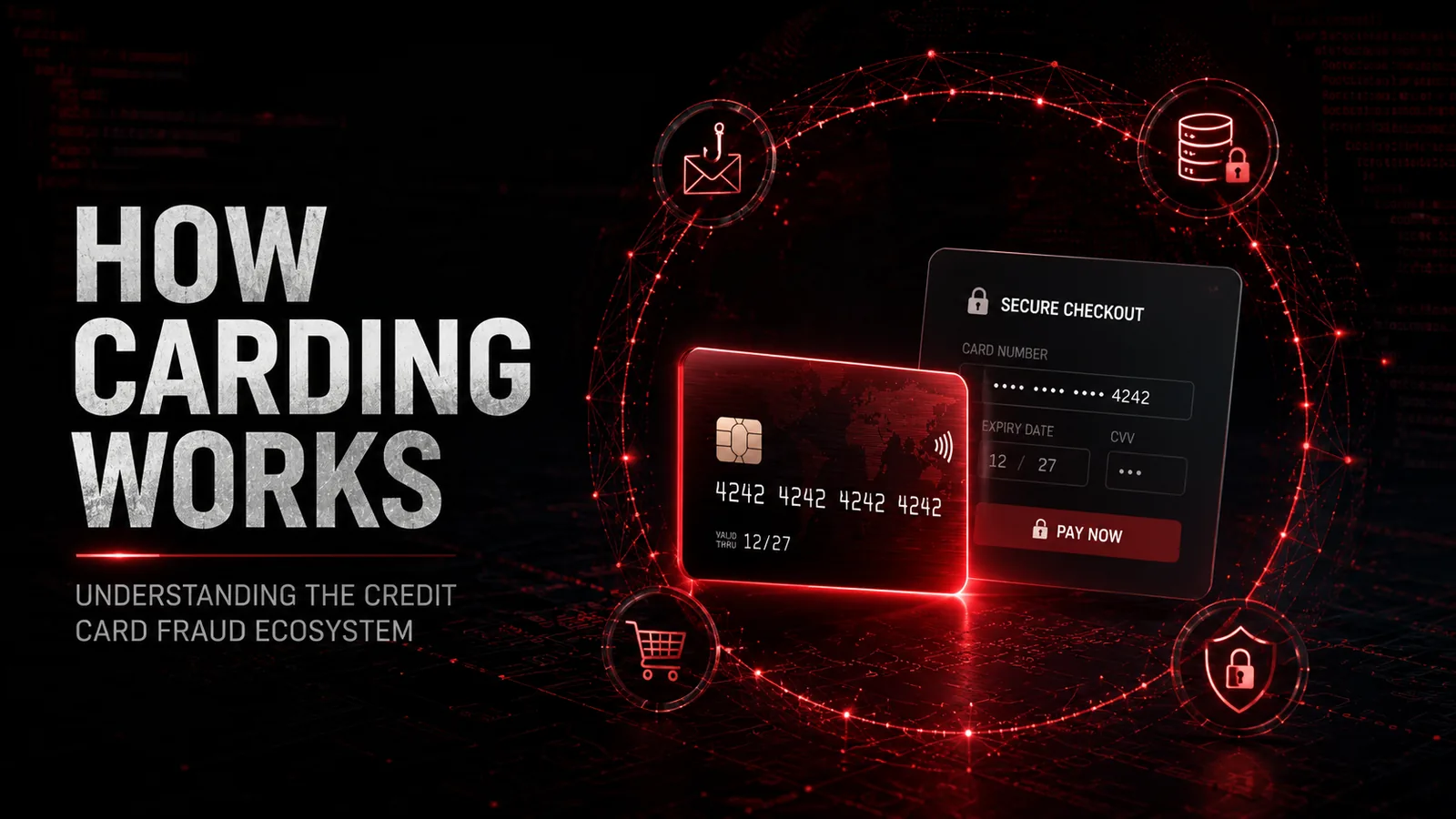
The fraud ecosystem can be summarized defensively as six broad stages: compromise, aggregation, attempted misuse, transaction authorization, fulfillment or monetization, and detection/response.
Not every incident passes through all six stages. Some stolen credentials are detected before any transaction is attempted. Some attempted transactions are declined automatically. Others may be approved but later discovered by the cardholder or merchant. Understanding these stages helps defenders place controls before, during, and after authorization.
Stage 1: Payment Data Is Compromised
Carding cannot occur unless payment credentials or access to a payment account have first been compromised. The initial compromise is therefore one of the most important places to focus defensive security.
Common sources of compromise include phishing and social engineering, merchant or service-provider data breaches, malicious software, account takeover, physical skimming, and e-skimming on compromised checkout pages.
PCI Security Standards Council guidance specifically addresses payment-page security and e-skimming because malicious changes to e-commerce pages can expose payment data entered by customers. PCI SSC also warns merchants about physical skimming devices attached to payment terminals.
From a defensive perspective, the key lesson is that payment fraud is often the final symptom of an earlier security failure. Protecting credentials at the point of entry, storage, transmission, and account access can prevent later stages entirely.
Stage 2: Compromised Data May Be Collected or Traded
Once payment information has been stolen, criminal actors may keep it for their own misuse, transfer it to associates, or advertise it in underground markets. Europol has documented law-enforcement actions against websites and dark-web marketplaces involved in selling compromised card details.
The existence of underground markets does not mean every advertised record is genuine. Criminal marketplaces are also filled with scams, recycled data, malware, impersonation, and fake sellers. This makes the ecosystem dangerous even for people attempting to participate in it.
For defenders, the important point is that a compromise can continue causing harm after the original breach. Organizations therefore need incident response, card replacement, fraud monitoring, and notification processes rather than assuming that closing the initial vulnerability immediately eliminates downstream risk.

Stage 3: Fraudulent Use Is Attempted
The next stage is an attempt to use the compromised credentials without the legitimate cardholder's permission. In e-commerce, this is generally a card-not-present environment because the physical card is not presented.
At this point the attacker is no longer interacting only with stolen data; the attempted transaction enters a complex payment ecosystem involving the merchant, payment gateway or processor, acquiring bank, card network, issuing bank, and various fraud and authentication systems.
This stage is where many simplistic descriptions of carding become misleading. Possession of a card number does not guarantee a successful transaction. Modern payment systems evaluate numerous risk signals and may decline, challenge, or otherwise stop suspicious activity.
Stage 4: The Payment Authorization Process
When a legitimate or fraudulent card transaction is submitted, the merchant sends an authorization request through its payment infrastructure. The request ultimately reaches the card issuer, which decides whether to approve or decline the transaction based on account status, available credit or funds, authentication information, risk signals, and other controls.
Fraud screening can happen at several points. The merchant may use its own rules or a fraud platform. The payment processor or network may contribute risk intelligence. The issuer evaluates the transaction from the account side.
A decline does not necessarily mean fraud was proven. It means the transaction did not satisfy the issuer or payment system's authorization criteria. Likewise, an approval does not guarantee that a transaction is legitimate; some fraud is discovered only later.
Where 3-D Secure Fits Into the Ecosystem
EMV 3-D Secure (EMV 3DS) is designed to help issuers and merchants authenticate consumers and reduce card-not-present fraud. EMVCo explains that 3DS enables information to be exchanged between the merchant and issuer so that the issuer can assess transaction risk and, when appropriate, authenticate the cardholder.
Modern 3DS can support frictionless authentication for lower-risk transactions while requiring an additional customer verification step when the issuer determines that more assurance is needed.
This illustrates a central principle of modern fraud defense: authentication does not rely on one static piece of card information. It can combine transaction context, device information, issuer intelligence, and stronger identity checks.
Stage 5: Fulfillment Creates Merchant Risk
If an unauthorized transaction is approved, the merchant may fulfill an order before anyone realizes that the payment was fraudulent. For physical goods, the merchant can lose both the merchandise and the revenue if the transaction is later disputed. For digital goods or services, value may be delivered instantly, giving fraud teams very little time to intervene.
Merchants therefore evaluate more than the payment authorization result. They may also assess customer history, delivery information, account age, unusual order value, transaction velocity, device signals, and other indicators before fulfillment.

The objective is not to create a checklist that criminals can reverse engineer. The objective is to combine many signals so that no single observable characteristic determines whether an order is approved.
Stage 6: Detection, Disputes, and Chargebacks
Fraud may be detected seconds after an attempted payment or weeks later when a cardholder reviews a statement. Issuers can detect anomalous behavior automatically, merchants can identify suspicious order patterns, and consumers can report transactions they do not recognize.
When an unauthorized card transaction is reported, the issuer and merchant may enter a dispute process governed by network rules and applicable law. In some cases the merchant can lose the transaction amount and may also bear operational costs associated with the dispute.
Chargebacks are therefore one of the economic mechanisms through which card fraud moves losses through the ecosystem. They also generate data that merchants and payment providers can use to improve future fraud detection.
The Main Participants in the Payment Fraud Ecosystem
Cardholder: The legitimate person or organization authorized to use the payment account. Cardholders are often the first to recognize unfamiliar transactions.
Merchant: The business accepting payment. Merchants must balance fraud prevention with legitimate customer approval and checkout experience.
Acquirer and processor: These organizations help merchants route and process card transactions.
Card network: Payment networks connect participants and establish technical and operational rules for card transactions.
Issuer: The financial institution that issued the card or payment account and ultimately approves or declines many authorization requests.
Fraud and authentication providers: Specialized systems help merchants and issuers assess risk, authenticate customers, protect payment pages, and identify suspicious behavior.
Law enforcement and regulators: Authorities investigate organized payment fraud, data theft, identity crime, and related cybercrime.
Card-Present vs. Card-Not-Present Fraud
Card-present fraud occurs when a physical payment environment is involved, such as a compromised point-of-sale terminal or ATM. Traditional skimming is one example of how physical card data can be stolen.
Card-not-present fraud occurs when the card number is entered remotely, such as through an e-commerce site, mobile app, telephone order, or other non-face-to-face payment. Visa and EMVCo both describe online and remote transactions as CNP environments.
CNP fraud is especially important to understand because the merchant cannot simply inspect the physical card or the customer. Authentication and fraud analytics therefore play a larger role.
Why Static Card Data Is Not Enough for Modern Security
Older payment models placed significant trust in static card information. Modern systems increasingly try to reduce reliance on reusable credentials.

Tokenization is one example. Visa describes tokenization as replacing sensitive payment details with unique token values. If correctly implemented, a token can reduce exposure of the underlying account number and make stolen data less reusable.
EMV 3DS adds stronger transaction authentication. Device and behavioral risk systems analyze context. Digital wallets can use cryptographic and token-based mechanisms. Together, these controls make payment authorization increasingly dependent on dynamic information rather than a few static numbers printed on a card.
What Fraud Detection Systems Look For
Fraud detection is generally based on combinations of signals rather than one magic rule. Relevant categories may include transaction history, account behavior, device characteristics, authentication results, velocity, merchant context, geographic consistency, and known fraud intelligence.
Payment providers increasingly use machine learning and network-level analytics to identify patterns that would be difficult for a human reviewer to recognize in real time.
For security reasons, merchants and payment providers should not publicly expose exact decision thresholds or detailed anti-fraud rules. Doing so can make those controls easier to evade.
Why Small Test Transactions Matter to Defenders
Fraud teams sometimes observe suspicious patterns involving low-value or repeated authorization attempts. From a defensive standpoint, these patterns matter because a criminal may try to determine whether compromised credentials remain active before attempting more damaging misuse.
The practical lesson for cardholders is simple: do not ignore unfamiliar transactions merely because the amount is small. The practical lesson for merchants is to monitor abnormal transaction velocity and repeated failed authorizations without publishing exact thresholds.
How E-Skimming Fits Into Carding
E-skimming is a useful example of how the fraud ecosystem connects cyberattacks to payment fraud. A merchant website may be compromised first; malicious code then captures payment information entered by customers; that data may later be used in unauthorized transactions elsewhere.
PCI SSC's current e-commerce guidance emphasizes controls for authorizing payment-page scripts, checking their integrity, and detecting unauthorized changes. These controls are important because a merchant can use a reputable payment processor yet still expose customers if its own checkout environment is compromised.
This demonstrates why payment security must cover the entire customer journey, not only the final authorization request.
The Role of Tokenization
Tokenization replaces sensitive card details with substitute values that can be used for supported payment purposes. Visa says tokenization can reduce risk by limiting exposure of underlying card credentials.
For merchants, tokenization can reduce the amount of sensitive payment data present in their own systems. For customers, tokenized digital-wallet and card-on-file transactions can reduce repeated transmission or storage of the real account number.
Tokenization does not make every type of fraud impossible, but it can break an important link in the fraud ecosystem by making compromised merchant data less useful outside its intended context.
The Role of PCI DSS
PCI DSS is the payment-card industry security standard that establishes baseline technical and operational requirements for protecting payment account data.
Its role in the fraud ecosystem is preventive. PCI DSS addresses issues such as secure systems, protection of account data, access control, vulnerability management, logging, testing, and security policies.
PCI compliance should not be mistaken for a guarantee that fraud can never occur. Instead, it helps reduce the likelihood that weak handling of payment data becomes the first stage of a larger fraud incident.
Why Carding Harms More Than the Cardholder
The cardholder may experience unauthorized charges, card replacement, account restrictions, and identity-theft concerns. The merchant may lose merchandise, revenue, shipping expenses, and staff time. The issuer may absorb investigation and reimbursement costs. Payment processors and networks must operate increasingly sophisticated fraud systems.
There are also indirect effects. Aggressive fraud controls can create false declines, which frustrate legitimate customers and reduce merchant revenue. Security breaches can damage brand trust. Large fraud operations can involve identity theft, money laundering, account takeover, and other forms of organized cybercrime.
Payment fraud is therefore an ecosystem problem: a compromise at one organization can create costs for several other participants.
How Consumers Can Break the Fraud Chain
Use unique passwords and protect the email account that controls password resets. Enable multi-factor authentication where available. Treat unexpected messages requesting financial information or authentication codes as suspicious. Use official banking apps or trusted bookmarks rather than unsolicited links.

Turn on transaction notifications and review statements regularly. If you see a transaction you do not recognize, contact the issuer through an official channel immediately. Prompt reporting gives the bank a better opportunity to protect the account and investigate related activity.
Where available and appropriate, digital wallets and tokenized payment methods can reduce exposure of the actual card number.
How Merchants Can Break the Fraud Chain
Merchants should minimize the payment data they store, use reputable and properly configured payment providers, follow PCI DSS, protect administrative accounts with strong authentication, patch internet-facing systems, and monitor checkout pages for unauthorized changes.
For transaction risk, merchants can combine EMV 3DS, device and behavioral intelligence, velocity controls, account history, fraud-scoring tools, and manual review for appropriate high-risk cases.
Fraud controls should be layered and continuously tuned. A control that blocks fraud but also rejects large numbers of legitimate customers can create serious business harm. Effective fraud prevention attempts to reduce both fraud losses and false declines.
Common Misconceptions About How Carding Works
Myth: Stolen card details automatically guarantee successful purchases. Reality: authorization, authentication, fraud scoring, issuer controls, and merchant review can stop transactions.
Myth: Carding happens entirely on the dark web. Reality: the original compromise may happen through phishing, malware, skimming, account takeover, or a breached merchant. Underground markets are only one possible part of the chain.
Myth: The merchant is safe once an authorization is approved. Reality: an approved transaction may later be reported as unauthorized and disputed.
Myth: One anti-fraud rule can stop carding. Reality: fraud adapts, and effective defense relies on layered controls and continuous monitoring.
Myth: Only large businesses are targeted. Reality: small merchants can also be attractive targets, particularly when they have weak security or limited fraud-management resources.
What Happens After a Carding Operation Is Disrupted?
Law-enforcement investigations can target individuals who steal data, operators of criminal marketplaces, buyers of compromised credentials, money-laundering networks, and other participants. Europol has supported multinational operations involving compromised card data and underground card markets.
For victims and financial institutions, disruption does not automatically erase exposed credentials. Cards may still need to be replaced, compromised accounts monitored, and affected systems remediated.
This is another reason incident response must address both the technical breach and the downstream payment-fraud risk.
The Future of the Carding Ecosystem
The payment ecosystem is moving toward stronger authentication, tokenized credentials, richer risk signals, more sophisticated fraud analytics, and payment experiences that expose less reusable account data.
At the same time, attackers increasingly focus on the human and application layers: phishing, social engineering, account takeover, compromised merchant scripts, and abuse of legitimate online services. Defenders therefore need to protect identity, devices, applications, payment pages, and transaction authorization together.
The long-term direction is clear: the harder it becomes to reuse static payment credentials by themselves, the less valuable stolen card data becomes.
Conclusion
Understanding how carding works requires looking beyond stolen card numbers. Payment fraud is an interconnected ecosystem that begins with data compromise, passes through complex authorization and fulfillment systems, and ends with detection, disputes, financial losses, or law-enforcement action.
That broader view also shows why payment security cannot depend on a single control. PCI DSS can reduce the chance of credential exposure. Payment-page monitoring can detect e-skimming. Tokenization can reduce reusable card data. EMV 3DS can strengthen customer authentication. Fraud analytics can identify suspicious transaction patterns. Rapid consumer reporting can limit downstream harm.
For Carding Pioneers, the most useful way to study the ecosystem is defensively: understand every stage well enough to identify where it can be interrupted, while avoiding operational details that would help someone commit the fraud being explained.