


Introduction
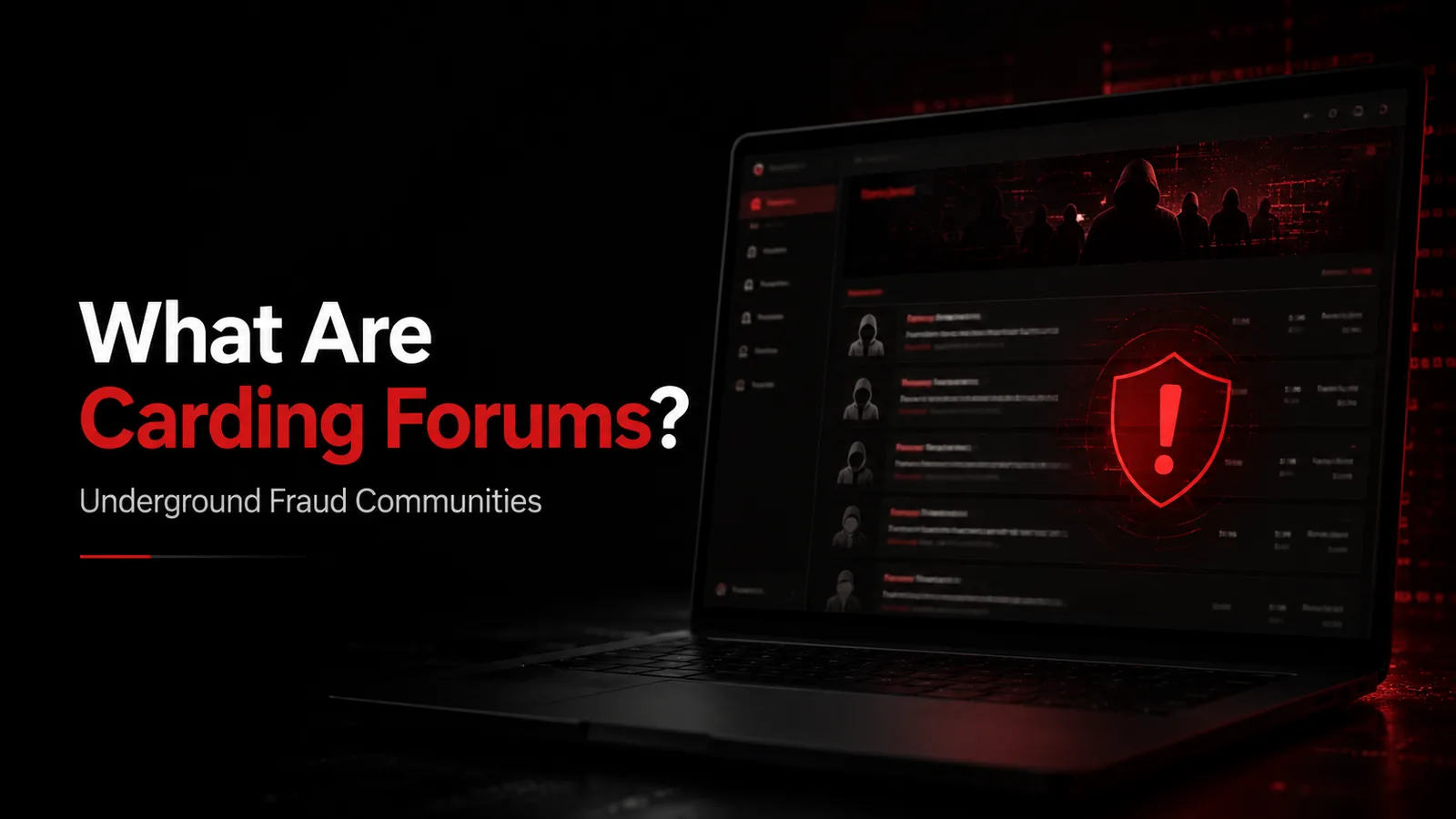
Carding forums are online communities associated with payment-card fraud, stolen financial information, identity crime, account compromise, and related cybercrime services. Historically, these communities have functioned as meeting places where criminals advertise illicit goods, exchange reputation information, recruit collaborators, discuss fraud trends, and direct users toward marketplaces or services.
The FBI has described carding forums as websites used by criminals engaged in carding to facilitate criminal activity. Europol's payment-fraud guidance similarly says compromised card details obtained through breaches, social engineering, malware, and phishing become available through forums, marketplaces, and automated card shops on the deep web and Darknet.
The term 'forum' can be misleading if it creates the impression of a simple message board. Mature underground communities can develop roles, reputation systems, moderators, paid advertising, private messaging, invitation systems, vendor sections, escrow-like trust mechanisms, and connections to other criminal services.
At the same time, underground fraud communities are notoriously untrustworthy. Participants can be scammed by other criminals, exposed by poor operational security, infiltrated by law enforcement, identified through seized servers, or caught when administrators, vendors, and buyers leave evidence behind.
This article explains carding forums from a defensive and educational perspective. It does not provide active forum names, links, access instructions, invitation methods, vendor recommendations, operational fraud tutorials, or guidance for buying or selling stolen payment information.
Quick Answer: What Is a Carding Forum?
A carding forum is an online criminal community where people involved in payment-card fraud and related cybercrime can communicate, advertise illicit goods or services, build reputations, exchange referrals, and connect with other participants.
Historically, these forums have been used to facilitate trafficking in stolen credit and debit card data, identity information, counterfeit documents, compromised accounts, malware, and other fraud-enabling services.
They may exist on the open web, deep web, Darknet, or encrypted communication platforms, and modern cybercrime communities increasingly move between several channels rather than remaining on one site.
A forum is not necessarily the same as a card shop or marketplace. Forums emphasize community, discussion, reputation, and networking, while automated shops focus more directly on listings and transactions.
Participation can expose users to criminal liability, financial scams, malware, extortion, law-enforcement investigations, and permanent digital evidence.
Why Are They Called Carding Forums?
The word 'carding' is commonly used for criminal trafficking or unauthorized use of payment-card information.
A carding forum is therefore a community organized around that broader fraud ecosystem.
The U.S. Department of Justice has described criminal carding forums as internet discussion groups created to facilitate buying and selling stolen financial-account information and related goods and services used in credit-card fraud.
The term became especially common during the 2000s and early 2010s, when dedicated message boards were a major way for participants to find one another.
Modern fraud communities can look different, but the basic role of connecting criminals remains.
Carding Forums vs Card Shops
A carding forum and a card shop are not the same thing.
A forum is primarily a community and communications environment.
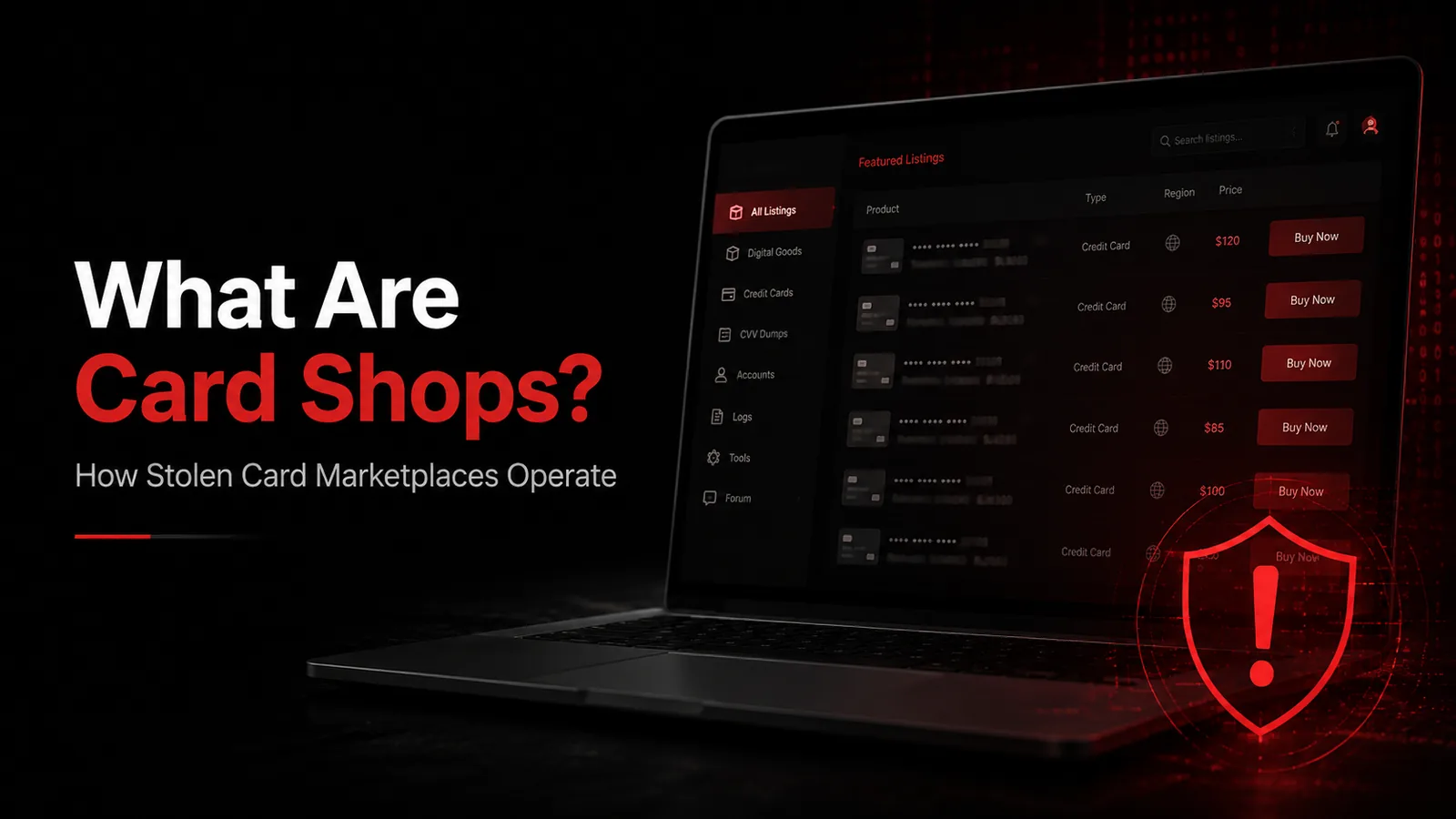
A card shop or automated marketplace is more directly structured around listings and transactions involving stolen payment information.
A forum may contain advertisements that point users toward shops, while a shop may maintain a forum or chat channel to provide announcements and support.
Europol's current payment-fraud guidance distinguishes forums, marketplaces, and automated card shops as overlapping parts of the underground ecosystem.
For defenders, understanding this distinction helps explain why shutting down one marketplace does not necessarily eliminate the surrounding community.
Carding Forums vs Dark Web Marketplaces
Dark web marketplaces can sell many categories of illicit goods rather than focusing on one fraud community.
Carding forums may be more specialized around payment fraud, identity data, account access, and fraud-enabling services.
Some forums operate or have operated on ordinary internet infrastructure, while others use anonymity networks or restricted access.
The phrase 'dark web' should therefore not be treated as synonymous with 'carding forum.'
The criminal ecosystem spans clear web, deep web, Darknet, messaging platforms, and other channels.
Are All Carding Forums on the Dark Web?
No.
Europol has long observed that underground criminal communities can exist across the open internet, deep web, Darknet, and private communication environments.
Some communities move between domains after takedowns or use ordinary web infrastructure combined with access controls.
Others rely on encrypted messaging to supplement or replace traditional forums.
The security lesson is that criminality depends on the activity, not on whether the platform uses a particular network technology.
How Underground Fraud Communities Are Structured
Criminal forums often try to imitate some features of legitimate online communities.
There may be administrators, moderators, long-term members, new members, advertisers, sellers, service providers, and users seeking information or access.
Reputation may be represented through account age, feedback, status labels, transaction history, endorsements, or membership tiers.
These mechanisms exist because criminals face a major problem: they cannot safely rely on ordinary legal contracts or consumer-protection systems when dealing with one another.
The resulting trust systems are imperfect and can themselves be manipulated.
Administrators and Moderators
Administrators and moderators can control forum accounts, sections, advertising, disputes, bans, private areas, or platform infrastructure.
These roles can make individuals especially valuable to law-enforcement investigations because administrators may have access to records connecting many participants.
Forum operators also face financial and technical risks from rivals, extortion, infrastructure seizures, and insider disputes.
Law-enforcement operations have repeatedly targeted the people and servers behind large cybercrime communities rather than only individual users.
The 2025 international disruption of the Cracked and Nulled cybercrime forums involved arrests, server seizures, device seizures, and financial seizures, illustrating the exposure created by centralized forum infrastructure.
Vendors and Advertisers
Underground forums may allow vendors to advertise stolen data or criminal services.
Offers can relate to compromised accounts, payment information, identity data, malware, phishing services, hosting, or other fraud-enabling resources.
Forums may charge advertising fees or offer special seller status.
None of these labels should be interpreted as evidence that the advertised material is authentic.
Criminal sellers frequently misrepresent quality, disappear with payments, recycle old data, or intentionally scam other criminals.
Reputation and Vouching
Because criminals cannot rely on courts to enforce an illegal sale, reputation becomes important inside underground communities.
Participants may rely on reviews, vouches, status badges, account history, or recommendations from established members.
But reputation systems are vulnerable to manipulation.
Fake reviews, compromised accounts, coordinated promotion, bribed moderators, insider relationships, and exit scams can all undermine apparent trust.
A highly rated criminal account is not equivalent to a regulated or accountable business.
Private Messages and Restricted Sections
Forums may use private messages or restricted areas for conversations not visible to all users.
Access can be based on account age, reputation, invitation, payment, or moderator approval.
From an investigative perspective, private does not mean unrecorded.
Server logs, account databases, messages, payment records, seized devices, backups, and cooperating witnesses can all create evidence.

One of the recurring mistakes in cybercrime is assuming that restricted access equals anonymity.
Why Criminal Forums Need Trust Systems
Underground markets face a basic economic problem: every participant knows the other person may be dishonest.
The seller may provide worthless data. The buyer may attempt to reverse or dispute a payment. A middleman may steal both sides' funds. An administrator may seize balances and disappear.
Forums therefore develop informal trust systems to make criminal trade possible.
Those systems can reduce friction, but they cannot create genuine legal accountability.
The result is an environment where fraudsters routinely become victims of fraud themselves.
Escrow-Like Services and Their Limits
Some underground communities have historically used escrow-like arrangements or trusted intermediaries.
The concept is meant to reduce the risk that one party disappears immediately after receiving payment.
But an illegal escrow operator has no regulated fiduciary obligation and can disappear with the money.
Forum administrators may also control the dispute process and have incentives that participants cannot independently verify.
The existence of an escrow label should never be interpreted as making an illegal transaction safe.
Why Carding Forums Are Full of Scams
Criminal communities are attractive environments for scammers because victims are often reluctant to report losses to law enforcement.
A person attempting to buy illegal material has limited legitimate recourse when another criminal steals the payment.
Common underground risks include fake vendors, fake administrators, impersonation, malware disguised as tools, fabricated data, advance-fee scams, blackmail, and exit scams.
Some communities also attract inexperienced users who are easy targets for criminals selling worthless tutorials or invented access.
The widespread presence of fraud against other fraudsters is one reason claims of 'trusted' underground services deserve skepticism.
What Is an Exit Scam?
An exit scam occurs when the operator of an illicit service or marketplace disappears with funds or balances belonging to users.
Because participants cannot rely on ordinary financial regulation or consumer-protection law, there may be little practical recovery.
Rumors of an exit scam can also trigger panic and conflict inside underground communities.
From a defensive perspective, the concept illustrates why criminal marketplaces cannot offer the protections of legitimate financial commerce.

The same anonymity participants seek can make accountability almost impossible.
Malware Risk Inside Criminal Communities
Files, tools, browser extensions, links, and software shared through underground forums can themselves contain malware.
Someone searching for a fraud tool may instead install an information stealer or remote-access malware that compromises their own device.
This creates a form of predator-versus-predator risk inside criminal ecosystems.
Security researchers should never treat underground downloads as trustworthy and should use lawful, controlled research environments and institutional procedures when examining malicious content.
Ordinary users should not download software from criminal communities at all.
Extortion and Doxxing Risks
Underground participants may collect personal information about one another and use it for threats, harassment, or extortion.
Disputes can lead to exposure of real names, photographs, addresses, phone numbers, financial accounts, or other identifying details.
Criminal communities do not provide reliable moderation or victim protection.
A person who joins expecting anonymity can become a target of the same social-engineering and data-theft techniques used against ordinary victims.
Anonymity claims therefore should be treated as highly uncertain.
What Types of Information Circulate in These Communities?
Law-enforcement and Europol reporting describes underground trade involving stolen credit and debit card information, compromised account credentials, personal identity information, malware, counterfeit documents, and fraud-related services.
The exact offerings vary by community and period.
Europol says compromised payment-card details stolen through breaches, social engineering, malware, and phishing can become available through forums, marketplaces, and automated shops.
This movement of stolen information between specialized actors is one reason payment fraud operates as an ecosystem rather than a single criminal act.
This article intentionally does not reproduce listings, prices, active sellers, or instructions for purchasing any such material.
The Crime-as-a-Service Connection
Underground forums help connect people who specialize in different parts of cybercrime.
One group may steal credentials, another may sell access, another may provide malware, another may launder proceeds, and another may specialize in payment fraud.
Europol has described this specialization as part of the broader crime-as-a-service economy.
The forum acts as a networking layer that allows people with different criminal skills to find services without building every capability themselves.
That specialization can increase scale but also creates dependencies law enforcement can target.
How Stolen Card Data Reaches Forums
Stolen payment information can originate from data breaches, phishing, malware, physical skimming, digital skimming, compromised merchants, or account takeover.
Europol specifically identifies breaches, social engineering attacks, data-stealing malware, and phishing as important sources of compromised card details.
Criminal forums and marketplaces can then become distribution channels for that information.
The important defensive insight is that card theft and card misuse may involve different people.
Stopping one stage of the chain can reduce opportunities for downstream fraud.
Why Data Gets Resold
Stolen data can move through multiple hands.
A person who steals credentials may not be the person who ultimately attempts payment fraud.
Intermediaries can aggregate, advertise, or redistribute compromised information.
This repeated circulation makes it difficult for victims to know exactly where exposure occurred.
It also means one breach can create fraud risk long after the original attacker has moved on.
Why Forum Listings Can Be Unreliable
Underground advertisements are not independently audited.
Data may be old, duplicated, already cancelled, fabricated, or obtained from another criminal source.
Sellers may exaggerate what they possess to collect payments.
Buyers may post false accusations in disputes.
Administrators may manipulate visibility for advertisers.
For defenders, this uncertainty is another reminder that underground commerce is inherently unstable and deceptive.
How Forums Recruit New Participants
Criminal communities can attract users through social media, messaging platforms, search results, videos, fake 'educational' claims, or referrals from other underground spaces.
Some scams intentionally market the idea that carding is easy or low-risk in order to sell worthless courses, fake access, or nonexistent data.
Young or inexperienced users may be particularly vulnerable to these narratives.
Fraud-awareness content should challenge the mythology rather than glamorize criminal communities.
There is no legitimate guaranteed-profit path through stolen payment information.
Why 'Educational Carding Groups' Can Still Be Dangerous
A group can describe itself as educational while distributing criminal instructions, stolen data, phishing tools, or links to illegal markets.
The label applied by the administrator does not determine whether the conduct is legal.

Users should distinguish defensive fraud education from operational guidance that enables unauthorized access or payment fraud.
Legitimate cybersecurity education uses controlled labs, authorized test data, legal bug-bounty programs, academic research, and defensive simulations.
It does not require real victims' payment credentials.
Open Web, Dark Web, and Encrypted Messaging
Modern underground fraud communities are not confined to one type of platform.
Traditional forums may connect to encrypted messaging channels, marketplaces, and other services.
Law enforcement has observed criminal ecosystems spanning ordinary websites and anonymity-focused platforms.
This hybrid structure helps communities migrate after disruptions but also creates additional technical and human points of exposure.
The more platforms participants use, the more metadata, accounts, devices, contacts, and financial traces may exist.
Are Carding Forums Anonymous?
No platform can promise perfect anonymity.
Participants can reveal themselves through reused usernames, email addresses, cryptocurrency records, IP logs, device evidence, payment accounts, private messages, operational mistakes, or relationships with other suspects.
Administrators can also retain information users do not realize is being logged.
Infrastructure can be seized and analyzed.
Law-enforcement history repeatedly demonstrates that people who believed they were communicating inside criminal communities can later be identified.
Law Enforcement Can Operate Undercover
Criminal forums create opportunities for undercover investigations.
One well-known historical example is the FBI's Operation Card Shop, a two-year undercover carding investigation announced in 2012.
The FBI and Justice Department said the operation led to arrests across multiple countries and protected hundreds of thousands of potential victims while preventing substantial estimated losses.
The operation is important because it demonstrates a central reality of underground communities: participants cannot reliably know who is on the other side of an account.
A person advertising criminal services may be communicating with law enforcement.
Historical Example: Operation Card Shop
In 2012, U.S. authorities announced an international cybercrime takedown following an undercover investigation focused on carding activity.
The FBI described carding forums as websites used by carders to facilitate criminal activity involving stolen payment information and related services.
Authorities announced 24 arrests in eight countries initially, with additional arrests later bringing the reported total higher.
The Justice Department said the operation protected more than 400,000 potential cybercrime victims and prevented more than $205 million in estimated losses.
The case remains a useful educational example of how forum activity can create evidence and investigative opportunities rather than guaranteed anonymity.
Recent Example: Large Cybercrime Forum Takedowns
Cybercrime forum disruptions continue today.
In January 2025, Europol announced the takedown of two of the world's largest cybercrime forums in an international operation.
Europol said the two platforms together had more than 10 million users and that authorities seized servers, electronic devices, cash, and cryptocurrency.
The U.S. Justice Department separately said one of the targeted platforms had millions of users and tens of millions of posts advertising stolen information and cybercrime tools.
These were broader cybercrime forums rather than carding-only platforms, but the operation illustrates the vulnerability of centralized underground communities.
Recent Example: Criminal Card Marketplace Seizures
Law enforcement also targets platforms focused more directly on stolen payment data.
In June 2025, the U.S. Secret Service announced the seizure of approximately 145 domains associated with a criminal marketplace that trafficked stolen credit-card information and other personal data.
The seized data described by authorities included credit-card numbers, expiration dates, and card-verification information.
A marketplace is structurally different from a discussion forum, but the enforcement lesson is similar: domains, servers, payment trails, administrators, and customer records can become investigative evidence.
Users should not interpret longevity or popularity as proof that an underground platform is beyond law enforcement.
Why Server Seizures Matter
A seized server can contain far more than the public pages users remember seeing.
Potential evidence can include account records, private messages, administrator logs, IP data, payment records, uploaded files, databases, backups, and moderation history, depending on what the service retained.
Investigators can correlate digital evidence with devices, financial transactions, email accounts, cryptocurrency activity, and other investigations.
This is why deleting a forum account later does not guarantee that historical evidence disappears.
Data retention can outlast the visible platform.
Cryptocurrency Does Not Guarantee Anonymity
Underground communities frequently use cryptocurrency because it can move value without traditional card payments.
But cryptocurrency transactions can create durable blockchain records.
Investigators can combine blockchain analysis with exchange records, seized devices, forum messages, and other evidence.
The level of traceability varies by asset and transaction structure, but 'paid in crypto' should not be equated with 'untraceable.'
Law-enforcement seizures regularly include cryptocurrency associated with cybercrime investigations.
Why Usernames Can Become Evidence
A pseudonym can create a false sense of separation from a real identity.
Users often reuse handles across forums, messaging services, gaming sites, email accounts, developer platforms, and social media.
Even when the same name is not reused, writing style, time zone, contact relationships, payment history, or device evidence may connect accounts.
Criminal investigations commonly combine multiple weak identifiers rather than relying on one perfect clue.
The safest way to avoid this risk is not to participate in illegal communities.
Why Deleted Accounts Are Not Necessarily Gone
Deleting an account may remove the visible profile without erasing all records.
Backups, logs, messages quoted by other users, administrator records, payment histories, screenshots, law-enforcement copies, and data from other participants may remain.
A forum itself may also be compromised before a user decides to leave.
Digital evidence can persist in many independent locations.
This undermines the idea that participation can always be erased afterward.
Legal Risks
Buying, selling, trafficking, or using stolen payment information can violate criminal laws in many jurisdictions.
Other offenses can arise from identity theft, unauthorized computer access, wire fraud, money laundering, conspiracy, possession or trafficking of access devices, and related conduct.
The exact charges depend on the jurisdiction and facts.
Simply reading publicly available reporting about criminal forums is different from participating in transactions or criminal activity.
Anyone conducting legitimate research should follow institutional legal and ethical procedures and avoid interacting with stolen credentials or illegal services without appropriate authorization.
Why Forum Users Can Become Victims
Participation can expose users to financial loss, malware, identity theft, extortion, threats, and law-enforcement scrutiny.
A criminal seller may collect identification or payment information from a buyer and later use it for blackmail.
Malicious downloads can compromise the buyer's device.
A fake forum may exist primarily to steal cryptocurrency.
An administrator may disappear with deposits.
The same ecosystem built around victimizing outsiders also victimizes its own participants.
Why Businesses Should Understand Carding Forums
Businesses do not need to visit criminal communities themselves to benefit from understanding them.
Fraud teams should know that compromised credentials may be redistributed, combined with other data, and resold after a breach.
This helps explain why fraudulent activity can continue even after the original compromise has been contained.

Threat-intelligence providers, payment networks, law enforcement, and specialist security firms can provide lawful intelligence without requiring ordinary merchant staff to interact with illegal markets.
The goal is to understand downstream risk, not participate in the underground ecosystem.
How Payment Providers Use Threat Intelligence
Payment networks and fraud-prevention teams can monitor patterns associated with compromised credentials and known criminal activity.
Issuers may replace cards or raise fraud monitoring when account numbers are identified as compromised.
Merchants may use transaction analytics, device intelligence, authentication, velocity controls, and other risk signals to stop downstream misuse.
Threat intelligence is most effective when connected to actual fraud controls rather than treated as interesting information alone.
Businesses should obtain intelligence through lawful professional channels.
What Consumers Should Know
Consumers do not need to monitor carding forums personally.
If a card is exposed in a breach, the practical response is to work with the issuer, enable transaction alerts, review statements, and replace the card when recommended.
An unfamiliar charge should be reported promptly.
If passwords or broader identity information were also compromised, consumers may need additional account-security or identity-theft protections.
Searching criminal forums for your own card number can expose you to scams, malware, and illegal content without providing reliable assurance.
Do Not Pay Someone to 'Remove' Your Card From a Forum
Scammers sometimes exploit fear around breaches by claiming they can remove stolen information from criminal markets for a fee.
There is no reliable way for an unknown third party to guarantee that every copy of compromised payment information has been deleted.
Card credentials can be duplicated and redistributed.
The safer response is to replace or secure the affected credential through the issuing bank rather than paying an unverified 'removal' service.
If broader identity information is involved, use official identity-theft and credit-protection resources.
Can Researchers Study Carding Forums Legally?
Legitimate academic, law-enforcement, cybersecurity, and threat-intelligence research can study underground ecosystems under appropriate legal, ethical, and institutional controls.
Researchers should define the authorization and scope before collecting data or interacting with participants.
They should avoid unnecessary possession of real victim data and follow applicable privacy, evidence-handling, and reporting requirements.
Organizations may use specialized vendors or counsel when research creates legal uncertainty.
Defensive research is different from buying stolen information or requesting criminal services.
Safer Ways to Learn About Underground Fraud
You do not need direct forum access to understand how the ecosystem works.
Useful lawful sources include Europol threat assessments, FBI and Justice Department cases, Secret Service investigations, payment-network fraud reports, PCI SSC guidance, academic research, and reputable cybersecurity threat-intelligence reporting.
These sources provide evidence about criminal structures, takedowns, fraud methods, and defensive lessons without requiring participation.
For students and security professionals, controlled cyber ranges and synthetic datasets provide safer environments for studying fraud detection.
Real stolen credentials should never be necessary for ordinary training.
How Law Enforcement Disrupts Underground Communities
Investigations can target administrators, vendors, infrastructure, domains, payment systems, cryptocurrency flows, hosting providers, and individual users.
Techniques can include undercover operations, search warrants, server seizures, domain seizures, international cooperation, financial investigation, device forensics, and arrests.
The exact investigative methods are sensitive and vary by case.
Public enforcement announcements show that cybercrime communities are not separate from the physical world: servers exist somewhere, administrators use devices, money moves, and people make mistakes.
International coordination is particularly important because forums and their users often span many countries.
Why Takedowns Do Not End the Ecosystem
When a major forum disappears, users can migrate to another platform.
New forums can emerge, messaging channels can replace traditional boards, and sellers can rebuild reputations elsewhere.
This resilience is one reason law enforcement combines platform disruption with arrests, financial seizures, infrastructure action, and intelligence collection.
Businesses likewise need continuous fraud controls rather than assuming one famous takedown permanently removes the threat.
Underground communities adapt, but every migration creates friction and new opportunities for detection.
How Forum Disruptions Help Defenders
Even when a criminal community later reappears elsewhere, disruption can have value.
It can remove infrastructure, expose administrators, seize funds, identify users, create distrust, interrupt transactions, and generate intelligence for additional investigations.
Repeated disruption also increases the cost of operating criminal services.
For financial institutions, intelligence produced through these investigations can contribute to credential monitoring and fraud prevention.
The objective is not always one permanent shutdown; it can be sustained pressure on the ecosystem.
Why Carding Forums Are Not 'Hacker Communities' in the Legitimate Sense
Legitimate cybersecurity communities study systems, share defensive research, disclose vulnerabilities responsibly, build security tools, and conduct authorized testing.
Carding communities center on unauthorized payment information and fraud-enabled commerce.
Conflating the two unfairly associates lawful security researchers with financial crime.
Ethical hacking requires permission and defined scope.
Using stolen payment credentials or victim accounts is not a substitute for authorized security testing.
Common Myths About Carding Forums
Myth: Carding forums are anonymous and safe from law enforcement. Reality: undercover operations, infrastructure seizures, device forensics, and international investigations have repeatedly identified participants.
Myth: A highly rated vendor must be trustworthy. Reality: reputation systems can be manipulated and criminal sellers have no enforceable legal obligations.
Myth: All carding forums are on the dark web. Reality: criminal communities can operate across ordinary websites, Darknet services, marketplaces, and encrypted messaging.
Myth: Forums only discuss credit cards. Reality: underground communities can overlap with stolen identities, credentials, malware, account access, counterfeit documents, and other cybercrime services.
Myth: Cryptocurrency makes transactions untraceable. Reality: crypto activity can create durable records and has repeatedly been seized or analyzed in cybercrime investigations.
Myth: Deleting an account deletes the evidence. Reality: logs, messages, backups, devices, payment records, screenshots, and seized server data may persist.
Myth: Joining only to learn is automatically harmless. Reality: direct participation can expose users to illegal content, malware, scams, and investigations; lawful public sources are safer for education.
Conclusion
Carding forums are best understood as social infrastructure for payment fraud.
They allow criminals to find one another, advertise illicit services, build reputations, exchange referrals, and connect stolen information with people who want to exploit it.
But the same features that make a forum useful to criminals can create evidence for investigators. Accounts, messages, administrators, servers, payments, cryptocurrency transactions, devices, and social relationships all create potential investigative leads.
Historical cases such as Operation Card Shop demonstrated the effectiveness of undercover forum operations, while modern international takedowns continue to show that even very large cybercrime communities can lose their domains, servers, funds, devices, and administrators.
For consumers, the lesson is not to visit underground forums after a breach. Secure the payment account through the issuer.
For businesses, the lesson is to understand that stolen data can circulate through a broader ecosystem after compromise and to combine breach prevention with credential monitoring, authentication, fraud analytics, and rapid card replacement.
For researchers and students, lawful reports from law enforcement, Europol, payment networks, and professional threat-intelligence organizations provide a much safer path to understanding underground fraud than attempting to join it.