
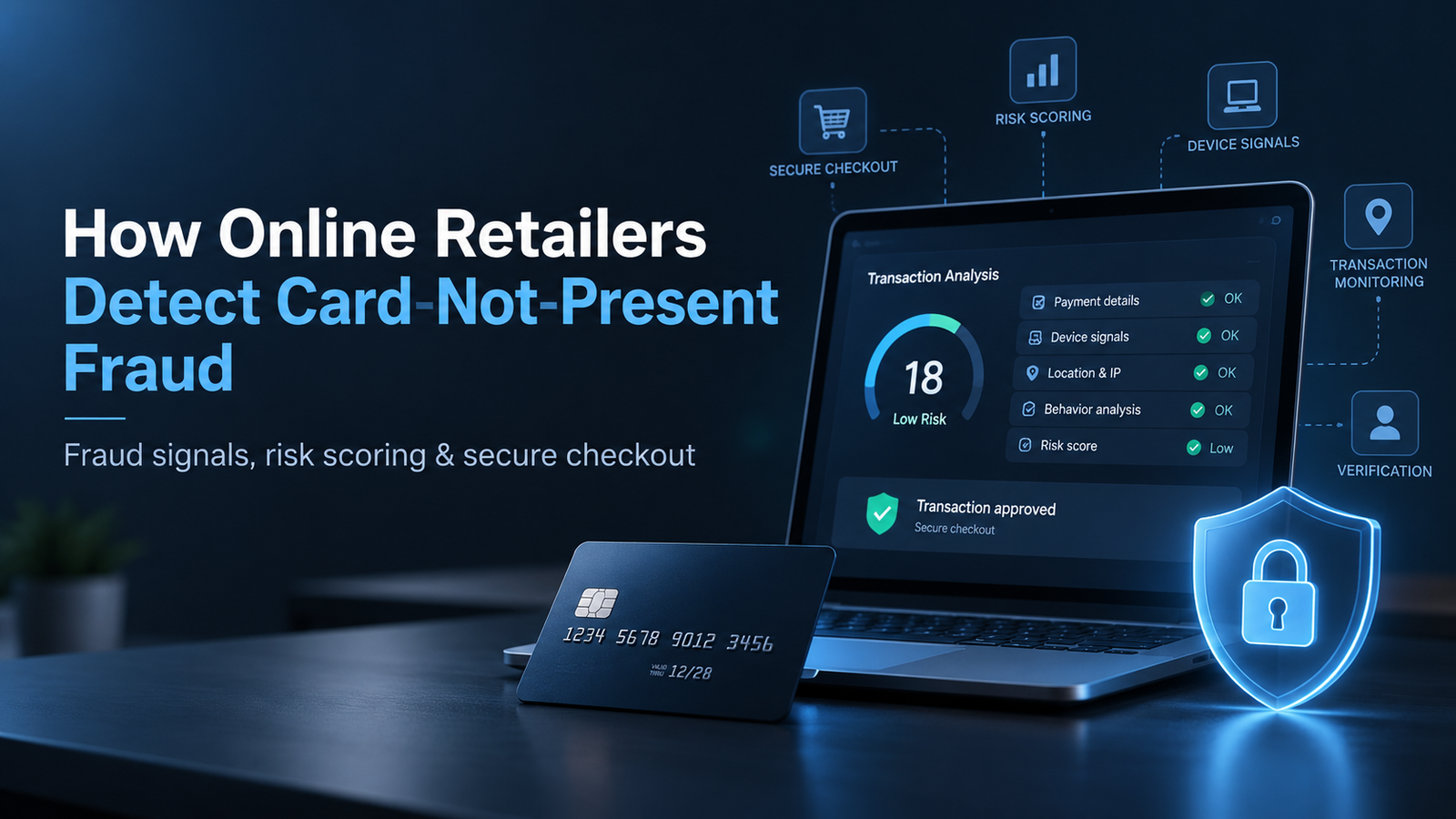
Online retailers cannot physically inspect a customer's payment card during an ecommerce purchase. That makes card-not-present (CNP) fraud detection a data problem: merchants must decide whether a remote transaction appears consistent with a legitimate customer or shows signs of unusual risk.
Modern retailers rarely rely on one signal. Fraud systems combine payment information, device and network context, account behavior, purchase history, authentication results and transaction patterns to estimate risk before or during authorization.
The objective is not to block every unusual order. It is to identify combinations of signals that justify stronger authentication, review or rejection while allowing legitimate customers to check out with as little unnecessary friction as possible.
Quick answer: Online retailers detect card-not-present fraud by combining multiple signals - such as transaction history, device and location context, account behavior, AVS/CVV results, payment authentication and velocity patterns - into a risk decision. Higher-risk transactions may be challenged with 3-D Secure, sent for manual review or declined according to the merchant's fraud policy.
What Is Card-Not-Present Fraud Detection?
Card-not-present fraud detection is the process of evaluating remote card transactions for signs that the payment or customer account may be unauthorized.
Unlike a physical checkout, an online merchant cannot rely on seeing the card or interacting with the buyer face to face. Instead, the merchant and its payment providers analyze the digital context surrounding the transaction.
Why Retailers Use Layered Fraud Detection
No single fraud signal is reliable enough to make every decision. A billing-address mismatch can be caused by a typo. A new device can belong to a legitimate returning customer. A high-value order can be completely normal.
Layered detection reduces this problem by looking at several independent signals together. A transaction becomes more concerning when multiple unusual indicators appear at the same time.
1. Transaction Risk Scoring
Many ecommerce fraud platforms calculate a risk score for each transaction. The score is based on patterns learned from historical data and the specific details of the current order.
- Transaction amount and product type
- Customer and account history
- Device and browser context
- Geographic consistency
- Payment verification results
- Purchase velocity and recent activity
- Authentication outcomes
The merchant can then use the score as one input in a broader decision. A low-risk purchase may proceed normally, while a higher-risk transaction may require additional authentication or manual review.

2. Device and Browser Signals
Fraud systems often examine the device used for checkout. The goal is not simply to identify a specific computer or phone, but to understand whether the device context is consistent with the customer's expected behavior.
- Whether the device has been seen on the account before
- Browser and operating-system characteristics
- Signs of unusual automation or repeated attempts
- Changes in device context immediately before a high-risk purchase
Device signals are most useful when combined with other evidence. A first-time device should not automatically be treated as fraud.
3. IP Address and Geolocation Consistency
A retailer may compare the apparent network location of the shopper with other information in the order.
For example, a transaction can receive additional scrutiny when the IP location, billing address, shipping destination and card-issuer geography are unexpectedly inconsistent. Stripe's fraud guidance identifies inconsistent geolocation as one common warning signal for online stores.
However, geographic differences can also be legitimate because customers travel, use mobile networks, purchase gifts and use cards issued in countries different from their current location.
4. Account and Login Behavior
Retailers with customer accounts can evaluate activity before the checkout itself.
- A login from an unfamiliar device or location
- A password reset followed immediately by a high-value purchase
- A sudden change to shipping or contact details
- Unusual changes to saved payment methods
- Purchases that differ sharply from the account's normal history
These patterns can help identify possible account takeover, especially when several occur close together.
5. Velocity and Repeated Attempt Patterns
Velocity checks look at how frequently transactions or payment attempts occur within a period of time.
A sudden burst of many payment attempts, repeated small authorizations or multiple cards used from the same device can be suspicious. Stripe describes card testing as a pattern that can appear as many authorization attempts over a short period, often connected to the same IP address or device fingerprint.

Effective detection focuses on unusual patterns rather than exposing fixed merchant thresholds that could become predictable.
6. AVS Results
Address Verification Service (AVS) compares billing-address information supplied during checkout with information available to the card issuer where AVS is supported.
- Full match can be a reassuring signal.
- Partial match may justify additional context or review.
- No match can increase risk depending on the transaction.
- Unavailable results should not automatically be treated as fraud.
AVS is a risk signal rather than an identity check. Legitimate customers can produce mismatches because of address changes, formatting differences or entry mistakes.
7. CVV or CVC Verification
Card verification codes such as CVV2, CVC2 or CID are commonly requested during card-not-present transactions to help verify that the shopper has access to the card's security value.
PCI Security Standards Council guidance permits merchants to request these values for authorization but prohibits storing them after authorization. A CVV mismatch can increase transaction risk, but it should still be interpreted alongside other signals.
8. EMV 3-D Secure Authentication
EMV 3-D Secure (3DS) is an ecommerce fraud-prevention protocol that allows merchants and issuers to exchange transaction, payment and device information so the issuer can authenticate the consumer.
EMVCo explains that this data exchange helps issuers identify fraudulent card transactions quickly and accurately while minimizing unnecessary checkout friction.
Low-risk transactions can often proceed without an additional customer challenge, while higher-risk transactions may require the cardholder to complete an authentication step.
9. Behavioral Signals
Fraud detection can also consider how an order fits the customer's or merchant's broader behavioral patterns.
- Unusual order size or product mix
- Purchasing behavior inconsistent with prior account activity
- Rapid changes in shipping details
- Repeated failed payment attempts before a successful order
- Clusters of similar suspicious activity across accounts or devices
Behavioral analysis is useful because fraud often appears as a pattern rather than as one obviously fraudulent field.
10. Payment Tokenization and Credential Context
Tokenization helps retailers reduce exposure of the underlying Primary Account Number and can provide additional context about the payment credential.

Network tokens can be associated with a merchant, device or payment scenario, making them less reusable outside their intended environment. This does not replace fraud detection, but it can reduce the value of compromised card data and strengthen the payment architecture.
11. Shipping and Fulfillment Risk Signals
Retailers can also evaluate the fulfillment side of an order.
- Unexpected changes from the customer's normal delivery pattern
- Orders routed to unusual destinations compared with account history
- High-risk combinations of order value, product type and delivery behavior
- Multiple customer accounts repeatedly using the same delivery destination in unusual ways
These signals should be used carefully because legitimate gifts, travel and shared households can create similar patterns.
12. Manual Review for Ambiguous Orders
Automated systems are useful at scale, but some merchants retain manual review for transactions that fall into an uncertain risk range.
A reviewer may examine the consistency of the order, account history, payment verification results and fulfillment information. The goal should be to resolve uncertainty without requesting unnecessary sensitive information from the customer.
What Happens After a Transaction Is Flagged?
A fraud alert does not always mean an order is automatically declined. Retailers can respond in several ways depending on risk and business policy.
Possible response | Typical purpose |
|---|---|
Approve | Allow a low-risk transaction to continue. |
Request authentication | Use 3-D Secure or another legitimate verification step for higher-risk activity. |
Manual review | Have a trained reviewer assess an ambiguous transaction. |
Hold fulfillment | Delay shipment while a legitimate risk review is completed. |
Decline | Reject a transaction when the overall risk exceeds the merchant's acceptable threshold. |
How Machine Learning Helps Detect CNP Fraud
Large payment networks and fraud platforms increasingly use machine learning to evaluate complex patterns across transactions.
Visa describes CNP-focused fraud systems that model long-term cardholder and merchant behavior and use contextual information to improve risk scoring. Machine learning is valuable because it can identify combinations of signals that are difficult to express as simple fixed rules.
It should still be used with good governance, performance monitoring and controls designed to limit unnecessary false positives.
Why False Positives Matter
A fraud system that blocks too many legitimate customers can damage conversion rates and customer trust.
This is why modern fraud prevention aims to distinguish suspicious behavior from legitimate variation. Risk-based authentication, for example, can allow low-risk purchases to proceed with minimal friction while challenging transactions that need stronger verification.

Fraud Detection vs Fraud Prevention
Detection identifies suspicious activity. Prevention uses that information to reduce the chance that an unauthorized payment succeeds.
- Risk scoring detects unusual combinations of transaction signals.
- 3-D Secure can authenticate the customer when additional confidence is needed.
- Tokenization reduces exposure and reuse value of payment credentials.
- AVS and CVV provide supporting verification signals.
- Manual review can resolve uncertain cases.
- Secure account controls can reduce account takeover risk.
What Retailers Should Avoid
- Do not rely on one fraud indicator as universal proof of fraud.
- Do not publish or expose exact internal fraud thresholds or decision rules.
- Do not store CVV/CVC data after authorization.
- Do not weaken customer authentication simply to reduce checkout friction.
- Do not treat every international or first-time customer as suspicious.
- Do not collect excessive sensitive information during manual review.
A Practical Layered Detection Model
A mature online retailer typically combines several layers rather than searching for one perfect fraud signal.
- Secure checkout and payment-data protection
- Tokenization where supported
- AVS and CVV/CVC verification where applicable
- Device, account and geolocation context
- Velocity and behavior analysis
- Machine-learning or rules-based risk scoring
- EMV 3-D Secure or SCA when appropriate
- Manual review for genuinely ambiguous transactions
- Post-purchase monitoring and dispute analysis
Frequently Asked Questions
How do online retailers know if a card payment is fraudulent?
They usually do not rely on one piece of information. Retailers combine payment, device, account, location, authentication and behavioral signals to estimate transaction risk.
What is the most important CNP fraud signal?
There is no single universal signal. Multiple independent indicators considered together are usually more reliable than any one field.
Can AVS detect card-not-present fraud?
AVS can identify billing-address matches or mismatches where supported, but it does not authenticate the shopper and should be combined with other controls.
Does CVV prevent online fraud?
CVV/CVC verification adds another security signal, but it cannot prevent every type of fraud. PCI DSS also prohibits merchants from storing the code after authorization.
How does 3-D Secure help retailers detect fraud?
EMV 3DS exchanges transaction, payment and device information with the issuer so the issuer can assess risk and authenticate the consumer when necessary.
What is device fingerprinting in fraud detection?
It generally refers to evaluating device and browser characteristics to help determine whether a transaction is consistent with expected customer behavior.
How do retailers detect card testing?
Fraud systems can detect unusual velocity patterns such as bursts of repeated authorization attempts linked to the same device, IP address or account context.
Do online stores manually review orders?
Some do. Manual review is commonly used for ambiguous or higher-risk transactions that automated systems cannot confidently classify.
Can fraud detection accidentally block legitimate customers?
Yes. False positives are a major challenge, which is why retailers use layered signals and risk-based authentication rather than relying only on rigid rules.
Final Thoughts
Online retailers detect card-not-present fraud by looking for patterns across the entire transaction, not by searching for one magic warning sign.
Transaction risk scores, device and geolocation context, account behavior, AVS/CVV results, tokenization, velocity analysis and EMV 3-D Secure can each contribute a different piece of evidence.
The strongest systems use these signals together, apply stronger authentication when risk justifies it, and reserve manual review for uncertain cases. That layered approach helps retailers reduce fraud while minimizing unnecessary friction for legitimate customers.
Authoritative References
- EMVCo - EMV 3-D Secure
- Visa - Visa Secure with EMV 3-D Secure
- Visa - AI Solutions for Fraud Prevention and Detection
- Stripe - Online Store Fraud: Types, Detection, and Prevention
- PCI Security Standards Council - Card Verification Codes in CNP Transactions
Editorial note: This article is defensive and educational. Fraud-detection systems should protect their internal thresholds and decision rules while giving customers clear, lawful verification paths.