


Introduction
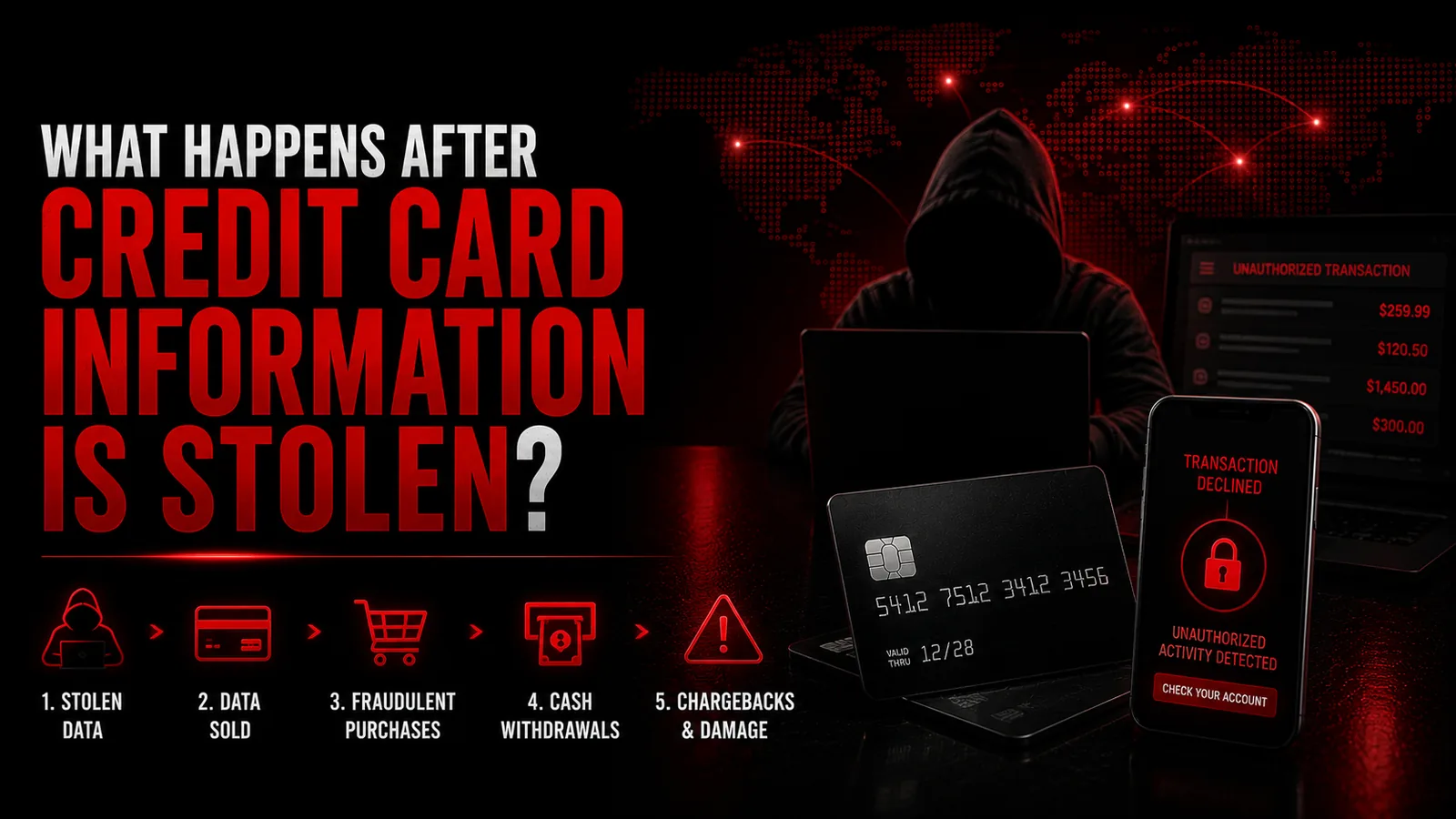
When credit card information is stolen, the compromise itself is only the beginning of the incident. What happens next depends on what information was exposed, how quickly the cardholder or issuer notices, whether unauthorized transactions are attempted, and whether the stolen data is part of a larger identity-theft or account-takeover incident.
In many cases, banks and payment networks detect suspicious activity before the customer notices anything. In other cases, the first warning is an unfamiliar charge, a declined purchase, a security alert, or a replacement card arriving unexpectedly.
The important point is that stolen payment-card information does not automatically mean every attempted transaction will succeed. Modern payment systems use authentication, transaction monitoring, device intelligence, fraud scoring, merchant controls, and issuer risk systems to detect and block suspicious activity.
This guide explains the post-compromise lifecycle from a defensive perspective: what criminals may try to do at a high level, what banks and merchants do in response, what consumers may experience, and what steps can reduce further harm.
First: What Does 'Stolen Credit Card Information' Mean?
Stolen credit card information can refer to different combinations of payment and identity data. A compromise might involve only the primary account number, or it might also expose the cardholder name, expiration date, billing information, security code, account login credentials, or other personal data.
The amount and type of information exposed matters because different data creates different risks. A stolen card number does not automatically provide access to online banking, and payment systems may still require authentication or reject suspicious transactions.
PCI Security Standards Council standards are designed to protect payment-account data wherever it is stored, processed, or transmitted. Reducing unnecessary exposure and storage of sensitive data is a core part of limiting the impact of breaches.
Stage 1: The Card Information Is Compromised
Payment information can become compromised through phishing, malware, data breaches, account takeover, physical skimming, e-skimming, social engineering, or compromised merchant infrastructure.
Visa notes that payment fraud can involve stolen credit or debit card details as well as other forms of unauthorized payment activity. PCI SSC also provides merchants with guidance for protecting customer payment data and reducing the risk of payment-data theft.
At this point, the cardholder may have no idea that anything has happened. A compromise can remain invisible until the issuer detects risk or an unauthorized transaction appears.
Stage 2: The Information May Be Used or Circulated
After payment information is stolen, it may be misused directly or circulated within criminal ecosystems. The exact path varies widely, and stolen information may never be successfully used at all.
Criminal payment-fraud markets can involve different participants who obtain, trade, or attempt to exploit compromised credentials. From a defensive perspective, the key fact is that stolen data may be copied and distributed, so replacing a compromised credential is often safer than assuming one blocked transaction ends the problem.
This is also why merchants and issuers monitor patterns across multiple transactions rather than treating each suspicious purchase as an isolated event.
Stage 3: Unauthorized Transactions May Be Attempted
If compromised card information is used, the payment request still has to pass through the normal payment authorization process.
The issuer and merchant may evaluate factors such as transaction history, authentication results, merchant information, device or account signals, unusual spending behavior, and other risk indicators.

A suspicious transaction may be approved, declined, challenged with additional authentication, or routed for further review. The outcome depends on the payment environment and the controls used by the issuer, merchant, payment processor, and network.
Why a Stolen Card Number Does Not Guarantee a Successful Purchase
Modern payment security uses multiple layers. A card number may be only one part of the information evaluated during authorization.
For online payments, systems may also use customer authentication, device information, account history, fraud scores, or EMV 3-D Secure. For card-present transactions, EMV chip technology can provide dynamic transaction security.
This is why compromised credentials can be blocked even when the information appears complete. It is also why criminals continually change tactics as payment security improves.
Stage 4: The Bank or Card Issuer May Detect Suspicious Activity
Issuers continuously analyze payment activity for patterns that differ from normal customer behavior. Visa describes fraud detection and transaction monitoring as essential tools for reducing payment losses and protecting customers.
When suspicious activity is detected, an issuer may decline the transaction, temporarily restrict the card, ask the cardholder to confirm whether a purchase is legitimate, or replace the account credential.
Consumers may therefore receive a fraud alert before noticing an unauthorized charge themselves. Transaction notifications can make this process faster by allowing cardholders to recognize suspicious activity quickly.
Stage 5: The Cardholder May Notice an Unauthorized Charge
For many consumers, the first visible sign of compromise is an unfamiliar transaction.

Other warning signs can include purchase alerts they did not initiate, repeated small charges, unexpected authentication messages, unusual login activity, or a legitimate purchase being declined because the issuer has already restricted the account.
The FTC recommends reviewing credit-card statements regularly so mistakes and unauthorized charges can be identified promptly.
Stage 6: The Card May Be Locked, Cancelled, or Replaced
Once a card is confirmed or strongly suspected to be compromised, the issuer may block the existing credential and issue a replacement.
This step helps prevent additional unauthorized transactions tied to the compromised card number. The cardholder may need to update legitimate recurring payments or saved payment methods after receiving the new card.
The exact process varies between financial institutions. Cardholders should use the issuer's official app, the number on the back of the card, or trusted contact information from an account statement when reporting suspicious activity.
Stage 7: Unauthorized Charges Can Be Disputed
Consumers should report unauthorized charges promptly. In the United States, the Consumer Financial Protection Bureau advises cardholders to contact the card company right away when disputing a charge, while the FTC provides guidance on billing disputes and unauthorized transactions.
U.S. federal protections vary by payment product. CFPB guidance states that liability for unauthorized credit-card use may be limited, while debit-card protections can depend more heavily on how quickly the problem is reported.
Rules differ by country, so consumers should follow the laws, issuer policies, and dispute procedures applicable to their jurisdiction.
Stage 8: The Merchant May Receive a Fraud Claim or Chargeback
When an unauthorized card payment has already been completed, the merchant may later receive a dispute or chargeback.
A merchant can lose the transaction value and may also have already shipped goods or provided services. This is one reason payment fraud affects more than the cardholder and bank.
Merchants use fraud tools, transaction evidence, authentication records, shipping information, and account history to evaluate disputes and reduce future fraud losses.
A chargeback does not automatically mean the merchant acted improperly. It is part of the payment ecosystem's process for resolving disputed transactions.
What Happens If the Stolen Information Includes More Than the Card Number?
Sometimes a payment-card incident is part of a broader identity compromise. If names, addresses, login credentials, government identifiers, or other personal information are also exposed, the risks can extend beyond unauthorized card purchases.
The FTC defines identity theft as the unauthorized use of someone's personal or financial information. Depending on what was stolen, criminals may attempt account takeover, impersonation, or other forms of fraud.
Consumers who believe broader identity information was compromised may need additional protections such as changing passwords, securing email accounts, reviewing credit reports, or considering fraud alerts or credit freezes where those tools are available.
Can Stolen Card Information Be Used After the Card Is Replaced?
Replacing the card generally invalidates the compromised card credential for ordinary future transactions, but consumers should still monitor accounts.
Some recurring-payment systems can receive updated card credentials through legitimate account-updater services, and separate account credentials may remain at risk if passwords or other identity information were also compromised.
That is why card replacement should be combined with reviewing account security rather than treated as the only response when the compromise may extend beyond the card number.
What Happens to Recurring Payments?
Replacing a card can affect legitimate subscriptions, memberships, utilities, and other recurring payments.
Some merchants may automatically receive updated credentials through payment-network services, while others may require the customer to enter the new card manually.
After replacing a compromised card, review important recurring payments and update them through trusted merchant channels where necessary.
What Should You Do Immediately If Your Card Information Is Stolen?
1. Contact the card issuer immediately using an official channel.
2. Lock or freeze the card if your issuer provides that option.

3. Report any unfamiliar transactions.
4. Follow the issuer's card-replacement and dispute instructions.
5. Review recent account activity for additional unauthorized transactions.
6. Change passwords for relevant financial, shopping, and email accounts if account compromise is possible.
7. Enable multi-factor authentication where available.
8. Continue monitoring your account after the initial incident.
9. If broader identity information was exposed, follow official identity-theft recovery guidance for your country.
Why Reporting Quickly Matters
Prompt reporting can help prevent additional losses. The FTC advises consumers to report lost or stolen cards and unauthorized activity immediately, while CFPB guidance likewise encourages consumers to contact their card provider quickly when suspicious charges appear.
Fast reporting gives the issuer an opportunity to restrict the compromised account, replace the credential, investigate transactions, and guide the customer through the dispute process.
Do not rely on contact details contained in suspicious emails or text messages. Use the bank's official app, website, statement, or the number printed on the card.
Should You Change Your Passwords?
If the incident involved only a payment-card number, changing unrelated passwords may not always be necessary. But if the card was stored in a compromised online account, or if phishing, account takeover, or email compromise may be involved, changing relevant passwords is a sensible precaution.
Prioritize the email account associated with financial services because email often controls password resets. Use unique passwords and multi-factor authentication wherever possible.
Should You Freeze Your Credit?
A stolen card number alone does not automatically mean someone can open new credit accounts in your name.
However, if a breach also exposed identity information that could support new-account fraud, a credit freeze or fraud alert may be appropriate in countries where those tools are available. The FTC notes that credit freezes and fraud alerts can help protect consumers from identity theft.
The right response depends on what information was actually exposed, so consumers should distinguish between payment-card compromise and broader identity theft.
What Banks Do After a Card Is Compromised
Banks and card issuers may block the card, replace the account number, monitor related transactions, investigate disputed charges, update fraud models, and notify the customer.
They may also share fraud signals through payment-network systems or use patterns from one incident to identify related suspicious activity.
The exact response depends on the issuer, payment network, type of card, transaction channel, and applicable regulation.

What Merchants Do After Stolen Card Data Is Used
Merchants may investigate the transaction, stop an order before fulfillment, review account and device signals, respond to a dispute, and adjust fraud controls if a pattern emerges.
Businesses that discover a payment-data compromise may also need to investigate the security incident, contain affected systems, notify appropriate parties, and follow payment-industry and legal requirements.
PCI DSS establishes baseline technical and operational requirements for protecting payment-account data and is central to reducing the risk of future compromise.
How Merchants Can Reduce the Impact of Stolen Card Data
Use secure payment providers and minimize unnecessary storage of sensitive payment data.
Maintain applicable PCI DSS controls.
Use tokenization where appropriate to reduce exposure of underlying card numbers.
Protect e-commerce payment pages and third-party scripts.
Use strong authentication for merchant administrative accounts.
Apply transaction monitoring and fraud analytics.
Use EMV 3-D Secure where appropriate for e-commerce authentication.
Train employees against phishing and social engineering.
Create rapid procedures for stopping fulfillment when fraud is detected before goods or services are delivered.
Common Myths
Myth: If the physical card is still in your wallet, the account cannot be compromised. Reality: card-not-present fraud can occur using stolen payment information while the cardholder still possesses the card.
Myth: One blocked transaction means the problem is over. Reality: compromised credentials may have been copied, so issuers often replace the card rather than relying on one decline.
Myth: A stolen card number automatically gives access to online banking. Reality: payment-card credentials and banking login credentials are different, although broader account compromise can involve both.
Myth: Only the cardholder loses money. Reality: merchants, banks, payment processors, and other businesses may also absorb fraud and investigation costs.
Myth: Every dispute proves the merchant committed fraud. Reality: disputes can result from stolen-card fraud, billing mistakes, service disagreements, or first-party misuse.
Conclusion
What happens after credit card information is stolen depends on both the criminal activity and the defenses surrounding the payment account.
The stolen data may never be successfully used. An attempted transaction may be blocked. A bank may detect suspicious behavior before the customer notices. Or an unauthorized charge may appear and trigger card replacement, disputes, merchant investigation, and broader identity-protection steps.
The strongest response is fast and layered: report suspicious activity, replace compromised credentials, secure related accounts, monitor for additional misuse, and treat broader identity exposure seriously.
For merchants and financial institutions, the lesson is equally important: protecting payment data before it is stolen is only one part of the problem. Authentication, fraud detection, secure payment environments, tokenization, and rapid incident response are all essential to reducing harm after compromise occurs.