
Address Verification Service (AVS) can return several different results after a merchant submits billing-address information with an eligible card payment. Those results are often represented by short response codes such as Y, A, Z, N, U or R, or by a payment provider's own normalized result.
Understanding the result matters because an AVS response is not simply 'pass' or 'fail.' It may show a full match, a partial match, a mismatch, an unavailable result or a situation where only part of the address could be checked.
Quick answer: AVS response codes describe how the billing street address and postal or ZIP code supplied during a payment compare with the information available to the card issuer. A full match is generally a positive signal, while partial matches, mismatches and unavailable results should be evaluated together with other fraud and authorization signals.
What Is an AVS Response Code?
An AVS response code is the result returned after billing-address information is checked against issuer records. The code helps the merchant or payment provider understand whether the street address, postal code or both matched.
Different card networks and payment processors can use different raw codes or map those codes into simpler categories. For that reason, merchants should use their processor's official documentation when implementing automated rules.
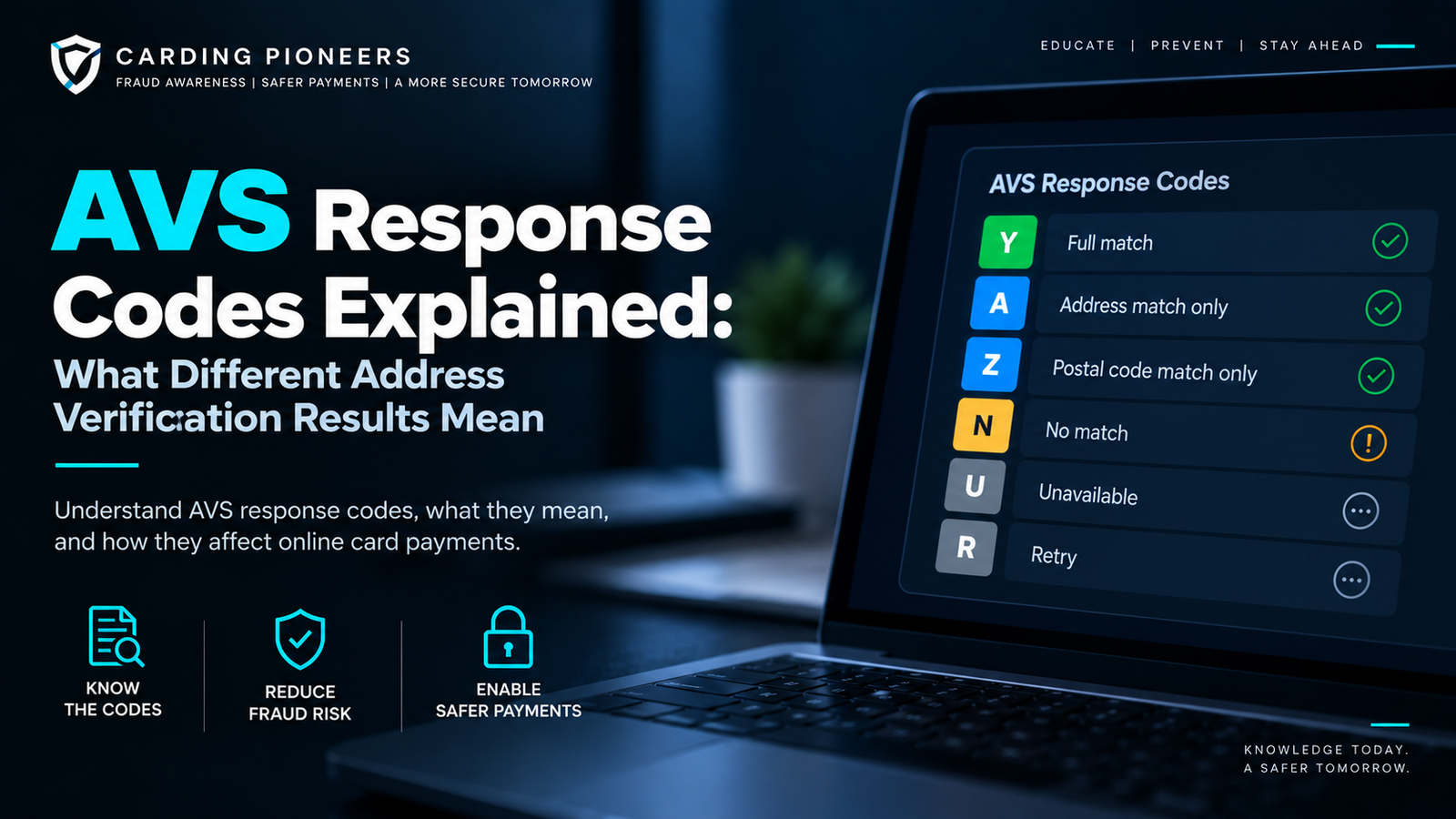
The Most Common AVS Results at a Glance
Visa's current developer documentation summarizes its modern address-verification outcomes into six common results. These are useful for understanding the core AVS concepts even though other networks and processors may use different raw values.
Common code | Result | What it generally means |
|---|---|---|
Y | Full match | Street address and postal/ZIP information match. |
A | Partial match - address | Street address matches, but postal/ZIP information does not. |
Z | Partial match - postal code | Postal/ZIP information matches, but the street address does not. |
N | No match | The checked address information does not match. |
U | Unable to verify | The address could not be verified or a usable AVS result was not available. |
R | Retry / indeterminate | The verification system was unavailable or timed out; the result may be retried. |
These codes should be treated as verification signals rather than universal approval or decline instructions. A card issuer can approve a transaction even when AVS produces a partial or unavailable result, and a full AVS match does not guarantee that a transaction is legitimate.
What Does a Full AVS Match Mean?
A full AVS match means the relevant street-address and postal-code information matched the issuer's records. Visa currently represents a full match with code Y in its simplified result set.
This is generally reassuring, but it should still be combined with authorization, authentication, CVV/CVC results, device or behavioral signals and the merchant's overall risk assessment.
What Does 'Address Matches, Postal Code Does Not' Mean?
A partial address match means the street-address portion matched while the postal or ZIP code did not. Visa commonly represents this type of result with code A.
Legitimate reasons can include an outdated postal code on file, a recent move, formatting differences or customer entry errors. It can also be a risk signal, so merchants should avoid making a decision from AVS alone.

What Does 'Postal Code Matches, Address Does Not' Mean?
This is another partial match. The postal or ZIP code matches, but the street-address information does not. Visa commonly uses code Z for this result.
A postal-code-only match is less specific than a full address match. It should be considered together with other information about the transaction rather than treated as automatic proof of fraud.
What Does an AVS No-Match Result Mean?
A no-match result indicates that the address information checked did not match the issuer records. Visa represents this with code N in its simplified result set.
A no-match result deserves attention, especially in a card-not-present transaction, but there are legitimate reasons for mismatches. Examples include typing mistakes, outdated account information, international address formatting and differences between billing and shipping details.

What Does 'AVS Unavailable' Mean?
An unavailable result means the address could not be verified at that moment or the issuer did not return a usable verification result. Visa's simplified code U represents an unable-to-verify outcome.
Adyen similarly groups several raw network responses into an 'AVS unavailable' category, including situations where the issuer does not support the check, no data is available, or the system is unavailable.
What Does an AVS Retry Result Mean?
A retry or indeterminate result typically means the address-verification system could not complete the check because of a timeout or temporary system problem. Visa uses code R for this outcome.
This differs from a confirmed mismatch: the system was unable to produce a reliable comparison.
Why AVS Codes Differ Between Payment Providers
Merchants may see different codes depending on their payment gateway, acquirer, network and reporting interface. A provider can translate several network-specific responses into a smaller set of normalized results.
For example, Adyen maps raw AVS responses into numeric categories such as address match with postal mismatch, neither matching, AVS unavailable, postal match with address mismatch, and full address-plus-postal match.
This is why copying an AVS-code table from one payment provider into another system can create mistakes. Always use the documentation for the processor actually handling the transaction.
AVS Response Code vs Payment Authorization Result
An AVS result and a payment authorization result answer different questions.
- AVS asks whether submitted billing-address information corresponds with issuer records.
- Authorization asks whether the issuer approves the payment transaction.
A transaction can therefore be authorized while AVS returns a partial match, unavailable result or even a mismatch. Likewise, a full AVS match does not guarantee authorization because the issuer can decline a payment for unrelated reasons.

How Merchants Should Interpret AVS Results
AVS works best as one part of a layered fraud-prevention strategy. A merchant can use the result as a risk signal while considering the broader context of the payment.
- Full match: generally positive, but continue normal authorization and fraud checks.
- Partial match: investigate the transaction context rather than treating it as an automatic decline.
- No match: consider stronger review, authentication or risk controls based on the merchant's policy.
- Unavailable or retry result: recognize that no reliable address comparison was completed.
- Repeated unusual mismatches: review alongside device, account, transaction and authentication signals.
Why Legitimate Customers Can Receive AVS Mismatches
- The customer recently moved and the issuer still has the old billing address.
- The shopper entered a shipping address instead of the billing address.
- Apartment, unit or house-number formatting differs between systems.
- Postal-code formats vary by country.
- The issuer or network does not fully support the requested AVS comparison.
- The customer made a typing mistake.
- International address normalization produces a partial or unavailable result.
Because false mismatches are possible, merchants should avoid designing AVS rules that unnecessarily block legitimate customers.
AVS Response Codes and Card-Not-Present Fraud
AVS is especially relevant to card-not-present payments because the merchant cannot physically inspect the payment card. Comparing billing details with issuer records adds another signal that can help identify suspicious transactions.
However, AVS does not authenticate the shopper's identity and should not replace technologies such as 3-D Secure or Strong Customer Authentication where those controls apply.
AVS vs CVV: Different Security Signals
AVS and CVV/CVC checks measure different things. AVS compares billing-address information, while a card verification code check evaluates the security value presented with the card payment.
A merchant may receive a positive AVS result and a negative CVV result, or the reverse. The combined pattern can be more informative than either signal on its own.
International AVS Results and Availability
AVS availability and behavior are not identical worldwide. Adyen notes broad support for Visa, Mastercard, Discover and American Express, while issuer support and verification requirements vary by country and region.
International address formats can also produce responses indicating that the address could not be fully verified. Merchants serving multiple countries should therefore use region-aware risk rules rather than assuming one AVS response has exactly the same significance everywhere.
Should Merchants Automatically Decline Every AVS Mismatch?
Not necessarily. A mismatch can be useful evidence, but automatic rejection of every mismatch can increase false declines and frustrate legitimate customers.
A stronger policy evaluates AVS together with transaction value, authentication status, account history, device signals, CVV/CVC results, shipping details and issuer authorization.

Frequently Asked Questions
What does AVS code Y mean?
In Visa's current simplified result set, Y means a full match: the relevant street-address and postal/ZIP information matched.
What does AVS code A mean?
A generally indicates a partial match where the street address matches but the postal or ZIP code does not.
What does AVS code Z mean?
Z generally means the postal or ZIP code matched but the street address did not.
What does AVS code N mean?
N means the checked address information did not match.
What does AVS code U mean?
U indicates that the address could not be verified or that a usable verification result was not available.
What does AVS code R mean?
R generally means retry or indeterminate outcome because the verification system was unavailable or timed out.
Does an AVS mismatch mean a card is stolen?
No. A mismatch can result from fraud, but it can also occur because of outdated information, formatting differences or user error.
Does a full AVS match guarantee a safe payment?
No. AVS is one fraud-risk signal and should be used with authorization, authentication and other security checks.
Are AVS codes the same for every payment processor?
No. Networks and payment providers can use different raw or normalized codes. Merchants should follow their own provider's documentation.
Final Thoughts
AVS response codes are most useful when they are interpreted as context rather than as a simple pass-or-fail verdict. A full match can support confidence in a transaction, while partial matches, mismatches and unavailable results can help a merchant decide when additional review or authentication may be appropriate.
The most important point is that AVS verifies address information, not the identity of the shopper. Merchants should use AVS together with authorization, authentication, CVV/CVC checks and broader fraud-prevention signals.
Authoritative References
- Visa Developer - Address Verification Results / Request and Response Codes
- Adyen Docs - Address Verification System (AVS)
- Adyen Docs - AVS responses for point of sale
- Stripe Docs - Card verification checks
Editorial note: This article is educational and focused on payment-fraud awareness. AVS result codes vary by network and processor, so merchants should always follow the documentation for their actual payment provider.