


Introduction
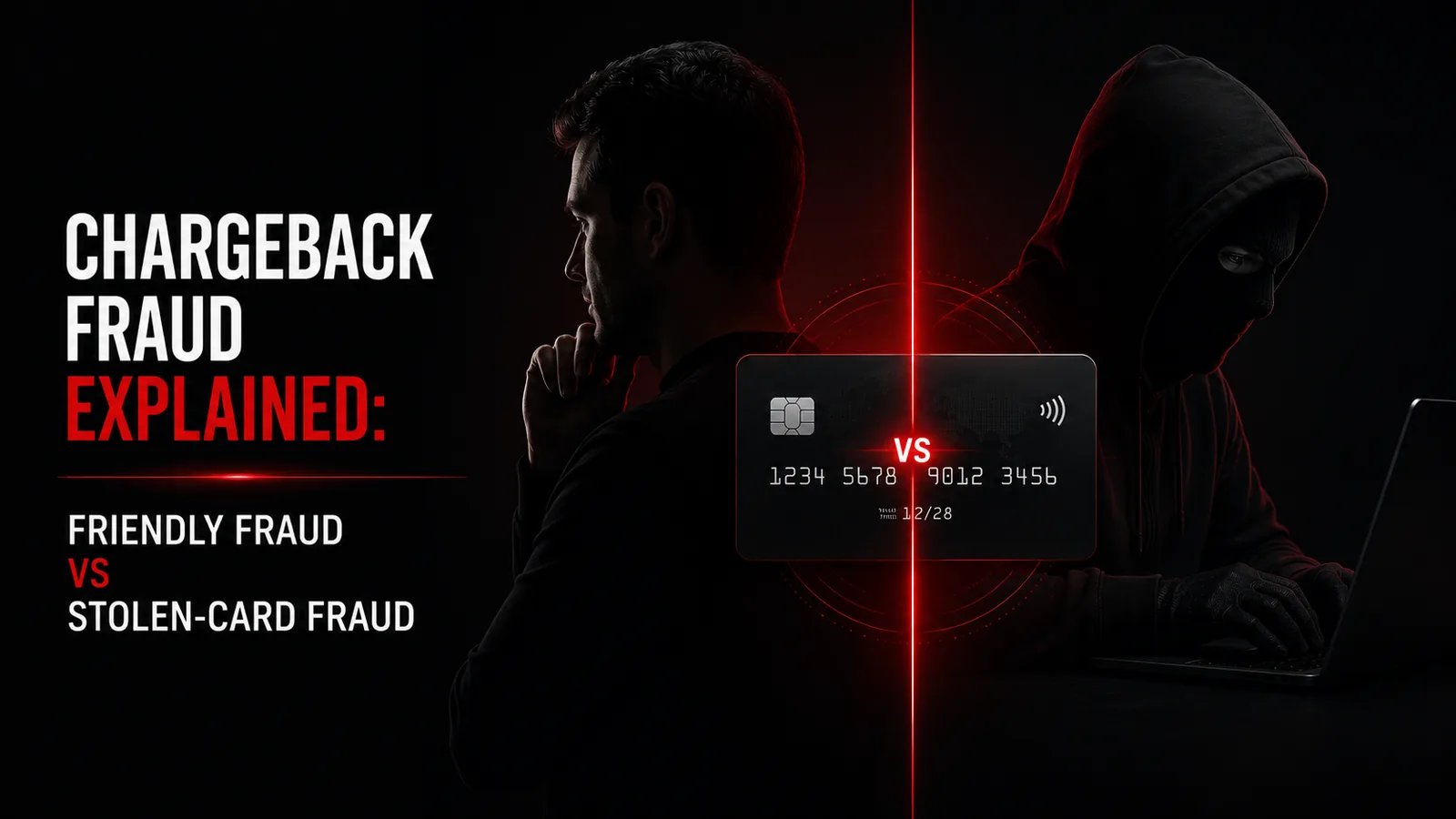
Chargebacks are an important consumer-protection mechanism, but not every chargeback has the same cause. Some disputes arise because a card was genuinely stolen or used without permission. Others arise when the real cardholder disputes a transaction they actually made or authorized. That second category is often called friendly fraud, first-party misuse, or chargeback abuse.
Visa defines friendly fraud, also called first-party misuse, as a situation in which a cardholder disputes a legitimate purchase. Mastercard similarly distinguishes first-party fraud from third-party fraud involving stolen credentials.
The distinction matters because merchants need different defenses. Stolen-card fraud is primarily prevented before authorization through authentication, tokenization, fraud scoring, device and account signals, and issuer controls. Friendly fraud is often reduced through clearer billing descriptors, better customer communication, proof of delivery or usage, transparent subscription terms, pre-dispute data sharing, and strong dispute evidence.
This article explains the difference defensively. It does not provide scripts, timing strategies, reason-code gaming, evidence fabrication, or other techniques for abusing the chargeback system.
Quick Answer: Friendly Fraud vs Stolen-Card Fraud
Friendly fraud or first-party misuse happens when the legitimate cardholder disputes a transaction that they actually made, authorized, or benefited from. Sometimes this is deliberate; sometimes it begins with confusion, forgotten purchases, family-member use, unclear merchant descriptors, subscription misunderstandings, or dissatisfaction handled through the card issuer instead of the merchant.
Stolen-card fraud is different. It happens when an unauthorized third party uses compromised payment credentials without the cardholder's permission.
Both can create chargebacks, but the evidence and prevention strategy differ. A merchant facing stolen-card fraud needs stronger transaction authentication and fraud detection. A merchant facing friendly fraud needs stronger transaction recognition, customer communication, fulfillment records, account history, and dispute evidence.
What Is a Chargeback?
A chargeback is a payment reversal initiated through the cardholder's issuer after a transaction is disputed and the applicable network process supports reversing the transaction.
Chargebacks exist to protect consumers from unauthorized use, billing errors, non-delivery, defective goods, and other qualifying disputes. They are not designed as a substitute for dishonest refund claims.
Visa describes the dispute process as beginning when the cardholder challenges a transaction, after which the merchant and acquirer may review records and respond. CFPB guidance likewise tells U.S. consumers to contact their card company when disputing a credit-card charge.
Chargeback Is Not the Same as a Refund
A refund is generally initiated by the merchant or service provider. A chargeback is initiated through the cardholder's issuer and payment-network dispute process.
Merchants often prefer legitimate complaints to be resolved through ordinary refund or customer-service channels because chargebacks create additional operational cost and dispute risk.
Consumers still have the right to use applicable dispute protections. Merchants should never pressure customers to surrender valid legal rights.
What Is Friendly Fraud?
Friendly fraud is the common industry term for a dispute involving a transaction that was actually made or authorized by the cardholder but is later reported as unauthorized or otherwise disputed in a way that improperly shifts the loss to the merchant.
Visa increasingly uses the term first-party misuse, which better reflects that the cardholder is the person initiating the disputed transaction rather than an outside thief.
Friendly fraud can be intentional, but not every mistaken dispute is deliberate fraud. Confusion, forgotten orders, family-member purchases, merchant-name mismatch, recurring billing, and poor customer service can all create disputes that resemble first-party fraud.
Why “Friendly Fraud” Is a Misleading Name
There is nothing friendly about a dishonest chargeback. The phrase developed as a way to distinguish disputes initiated by the real cardholder from third-party stolen-card fraud.
First-party misuse is often a more precise term because it focuses on who is responsible for the disputed purchase.
Merchants should still avoid automatically accusing every confused customer of fraud. Good dispute management begins by determining whether the problem is criminal misuse, customer confusion, merchant error, or a genuine service complaint.
What Is Stolen-Card Fraud?
Stolen-card fraud occurs when someone uses payment credentials without the legitimate cardholder's authorization.
The criminal may have obtained the card number through phishing, e-skimming, malware, data breaches, account takeover, physical theft, or other compromise.
When the real cardholder notices the unauthorized transaction, they may dispute it through the issuer. This is a legitimate fraud dispute, not friendly fraud.
The Core Difference: Who Authorized the Transaction?
The most important distinction is authorization.
If an outside fraudster used stolen credentials, the dispute is third-party fraud.
If the legitimate cardholder made or authorized the purchase and later falsely claims they did not, the issue is first-party misuse.
If the cardholder genuinely does not recognize a purchase made by a household member or the merchant descriptor is confusing, the dispute may be accidental rather than intentionally fraudulent.
This is why transaction-recognition data can prevent some disputes before they become formal chargebacks.
Why Merchants Should Not Treat Every Chargeback as Fraud
Chargebacks can arise from unauthorized use, billing errors, goods not received, defective goods, canceled services, duplicate processing, refund failures, subscription confusion, or customer dissatisfaction.
A merchant that labels every dispute as fraud may miss operational problems in shipping, product quality, support, billing descriptors, or cancellation flows.
Dispute analytics should therefore classify root causes rather than track only total chargeback volume.
How Friendly Fraud Commonly Starts: Transaction Confusion
A cardholder may see a merchant descriptor on their statement that does not match the storefront name they remember.
Visa offers transaction-recognition and pre-dispute tools specifically because clearer merchant and order information can prevent disputes caused by confusion or misinterpretation.

Merchants should use recognizable billing descriptors where possible and provide support contact details that customers can find quickly.
How Friendly Fraud Commonly Starts: Forgotten Purchases
Customers can forget one-time online purchases, digital content, preorders, travel deposits, or purchases placed weeks before fulfillment.
Clear receipts, shipment notifications, order histories, and merchant descriptors reduce this problem.
For delayed fulfillment, proactive communication is especially important because a charge may appear long before the customer receives the product.
How Friendly Fraud Commonly Starts: Family or Household Purchases
A spouse, child, employee, or other authorized person may use the card without the primary cardholder remembering the purchase.
The primary cardholder then reports the transaction as unknown.
Merchants should maintain account-login, device, fulfillment, and customer-history records that can help issuers distinguish household confusion from genuine third-party theft where lawful and appropriate.
How Friendly Fraud Commonly Starts: Subscription Confusion
Recurring billing is a major source of disputes when renewal terms, trial conversion, cancellation procedures, or billing frequency are unclear.
Merchants should present recurring terms before purchase, obtain appropriate consent, send confirmations, make cancellation straightforward, and notify customers where required or useful before material renewals.
Avoid dark patterns. Making cancellation intentionally difficult may increase disputes and create regulatory risk.
How Friendly Fraud Commonly Starts: Dissatisfaction
Some customers file chargebacks because they are unhappy with a product or service rather than using the merchant's refund or complaint process.
In some cases, the dispute may be legitimate if the merchant failed to deliver or honor its obligations. In others, the customer may keep the goods and seek a reversal anyway.
Clear refund policies and responsive customer service can resolve many problems before a formal dispute begins.
Deliberate First-Party Misuse
Deliberate first-party misuse occurs when a cardholder knowingly disputes a legitimate transaction in order to retain both the purchase and the money.
This is the clearest form of friendly fraud.
Visa and Mastercard both describe first-party misuse as a material merchant problem because it creates revenue loss, inventory loss, dispute expense, and operational cost.
Why Stolen-Card Fraud Looks Different to the Merchant
In true stolen-card fraud, the person placing the order may have no legitimate history with the cardholder.
The transaction can exhibit account, device, authentication, location, velocity, or fulfillment anomalies that fraud systems can evaluate before approval.
Modern controls such as EMV 3-D Secure, tokenization, account-takeover detection, machine-learning risk scoring, and issuer authorization are therefore particularly relevant to stolen-card fraud.
Why Friendly Fraud Can Be Harder to Detect Before Purchase
Friendly fraud may look completely legitimate at authorization time because the real cardholder is making the purchase.
The correct card, device, billing details, account history, and authentication may all be present.
This makes traditional fraud scoring less effective against first-party misuse than against stolen-card fraud.

Stripe and card-network guidance both note that friendly fraud is difficult to identify at the original transaction because the payer may be the genuine cardholder.
Prevention Strategy 1: Make Transactions Easy to Recognize
Use a clear billing descriptor that resembles the customer-facing brand where processor and network rules permit.
Include contact information customers can use before filing a dispute.
Send receipts containing merchant name, date, amount, product or service, and order identifier.
Visa's pre-dispute solutions emphasize transaction transparency as a way to prevent inquiries from escalating into chargebacks.
Prevention Strategy 2: Improve Customer Service
Make it easy for customers to ask what a charge is, request cancellation where permitted, report delivery problems, or seek a legitimate refund.
A customer who can quickly resolve a problem with the merchant is less likely to escalate directly to the issuer.
Support teams should have access to transaction and order information without exposing unnecessary payment-card data.
Prevention Strategy 3: Keep Clear Fulfillment Evidence
Merchants should preserve order confirmation, shipment data, delivery status, pickup records, service-access logs, and relevant customer communication as appropriate to the business model.
For digital goods, evidence may include account access, download or usage history, device/account continuity, and customer communications, subject to privacy and applicable network rules.
The purpose is to document what actually happened, not to manufacture evidence after a dispute.
Prevention Strategy 4: Use Clear Subscription Terms
Subscription businesses should clearly disclose price, billing interval, trial conversion, renewal, cancellation, and refund terms before purchase.
Keep evidence that the customer accepted the terms.
Send receipts and account notifications so recurring charges are recognizable.
Merchants should follow applicable consumer-protection and recurring-billing laws in each market.
Prevention Strategy 5: Use EMV 3-D Secure for Appropriate Transactions
EMV 3-D Secure can help reduce stolen-card fraud by giving issuers richer data and the ability to authenticate higher-risk e-commerce transactions.
It can also create useful authentication evidence for disputes, depending on the transaction and network rules.
3DS does not prove that a future cardholder dispute is dishonest and does not prevent all friendly fraud.
Prevention Strategy 6: Use Tokenization and Account Security
Tokenization reduces exposure of reusable card numbers, while account security reduces the chance that a criminal can take over a legitimate customer account.
Use MFA for sensitive account actions, secure password recovery, monitor high-risk profile changes, and minimize raw PAN storage.
These controls primarily reduce third-party fraud rather than deliberate first-party disputes.
Prevention Strategy 7: Detect Account Takeover
Account takeover can be mistaken for friendly fraud if the order appears under a real customer account.
Merchants should monitor unusual logins, password resets, new devices, changed addresses, and other high-risk account events.
If the account itself was compromised, the legitimate cardholder may have a valid stolen-card or unauthorized-use dispute even though merchant records show their normal account.
Prevention Strategy 8: Use Pre-Dispute Resolution Tools
Card networks and payment providers offer tools that can provide transaction detail to issuers or cardholders before a formal chargeback is filed.
Visa describes pre-dispute solutions that use transaction transparency to clarify purchases and reduce unnecessary disputes.
These systems can be particularly valuable for transaction-recognition problems and some forms of friendly fraud.
Prevention Strategy 9: Track Repeat Dispute Patterns Carefully
A merchant may identify accounts with repeated patterns of purchases followed by disputes.
Historical behavior can inform risk and customer-management decisions, but merchants should not automatically punish customers for exercising legitimate dispute rights.
Use lawful, proportionate, documented controls and allow for merchant error, genuine theft, and customer confusion.
Prevention Strategy 10: Measure the Root Cause of Every Dispute
Classify disputes into categories such as unauthorized third-party fraud, first-party misuse, merchant error, delivery failure, subscription confusion, refund delay, duplicate billing, or product/service dissatisfaction.
This turns chargeback management into a source of operational intelligence.
If many disputes come from unclear descriptors, better fraud scoring will not solve the problem. If many come from stolen cards, stronger authentication and transaction risk controls may help.
What Is Representment?
Representment is the merchant or acquirer process of responding to a dispute with evidence showing why the transaction should not be reversed under the applicable rules.
Visa Acceptance Solutions describes dispute representment as gathering relevant transaction evidence to support the merchant's case.
Merchants should submit truthful, relevant, timely evidence. Evidence should never be altered or fabricated.
Examples of Useful Merchant Evidence
Depending on the dispute category and network rules, relevant evidence can include transaction records, customer communication, order details, proof of delivery, terms accepted by the customer, refund history, account history, authentication information, or evidence of prior undisputed transactions.
Not every evidence type applies to every dispute.
The acquirer, processor, or dispute-management platform should guide the merchant on current network requirements.
Evidence Must Match the Dispute
A long evidence packet is not necessarily a strong one.
Merchants should respond to the specific dispute category and show the facts that matter.
For an unrecognized transaction, recognizable order and account history may matter. For non-delivery, fulfillment evidence may matter. For a canceled recurring service, cancellation and billing records may matter.
Irrelevant evidence can create noise and slow review.
Do Not Fabricate Compelling Evidence
Never create fake delivery records, alter timestamps, modify customer messages, or invent consent after a dispute is filed.
Chargeback evidence should come from ordinary business records and verifiable systems.
Fabricating evidence can create legal, contractual, and payment-network consequences far beyond the original transaction amount.

What Is Compelling Evidence?
Card networks use specific frameworks that allow certain merchant evidence to help issuers evaluate whether a disputed transaction is consistent with prior legitimate activity or other verified history.
The exact eligibility requirements and evidence rules change over time and differ by network and dispute category.
Merchants should follow current processor, acquirer, Visa, or Mastercard guidance rather than relying on old internet checklists.
Visa and Friendly-Fraud Prevention
Visa describes friendly fraud as first-party misuse and offers pre-dispute, transaction-recognition, and representment capabilities designed to reduce unnecessary disputes and help merchants respond with stronger data.
The broader strategy is transparency: give issuers and cardholders enough accurate transaction information to recognize legitimate spending before it becomes a chargeback.
Mastercard and First-Party Trust
Mastercard has expanded First-Party Trust, a program designed to use enhanced transaction and merchant data to help issuers distinguish genuine first-party misuse from legitimate consumer claims.
Mastercard says the program is intended to reduce the financial and operational impact of friendly fraud on merchants while giving issuers better information earlier in the process.
Chargeback Fraud vs Friendly Fraud
The phrases are often used interchangeably, but “chargeback fraud” can be broader.
Chargeback fraud can describe deliberate abuse of the dispute process, including intentional first-party misuse.
Friendly fraud sometimes includes accidental disputes caused by confusion, so not every friendly-fraud event is necessarily deliberate criminal fraud.
Use precise language when training teams and analyzing disputes.
Friendly Fraud vs Refund Fraud
Refund fraud generally involves manipulating a merchant's refund process, such as falsely claiming a refund is owed.
Friendly fraud involves a cardholder dispute through the payment ecosystem.
The two can overlap in motivation but use different processes and require different controls.
Friendly Fraud vs Return Abuse
Return abuse involves misuse of a merchant's return policies, while chargeback abuse uses the card dispute mechanism.
A customer might engage in one, both, or neither.
Merchants should separately track return, refund, and chargeback abuse so one problem is not incorrectly treated as another.
Friendly Fraud vs True Customer Dispute
A genuine dispute can involve goods not received, incorrect billing, defective goods, or a merchant failing to honor cancellation or refund terms.
Such disputes should not be mislabeled as friendly fraud simply because the merchant disagrees with the customer.
Good merchants use chargeback data to identify service failures as well as abuse.
The Consumer Perspective
Consumers should dispute transactions they genuinely did not authorize or where valid billing-error or purchase-protection rights apply.
CFPB advises U.S. consumers to contact their credit-card company when disputing a charge and explains federal billing-error protections.
Consumers should also contact the merchant when practical for ordinary service or refund issues, although U.S. Regulation Z does not require a consumer to contact the merchant first before asserting a billing-error dispute.
The Merchant Perspective
Merchants can lose the transaction amount, product or service value, shipping cost, dispute fees, investigation time, and future processing flexibility when chargebacks accumulate.
Visa and Mastercard both describe friendly fraud as a significant merchant cost because the merchant may lose both revenue and inventory while also carrying operational expense.
The correct response is better evidence and prevention, not retaliating against legitimate complainants.
The Issuer Perspective
The issuer receives the cardholder claim and must evaluate it under applicable law and network rules.
Better transaction detail can help issuers distinguish an unknown-but-legitimate purchase from true unauthorized use.
This is why card networks are investing in first-party fraud and transaction-recognition systems that surface richer merchant and customer history.
The Acquirer and Processor Perspective
The merchant's acquirer or processor usually manages network dispute messages and merchant responses.

Merchants should follow current deadlines, reason categories, evidence requirements, and technical processes provided by these partners.
Dispute rules change, so merchants should not build permanent internal processes around an old reason-code chart.
Why Chargeback Ratios Matter
High dispute levels can increase cost, operational scrutiny, or network monitoring for merchants.
The exact program thresholds and consequences depend on the network, merchant profile, region, and current rules.
Merchants should monitor dispute ratios internally without publishing operational thresholds that could encourage abuse.
Why False Fraud Claims Harm the Payments Ecosystem
Dishonest disputes increase costs for merchants, acquirers, issuers, networks, and ultimately consumers.
They also consume investigative resources that should be available for genuine stolen-card victims.
When first-party misuse becomes common, merchants may increase friction, tighten refund policies, or raise prices, affecting legitimate shoppers as well.
How Merchants Can Reduce Stolen-Card Chargebacks
Use EMV 3-D Secure where appropriate, tokenization, strong account security, secure checkout architecture, machine-learning fraud scoring, device and account context, velocity controls, issuer authorization, and post-authorization monitoring.
Protect checkout pages against e-skimming and follow PCI DSS requirements.
These controls aim to stop unauthorized third-party transactions before fulfillment.
How Merchants Can Reduce Friendly-Fraud Chargebacks
Use recognizable billing descriptors, clear receipts, transparent subscription terms, easy customer support, clear refund and cancellation policies, proof of fulfillment, account history, transaction-recognition tools, pre-dispute resolution, and truthful representment evidence.
Friendly fraud is often a post-purchase trust and evidence problem rather than a stolen-credential detection problem.
Why One Fraud Model Cannot Solve Both Problems
A stolen-card transaction can look suspicious before checkout because the person using the credential is not the legitimate cardholder.
A first-party misuse transaction can look perfectly legitimate because the cardholder is genuine.
This means a merchant can have excellent pre-authorization fraud scoring and still suffer friendly fraud.
Success requires both pre-purchase fraud prevention and post-purchase dispute management.
Common Mistakes Merchants Make
Treating every chargeback as stolen-card fraud.
Assuming every cardholder dispute is dishonest.
Using unclear billing descriptors.
Allowing confusing subscription renewals.
Failing to preserve ordinary order and fulfillment records.
Responding to every dispute with the same evidence packet.
Ignoring chargeback root causes.
Focusing only on dispute win rate instead of prevention and customer experience.
Using outdated network rules or reason-code guidance.
Fabricating or overclaiming evidence.
How to Build a Better Chargeback Program
Assign ownership across payments, fraud, customer support, finance, fulfillment, and legal/compliance teams.
Classify disputes by root cause.
Measure dispute rate, fraud rate, refund rate, false declines, response success, customer contacts before dispute, and recurring-billing complaints.
Feed stolen-card chargebacks back into fraud models and feed friendly-fraud patterns into transaction-recognition and customer-history systems.
Review network and processor rules regularly.
Metrics That Matter
Total chargeback count alone is not enough.
Merchants should understand disputes by reason category, product, geography, payment method, customer tenure, fulfillment type, subscription status, and whether the transaction had authentication.
Measure how many disputes are prevented before chargeback, how many are resolved through customer support, and how many represent genuine merchant errors.
The objective is fewer avoidable disputes, not simply more aggressive representment.
Conclusion
Chargeback fraud is easiest to understand when merchants separate two very different risks.
In stolen-card fraud, the real cardholder never authorized the transaction. The merchant's challenge is to identify an unauthorized third party before goods or services are delivered.
In friendly fraud or first-party misuse, the transaction may have looked completely legitimate because the real cardholder made it. The challenge appears later, when the cardholder disputes the purchase.
That difference changes the defense. Stolen-card fraud requires strong authentication and transaction risk controls. Friendly fraud requires transaction recognition, transparent billing, customer communication, good records, pre-dispute resolution, and evidence that accurately reflects the customer relationship.
The strongest merchants do not simply fight more chargebacks. They prevent avoidable disputes, resolve legitimate complaints quickly, identify true unauthorized use, and build payment experiences that are both secure and easy for genuine customers to recognize.