

IIN stands for Issuer Identification Number. It is the standardized number at the beginning of a payment card's Primary Account Number (PAN) that identifies the institution responsible for issuing the card.
ISO/IEC 7812 defines the numbering system used for issuer identification and PANs. The American Bankers Association, which serves as the Registration Authority for ISO/IEC 7812, describes the modern IIN as an 8-digit identifier used to uniquely identify a card-issuing institution.
You will also see the term BIN, or Bank Identification Number. In modern payments, BIN is still widely used by banks, processors, merchants and fraud teams, but IIN is the formal standards terminology. In many everyday contexts, 'BIN' and 'IIN' refer to the same issuer-identification portion of the PAN.
Quick answer: An IIN is the issuer-identification portion at the beginning of a card's PAN. Under the current ISO/IEC 7812 framework, the IIN is 8 digits. BIN is the older and still widely used industry term for the same general concept.
What Does IIN Stand For?
IIN stands for Issuer Identification Number. Its purpose is to identify the institution that issued a card or other eligible identification credential within the ISO/IEC 7812 numbering system.
ISO/IEC 7812-1 specifies both the format of the Issuer Identification Number and the Primary Account Number. ISO/IEC 7812-2 defines application and registration procedures for IINs.
What Is a BIN?
BIN stands for Bank Identification Number. It is the traditional payments-industry term used for the issuer-identification digits at the beginning of a card number.
The word 'bank' can be misleading because not every card issuer is a traditional bank. That is one reason the standards terminology uses Issuer Identification Number rather than Bank Identification Number.
IIN vs BIN: What Is the Difference?
For most practical payment discussions, the difference is mainly terminology rather than function.
Feature | IIN | BIN |
|---|---|---|
Full name | Issuer Identification Number | Bank Identification Number |
Status | Formal ISO/IEC 7812 terminology | Widely used industry terminology |
Purpose | Identifies the card-issuing institution | Used for the same issuer-identification function in payment operations |
Modern length | 8 digits under the current ISO/IEC 7812 framework | Often called an 8-digit BIN in modern payment systems |
Why the wording differs | Works for bank and non-bank issuers | Legacy wording assumes a bank issuer |
Why Did IINs Expand From 6 Digits to 8 Digits?
For many years, issuer identification was based on the first six digits of the PAN. As the number of card-issuing institutions and payment products expanded globally, the available six-digit issuer-identification space became increasingly constrained.

ISO revised the standard to expand the IIN from six digits to eight digits. The change increased the number of issuer identifiers available without changing the basic purpose of the numbering system.
The American Bankers Association now describes ISO/IEC 7812 as the international standard for an 8-digit IIN, sometimes referred to as a BIN.
Are 6-Digit BINs Still Relevant?
Yes, but context matters. Many older databases, reports, integrations and industry habits still refer to six-digit BINs because that was the long-standing historical format.
Modern payment systems need to understand that the issuer-identification portion can be eight digits. Treating every card as if issuer identification ends after six digits can create inaccurate product, routing or reporting assumptions.
How an IIN Fits Into the PAN
The IIN is not the entire card number. It is the opening issuer-identification portion of the Primary Account Number.
PAN component | Role | Security note |
|---|---|---|
IIN | Identifies the issuer | Modern IIN is 8 digits. |
Account-identification portion | Distinguishes the individual account within the issuer's numbering structure | This is account-specific cardholder data. |
Check digit | Supports validation of the PAN format | Helps identify some entry errors but does not authenticate the customer. |
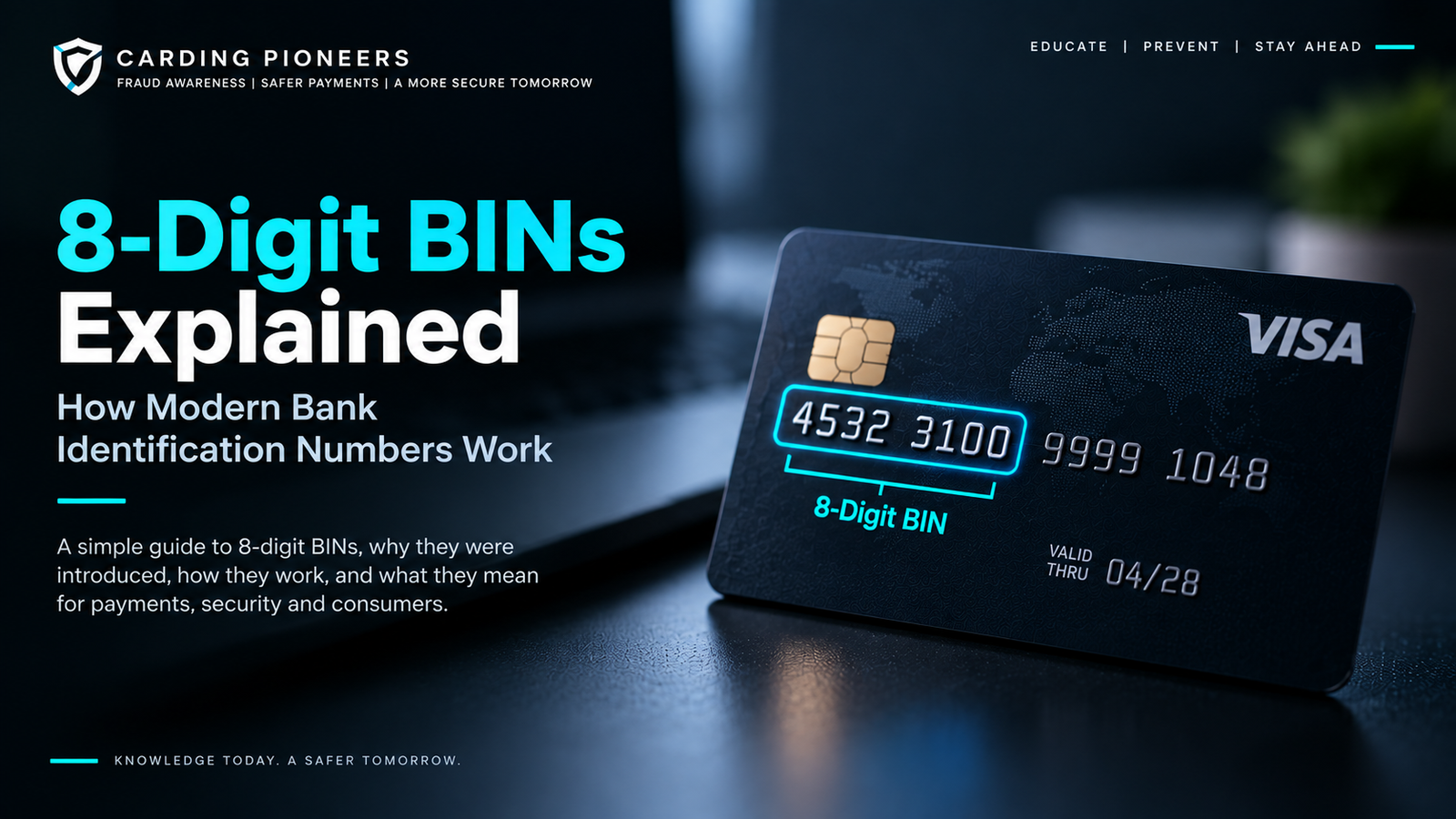
A safe illustrative format might be 4532 3100 **** 1048, where the first eight digits are shown only to demonstrate the position of the IIN. The example is not intended to represent a real account.

IIN vs PAN
The PAN is the complete payment-card account number. The IIN is only the issuer-identification portion at the beginning of that PAN.
- IIN: identifies the issuing institution.
- PAN: identifies the issuer and the individual cardholder account.
- The IIN is part of the PAN, not a separate cardholder account number.
Can an IIN Identify the Exact Cardholder?
No. The IIN identifies an issuing institution, not the individual cardholder.
It should not be treated as a public identity lookup. It does not reveal a customer's name, account balance, password, CVV/CVC or authentication credentials.
What Information Can IIN Data Describe?
In legitimate payment-processing systems, issuer-identification data can support routing, product classification, reporting and fraud-risk context.
- Issuing institution or issuer range
- Payment network or product context where supplied by an authorized data source
- Debit, credit, commercial or prepaid classification in some processor datasets
- Country or region information where provided by an issuer-range service
These attributes are not encoded universally in a way that every merchant can infer from the visible digits alone. Merchants should rely on their acquirer, processor or authorized issuer-range data rather than assuming a public BIN list is always complete or current.
Why 8-Digit IINs Matter to Merchants
- Routing rules should not assume all issuer identification stops at six digits.
- Fraud and risk systems may need updated issuer-range data.
- Reporting and analytics should support both legacy and modern range structures.
- Card-product assumptions based on stale six-digit data can be inaccurate.
- Stored rules should come from current payment-provider or network data rather than manually maintained public lists.
IINs and Fraud Detection
Issuer-identification information can be one contextual input in payment fraud detection, but it should never be treated as proof that a transaction is safe or fraudulent.
Modern retailers combine issuer context with authorization, 3-D Secure, AVS/CVV where relevant, device signals, account history, transaction patterns and risk scoring.
IINs and Card-Not-Present Payments
In ecommerce, the issuer range can help payment systems understand which institution and payment network are involved, but it does not replace cardholder authentication.
3-D Secure, issuer authorization, tokenization and merchant fraud controls provide different layers of protection for card-not-present transactions.

IINs and Tokenized Card Numbers
Digital wallets and network tokenization can replace the underlying PAN with a payment token. Tokenized payment credentials can have their own ranges and metadata that differ from the original funding PAN.
Merchants should therefore avoid assuming that every visible payment credential exposes the original card's underlying issuer range in the same way.
IIN vs Routing Number
An IIN is not a bank routing number. Routing numbers are used in banking and account-to-account payment systems, while the IIN is part of the payment-card numbering framework.
IIN vs IBAN
An IIN is also not an IBAN. IBAN stands for International Bank Account Number and identifies bank accounts in participating banking systems. IINs identify card issuers within the card-numbering framework.
IIN vs CVV/CVC
The IIN identifies the issuer. CVV/CVC is a separate card verification value used as an additional security signal in card-not-present transactions.
Knowing an issuer range does not reveal or replace the CVV/CVC.
IIN vs 3-D Secure
The IIN is a numbering and issuer-identification concept. 3-D Secure is an online authentication protocol.
A merchant may use issuer information as part of transaction context while 3DS allows the card issuer to authenticate the shopper when appropriate.
Does an IIN Tell You Whether a Card Will Be Approved?
No. Approval is determined by the issuer during authorization using account status, funds or credit availability, risk controls and other factors.
An IIN can identify issuer context, but it cannot predict whether a specific payment will be approved.
Why Public BIN/IIN Databases Can Be Inaccurate
Issuer ranges change over time as institutions launch products, migrate processors, receive new ranges or reorganize portfolios.
- A public dataset may still use six-digit groupings.
- Issuer names can change after mergers or portfolio transfers.
- Country or product classifications can be stale.
- Tokenized credentials may not map the way a basic PAN lookup expects.
- Different processors can expose different levels of issuer-range metadata.
For operational payment decisions, businesses should use current data from their payment provider, acquirer or authorized network sources.
Is It Safe to Display an IIN?
The first digits of a PAN are less account-specific than the rest of the card number, but merchants still need to follow PCI DSS and payment-brand rules for displaying or storing PAN data.
PCI SSC's truncation guidance recognizes both 6-digit and 8-digit BIN structures and provides brand-specific limits on how much of a PAN may be retained after truncation. Businesses should follow the applicable payment-brand requirements rather than inventing their own display or storage format.

Frequently Asked Questions
What is an IIN?
An IIN is an Issuer Identification Number, the standardized issuer-identification portion at the beginning of a payment card's PAN.
What does IIN stand for?
IIN stands for Issuer Identification Number.
Is IIN the same as BIN?
In most modern payment discussions, yes: BIN is the widely used industry term, while IIN is the formal ISO terminology.
How many digits is an IIN?
The current ISO/IEC 7812 framework uses an 8-digit IIN.
Why did BINs change from 6 digits to 8 digits?
The issuer-identification space was expanded to provide many more identifiers as the global number of issuers and payment products grew.
What is the difference between IIN and PAN?
The IIN identifies the issuer and forms the beginning of the PAN. The PAN is the complete card-account number.
Can an IIN identify the cardholder?
No. It identifies the issuer, not the individual cardholder.
Can an IIN tell whether a card is credit or debit?
Some authorized issuer-range datasets provide product classifications, but the visible IIN alone should not be treated as a universally reliable public product lookup.
Does an IIN include the CVV?
No. CVV/CVC is a separate card verification value.
Does an IIN determine whether a payment will be approved?
No. Authorization is an issuer decision based on the specific account and transaction.
Final Thoughts
An Issuer Identification Number is the standardized opening portion of a payment card's Primary Account Number used to identify the issuing institution.
The most important modern detail is that IINs are now 8 digits under ISO/IEC 7812. The payments industry still frequently calls them BINs, so '8-digit BIN' and '8-digit IIN' often describe the same issuer-identification concept.
For merchants, the practical lesson is to use current issuer-range data and avoid building payment or fraud rules around outdated six-digit assumptions. For consumers, an IIN is simply issuer-identification information - it is not an authentication code, cardholder identity record or guarantee that a payment will be approved.
Authoritative References
- American Bankers Association - Issuer Identification Numbers
- ISO/IEC 7812-1:2017 - Identification of Issuers, IIN and PAN Numbering
- ISO/IEC 7812-2:2017 - IIN Application and Registration Procedures
- ISO - Changes to the Issuer Identification Number Standard
- PCI Security Standards Council - PAN Glossary
- PCI Security Standards Council - Acceptable PAN Truncation Formats