
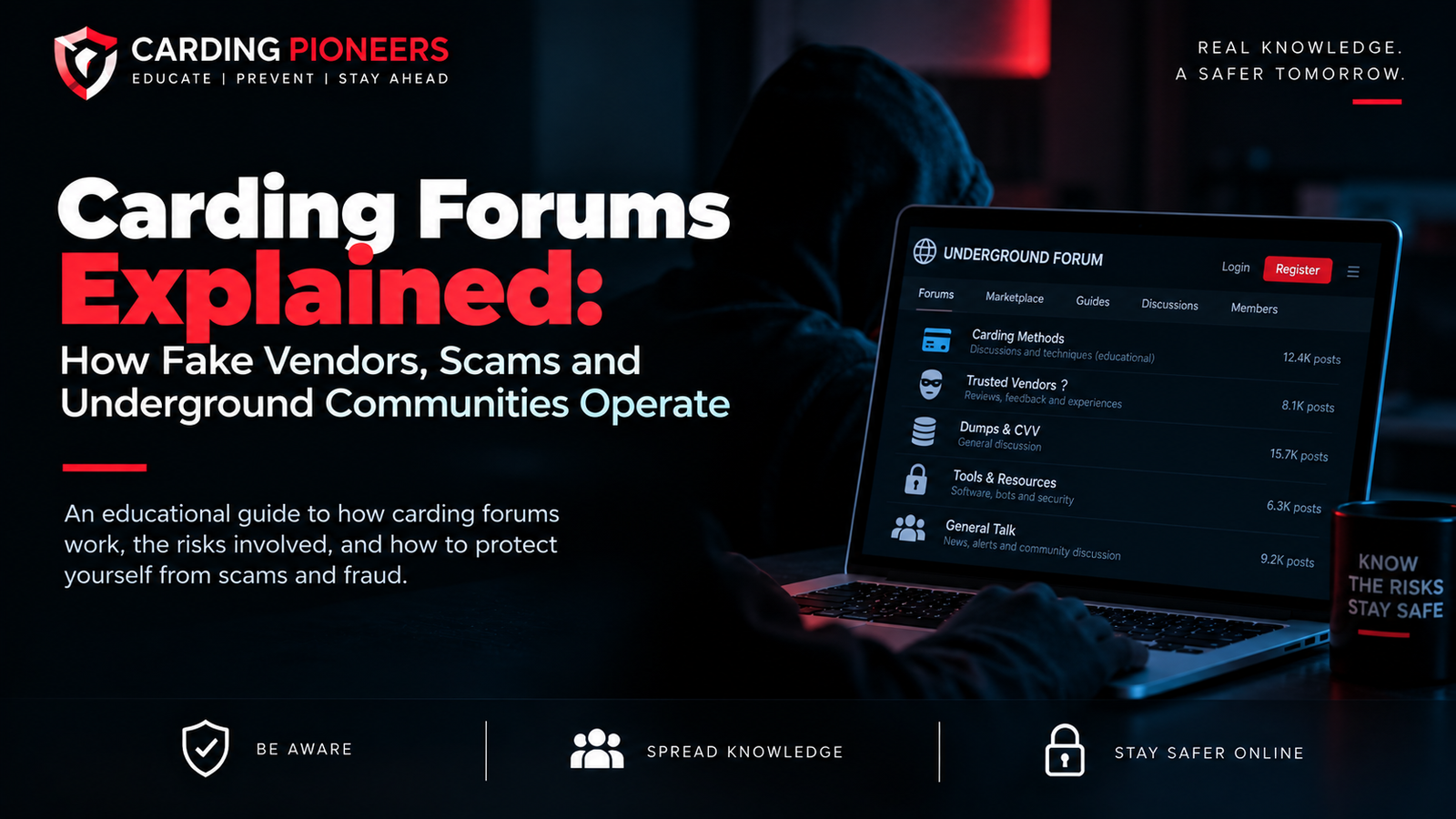
Carding forums are underground online communities associated with payment-card fraud, identity theft and the trafficking of stolen financial information. They can function as discussion boards, reputation systems and illegal marketplaces where participants advertise stolen data, fraudulent services or other cybercrime-related goods.
Law-enforcement records from the U.S. Department of Justice describe carding forums as online meeting places used to exchange information related to carding and to buy or sell stolen payment-card data and related services. Europol likewise identifies forums, marketplaces and automated card shops as distribution channels for compromised payment details.
These communities often try to imitate legitimate ecommerce platforms by using vendor profiles, reviews, moderators and status labels. But the resemblance is superficial: illegal markets have no reliable consumer protection, and deception between criminals is common. Fake vendors, impersonation, malware, fabricated reviews and exit scams can be part of the ecosystem.
Quick answer: A carding forum is an illegal online community built around payment-card fraud and related cybercrime. Its apparent trust systems - reviews, vendor ranks, moderators and guarantees - do not make it safe. Fake vendors, manipulated reputation, theft between users, malware, law-enforcement infiltration and sudden shutdowns are persistent risks.
Safety scope: This article explains underground forums for fraud awareness and prevention. It does not provide active forum names, links, joining instructions, transaction methods, evasion techniques or guidance for buying or selling stolen data.
What Is a Carding Forum?
A carding forum is a criminal online forum centered on stolen payment-card information and related fraud. DOJ court records describe these forums as places where participants can post public threads, communicate privately, advertise illegal goods and services and build relationships with other members.
Some historical forums restricted membership through invitations, sponsorship, fees or reputation checks. Those mechanisms were intended to create exclusivity and reduce infiltration, but law-enforcement operations have repeatedly shown that restricted access does not make such communities anonymous or secure.
What Roles Exist Inside Underground Communities?
Court cases and cybercrime investigations show that underground communities can develop recognizable roles similar to those found on ordinary online marketplaces.
Role | Typical function | Fraud-awareness risk |
|---|---|---|
Administrators | Operate the forum, enforce rules and manage access | Can manipulate accounts, payments or records and may disappear with funds |
Moderators | Manage discussions and disputes | A moderator badge does not guarantee independence or honesty |
Vendors | Advertise illegal data, tools or services | Listings can be fake, recycled, fabricated or designed to steal from buyers |
Reviewers / reputation users | Post feedback or evaluate sellers | Reputation can be bought, coordinated or forged |
Ordinary members | Consume information, communicate and participate in the market | Can be targeted by scams, malware or law-enforcement investigations |
Why Underground Forums Use Reputation Systems
Illegal markets have a fundamental trust problem: participants often hide behind aliases, cannot rely on courts or contracts, and know that other users may be criminals.

Forums therefore create substitutes for normal consumer protections, such as review counts, vendor badges, longevity, vouches and moderator-managed disputes. These systems can create an appearance of reliability, but they are easy to manipulate and provide no lawful guarantee.
Why Reputation Can Be Fake
- A vendor can control multiple accounts and create artificial praise.
- Compromised or purchased accounts can inherit an older reputation.
- Reviews can be coordinated between associates.
- A previously reliable account can be taken over by someone else.
- Forum staff can promote favored vendors or suppress complaints.
- A vendor can behave honestly for a period and later conduct an exit scam.
What Is a Fake Vendor Scam?
A fake vendor pretends to offer illicit goods or services but primarily intends to steal money, credentials or cryptocurrency from other forum users.
The scam can rely on a polished profile, fabricated reviews, copied screenshots or impersonation of an established seller. Because victims are participating in illegal activity, they have little realistic access to normal dispute resolution and may be reluctant to report the theft.
Common Scam Patterns Seen in Underground Markets
Scam pattern | How the deception works |
|---|---|
Vendor impersonation | A scammer copies a known alias, avatar or branding and directs victims to a fake account or communication channel. |
Fabricated reviews | Fake accounts create positive feedback designed to make a new vendor appear established. |
Exit scam | A marketplace or vendor builds trust, accumulates funds or orders, then disappears. |
Fake escrow or middleman | A supposed neutral party is controlled by one side of the scam or is impersonated. |
Malware disguised as a tool | Downloads advertised as useful software can contain credential stealers, remote-access malware or other malicious code. |
Account takeover | A trusted forum account is hijacked and then used to scam people who recognize the username. |
Fake guarantees | Claims of replacements, refunds or 'verified' status are used to lower skepticism but may be meaningless. |
Why Exit Scams Are So Common
Underground marketplaces have no enforceable legal obligations to their users. Once operators control enough money, valuable accounts or market attention, they may have a strong incentive to disappear.

The same problem applies to individual vendors. A seller can accumulate a strong reputation over time and then abruptly stop delivering. The earlier positive history can actually make the final scam more effective because victims lower their guard.
How Forums Create an Illusion of Professionalism
- Marketplace-style product listings
- Vendor badges and account levels
- Support or dispute sections
- Public review threads
- Announcements and rule pages
- Search and filtering tools
- Branding designed to resemble legitimate ecommerce
Professional-looking design is not evidence of legitimacy. Cybercrime markets deliberately borrow familiar ecommerce patterns because they make an illegal environment easier to navigate and can create false confidence.
Why Fake 'Verification' Badges Are Dangerous
A badge saying a vendor is 'verified,' 'trusted' or 'approved' only reflects whatever internal process the forum claims to use. It does not create an external audit, legal warranty or protection for victims.
In some criminal communities, reputation systems themselves become part of the scam: a moderator, reviewer and vendor may be controlled by the same person or group.
How Cybercrime Forums Lower the Barrier to Fraud
Europol has repeatedly described online carding forums as enablers of payment-card fraud because they bring together buyers, sellers and supporting services.
More broadly, Europol's 2025 takedown of large cybercrime forums showed how underground platforms can function as one-stop shops for stolen data, malware and cybercrime services. The platforms combined had millions of users before law-enforcement action disrupted them.
Why Criminals Scam Other Criminals
Underground communities are unusually favorable environments for fraud-on-fraud.
- Users often hide their real identities.
- Payments may be difficult or impossible to reverse.
- Victims cannot safely use normal consumer-protection systems.
- The market is already built around deception and stolen property.
- A victim may fear exposing their own criminal conduct by reporting a scam.
- Accounts and reputations can be disposable.
The Malware Risk Inside Underground Communities
Cybercrime forums do not only create financial risk. Files, tools and links shared in criminal communities can contain malware intended to steal from other participants.
A person seeking an illegal tool may unknowingly install credential-stealing malware, remote-access software or ransomware. This is another reason underground 'reviews' and download counts should never be treated as evidence that software is safe.
Law-Enforcement Infiltration and Takedowns
Restricted registration does not prevent law-enforcement access. Historical DOJ cases document undercover carding forums and investigations in which agents monitored forum activity, communications and transactions.
International operations have also seized or dismantled large cybercrime platforms. Forum shutdowns can expose user data, disrupt criminal networks and lead to arrests, asset seizures and prosecutions.
Carding Forums vs Automated Card Shops
A forum emphasizes discussion, relationships and vendor reputation. An automated card shop is closer to an illicit ecommerce storefront built around searchable inventory.

Europol notes that compromised card details can circulate through forums, marketplaces and automated card shops. The distribution format changes, but the underlying activity remains the trafficking of stolen payment data.
Carding Forums vs General Cybercrime Forums
A carding forum focuses primarily on payment-card and identity-related fraud. A broader cybercrime forum can also include stolen credentials, malware, hacking tools, compromised accounts and other illicit services.
The categories can overlap heavily, and many modern underground communities operate as multi-purpose marketplaces rather than narrowly specialized forums.
How Stolen Payment Data Reaches Underground Markets
Payment-card data sold or advertised in underground communities can originate from several upstream crimes.
- E-skimming and Magecart-style ecommerce compromise
- Phishing and fake login or payment pages
- Malware and credential theft
- Point-of-sale compromise
- Large-scale data breaches
- Account takeover and social engineering
Understanding these upstream sources is important for defenders because stopping credential theft earlier can reduce the data available to underground markets.
What Consumers Should Know
Consumers generally do not need to interact with underground forums to become victims. Their card details can be stolen elsewhere and later traded or misused without their knowledge.
- Enable transaction and login alerts.
- Review card statements and pending transactions.
- Use unique passwords and multi-factor authentication.
- Avoid entering card details through unexpected links.
- Contact the issuer promptly when suspicious activity appears.
- Treat breach notifications seriously and follow issuer guidance.
What Merchants and Security Teams Should Know
- Underground-market chatter can indicate stolen-data circulation, but monitoring should be conducted lawfully and through authorized threat-intelligence providers.
- Card testing can be an early indicator that compromised credentials are being validated.
- E-skimming prevention and payment-page integrity reduce one important source of stolen data.
- EMV 3-D Secure, tokenization, AVS/CVV where relevant and behavioral risk scoring provide different defensive layers.
- Exact fraud-detection thresholds and response rules should remain confidential.
Why You Should Not Attempt to 'Investigate' a Forum Yourself
Entering criminal communities can expose a person or organization to malware, scams, illegal material, surveillance and legal risk.
Businesses that need underground-threat intelligence should use qualified legal, security and law-enforcement channels rather than having employees create accounts or transact in criminal markets on their own.
Red Flags of a Fake Underground Vendor
Because these markets are criminal by definition, there is no genuinely safe vendor. Still, several behaviors illustrate how fraud-on-fraud is engineered.
- Sudden changes to a long-standing account's communication style
- Heavy reliance on unverifiable screenshots or testimonials
- Pressure to move away from the forum's normal communication process
- Claims that normal dispute procedures must be bypassed
- New accounts that appear to have unusually strong praise immediately
- Offers that depend on secrecy, urgency or a one-time exception
These warning signs are useful for fraud awareness, not for evaluating whether participation is safe. The only safe approach is not to participate in illegal marketplaces.
Frequently Asked Questions
What is a carding forum?
A carding forum is an illegal online community used to discuss, advertise or facilitate payment-card fraud and related cybercrime.
Are carding forums marketplaces?
Many function partly as marketplaces, with vendor profiles, listings, reviews and private messages, while others are primarily discussion communities.
What do fake vendors do?
Fake vendors pretend to sell illicit data or services but instead steal money, credentials or cryptocurrency from other users.

What is an exit scam?
An exit scam occurs when a vendor or marketplace builds trust, receives funds or orders and then disappears without delivering.
Can forum reviews be trusted?
No. Reviews can be fabricated, purchased, coordinated or posted from controlled accounts. A reputation system inside an illegal market has no reliable external guarantee.
What is a fake escrow scam?
It is a deception in which a supposedly neutral payment intermediary is controlled or impersonated by a scammer.
Why do carding forums restrict membership?
Historically, some forums used sponsorship, invitations, fees or reputation requirements to create exclusivity and reduce infiltration. These controls do not make them anonymous or safe.
Can law enforcement access underground forums?
Yes. DOJ cases document undercover operations and forum infiltration, and international agencies have repeatedly seized or disrupted cybercrime platforms.
Are carding forums the same as dark-web markets?
Not necessarily. Some operate through hidden services, while others have historically existed on ordinary web infrastructure. The defining factor is the criminal activity, not the access technology.
How can I protect myself from card data being sold underground?
Use strong account security, transaction alerts and trusted checkout practices, and contact your issuer promptly if your card information may be compromised.
Final Thoughts
Carding forums try to solve a trust problem inside an inherently untrustworthy criminal economy. Vendor ranks, reviews, moderators and guarantees can make the environment look organized, but they cannot create genuine consumer protection.
Fake vendors, impersonation, manipulated reviews, malware and exit scams are not side effects of underground markets; they are predictable consequences of an ecosystem built around anonymity, stolen property and deception.
For fraud prevention, the useful lesson is not how to navigate these communities but how to break the chain that feeds them: protect payment pages, reduce credential exposure, detect card testing, strengthen authentication and respond quickly when customer or card data is compromised.
Authoritative References
- U.S. Department of Justice - Carding Forum Background and Operation Card Shop
- U.S. Department of Justice - Carder.su Online Marketplace Case
- Europol - Fraud Against Payment Systems
- Europol - Takedown of Two Major Cybercrime Forums, January 2025
- FBI - FIN7 and Underground Markets for Stolen Payment Cards
Editorial note: This article is defensive and educational. It explains the structure and risks of underground carding communities without providing active marketplace names, links, joining procedures, payment methods, anonymity techniques or instructions for trafficking stolen data.