
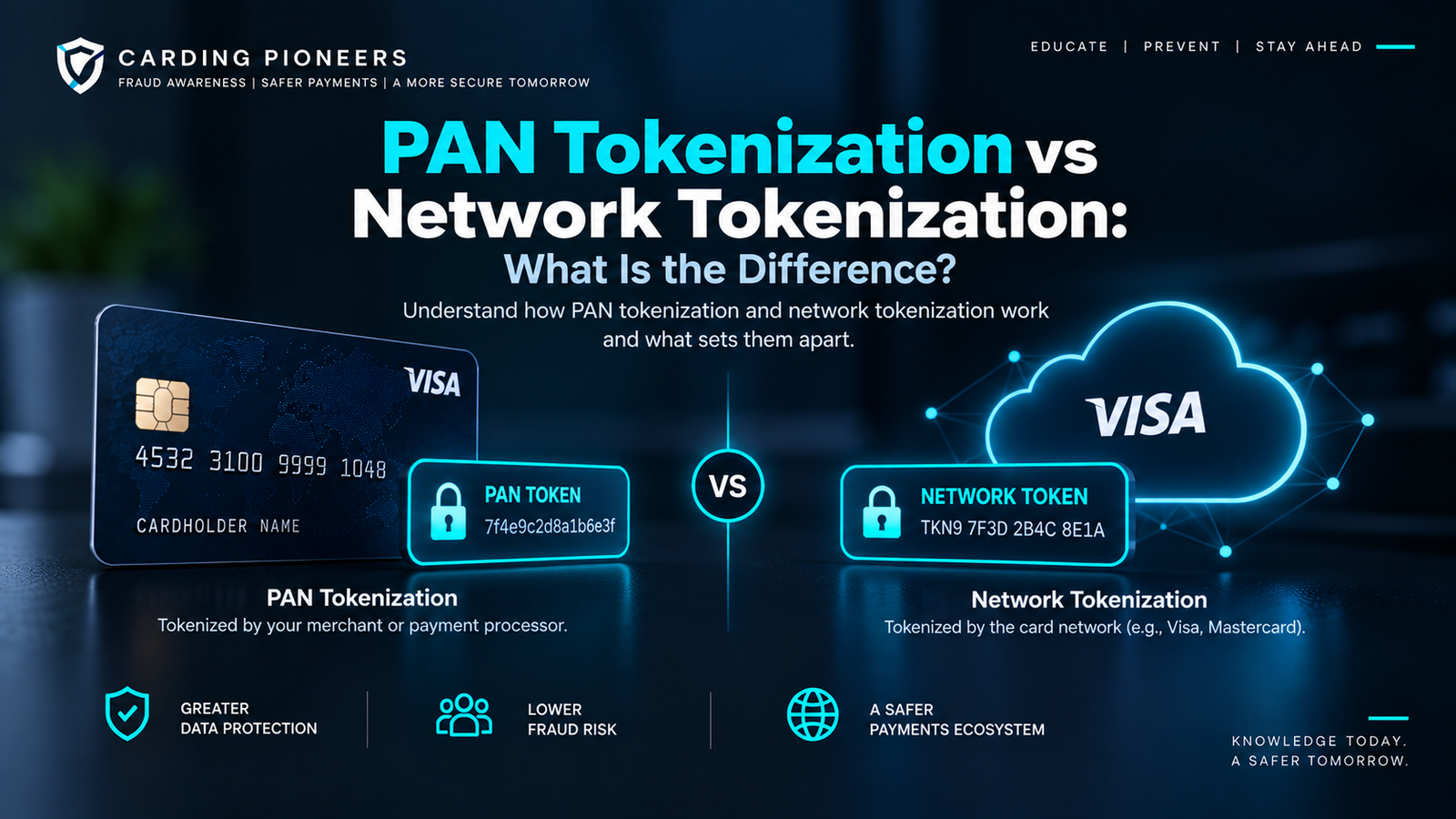
PAN tokenization and network tokenization both reduce exposure of a card's Primary Account Number (PAN), but they do not work in exactly the same way.
In many merchant and gateway systems, PAN tokenization means replacing the real card number with a proprietary surrogate token that is useful only inside that provider's environment. Network tokenization goes further by replacing the PAN with a payment credential issued and managed through payment-network token infrastructure, allowing the token itself to travel through supported payment processing and authorization flows.
The terminology can vary between providers, so this article uses 'PAN tokenization' as a practical shorthand for merchant, gateway or acquiring tokenization and 'network tokenization' for EMV payment tokens managed through network token services.
Quick answer: PAN tokenization usually gives a merchant a provider-specific token that references stored card data, while network tokenization replaces the PAN with a payment-network credential that can be used in supported authorization flows. Both reduce unnecessary PAN exposure, but network tokens can also carry domain controls and lifecycle management at the payment-network level.
First: What Is a PAN?
PAN stands for Primary Account Number. It is the main card-account number associated with a credit, debit or other eligible payment card.
Because a PAN is a valuable payment credential, merchants and payment providers try to avoid exposing or storing it more widely than necessary. Tokenization is one of the main technologies used to reduce that exposure.
What Is PAN Tokenization?
PAN tokenization is the general process of replacing a Primary Account Number with a surrogate value called a token.
In merchant, gateway or acquiring-tokenization systems, the payment provider typically stores the real PAN in a protected environment and returns a proprietary token to the merchant. The merchant can save and reuse that token for permitted functions such as legitimate card-on-file or recurring-payment workflows without keeping the raw PAN in ordinary application systems.
PCI Security Standards Council guidance describes acquiring tokens as tokens created by an acquirer, merchant or merchant service provider after receiving the PAN. These tokens are proprietary rather than based on an industry-standard token format and are generally redeemed within the provider's environment when a payment must ultimately be authorized.
What Is Network Tokenization?
Network tokenization replaces the PAN with a payment token provisioned and managed through card-network token infrastructure.
EMVCo defines EMV Payment Tokenisation as replacing a PAN with a unique alternative value that can be limited according to where and how it is used. For example, a token can be associated with a particular merchant, consumer device or payment scenario.

Unlike a merchant-only reference token, an EMV payment token can be carried through supported payment processing from the point of purchase, through the acquirer and payment network, to authorization by the card issuer.
PAN Tokenization vs Network Tokenization at a Glance
Feature | PAN / merchant tokenization | Network tokenization |
|---|---|---|
What replaces the PAN? | A proprietary surrogate or reference token | An EMV payment token |
Who commonly manages it? | Merchant, gateway, acquirer or service provider | Network/token service infrastructure with issuer participation |
Typical scope | Provider or merchant environment | Supported network payment ecosystem |
Can token travel in authorization? | Usually the provider resolves it before authorization | Yes, supported payment tokens can pass through network authorization |
Domain controls | Depends on provider design | Can be restricted by merchant, device or payment scenario |
Lifecycle updates | Provider-specific | Can support network-managed lifecycle events |
Common uses | Vaulting, subscriptions, card-on-file | Digital wallets, ecommerce, in-app and card-on-file payments |
How Merchant or Gateway PAN Tokenization Works
1. The customer provides card details through a legitimate payment flow.
The payment provider receives the PAN through a secure checkout or payment interface.
2. The provider stores or protects the PAN.
Sensitive account data is kept inside the provider's controlled card-data environment.
3. The merchant receives a token.
Instead of storing the real PAN, the merchant stores a provider-specific token or reference.
4. The merchant uses the token later.
For an authorized card-on-file or recurring payment, the merchant submits the token to the provider.
5. The provider resolves the token.
The provider maps the token back to the protected payment credential inside its controlled environment and processes the payment.
How Network Tokenization Works
1. An eligible PAN is tokenized through network infrastructure.
A network token service provisions a payment token representing the underlying card account.
2. The token can be tied to a domain.
It may be restricted to a merchant, device, wallet or transaction scenario.
3. The merchant or wallet uses the network token.
The payment token replaces the PAN in supported transactions.

4. The token travels through the supported payment rails.
The token can pass from merchant to acquirer and payment network for authorization.
5. Network and issuer systems connect it to the underlying account.
Trusted payment infrastructure resolves the relationship without exposing the PAN to every participant in the flow.
Why the Difference Matters
Both approaches reduce merchant exposure to sensitive card data, but the security and operational characteristics differ.
- Merchant tokens usually remain meaningful only inside a particular provider's vault or platform.
- Network tokens can be usable across supported payment authorization flows without substituting the PAN back into the merchant's request.
- Network tokens can be constrained to approved domains, reducing usefulness if copied outside the intended context.
- Network token services can manage credential lifecycle events when supported by the issuer and network.
- Merchant tokenization can still be highly valuable for reducing PAN storage and simplifying card-on-file security.
What Does 'Tokenized PAN' Mean?
The phrase 'tokenized PAN' generally means that the original Primary Account Number has been replaced with a token or surrogate value.
It does not tell you which tokenization architecture is being used. The token might be a gateway-specific reference, an acquiring token or an EMV payment token. For that reason, developers and merchants should ask what type of token they are receiving rather than assuming all tokenized card numbers behave the same way.
What Is an Acquiring Token?
PCI SSC uses the term 'acquiring token' for tokens created by an acquirer, merchant or merchant service provider after the PAN or other payment credential is presented.
These tokens are proprietary and are not based on a universal industry-standard format for generation, provisioning or use. They are commonly useful for card-on-file and recurring payment functions within the provider's ecosystem.
The acquiring token itself generally is not the credential sent end-to-end as a new network authorization credential. The provider uses its secure tokenization environment to resolve the token and process the payment appropriately.
What Is an EMV Payment Token?
An EMV payment token is the standardized token type defined through EMV Payment Tokenisation. It replaces the PAN and is designed to operate within supported payment transactions.
EMVCo states that payment tokens can support face-to-face and remote transactions and can be defined according to where and how they may be used.
This ability to bind a token to a particular usage domain is one reason network tokenization can reduce the usefulness of compromised payment data.
Network Tokens and Domain Controls
A major security property of network tokenization is that a token can be restricted to its intended environment.
- Merchant-specific use: the token may be valid only with a designated merchant or merchant relationship.
- Device-specific use: a token may be associated with a particular consumer device or wallet.
- Transaction-specific use: token rules can limit the payment scenarios in which the credential is accepted.
These controls mean that possession of the token alone may not be enough to use it outside the environment for which it was provisioned.
Network Tokens and Credential Lifecycle Management
Network-token infrastructure can also support lifecycle management when the underlying card changes.
A payment provider integrated with network token services may receive updates when a card is replaced, renewed or otherwise changed. This can help legitimate subscriptions and stored-credential relationships continue without requiring the customer to manually re-enter new card details in every supported service.

The exact lifecycle behavior depends on the network, issuer, merchant, token service provider and payment platform.
Which Type Is Better for Security?
There is no universal answer because the two approaches can serve different roles.
Merchant or gateway tokenization can significantly reduce the number of systems that store or handle PAN data. Network tokenization adds standardized payment-token capabilities, domain controls and network-level lifecycle management.
Many modern payment platforms use both layers: a merchant may interact with a provider-specific token while the provider also provisions network tokens behind the scenes where supported.
Does Tokenization Reduce PCI DSS Scope?
Tokenization can help reduce the amount of cardholder data present in a merchant environment, which can simplify some PCI DSS responsibilities.
However, PCI SSC explicitly states that tokenization does not automatically eliminate the need to maintain and validate PCI DSS compliance. The effect on scope depends on the implementation and whether systems claimed to be outside scope can retrieve or otherwise access the original PAN.
PAN Tokenization, Network Tokenization and Fraud Prevention
The primary fraud-prevention benefit of tokenization is reducing the value and exposure of sensitive payment credentials.
- A breached merchant database can contain tokens instead of reusable PANs.
- Network tokens can be restricted to approved domains.
- Merchants can avoid unnecessary storage of raw card numbers.
- Credential lifecycle management can reduce risky or outdated stored-card data.
Tokenization is still only one security layer. It does not replace payment authorization, Strong Customer Authentication where applicable, 3-D Secure, AVS/CVV checks, secure account access or transaction monitoring.
PAN Tokenization vs Encryption
Tokenization should also be distinguished from encryption. Encryption transforms sensitive data using cryptographic methods so authorized systems can decrypt it. Tokenization substitutes the sensitive value with another value.
Secure payment systems commonly use both technologies together: encryption protects data in transit and at rest, while tokenization reduces how widely the original PAN must appear.
Common Misunderstandings
- Myth: every token is a network token. Reality: merchants and gateways can use proprietary acquiring tokens that differ from EMV payment tokens.
- Myth: a token is simply an encrypted PAN. Reality: tokenization substitutes the PAN; encryption is a separate security method.
- Myth: all tokens can be sent directly through the card network. Reality: proprietary merchant tokens are commonly resolved by the provider before authorization, while supported network tokens can act as payment credentials in network flows.
- Myth: network tokenization authenticates the shopper. Reality: it protects the payment credential; authentication is a separate function.
- Myth: tokenization eliminates every PCI DSS obligation. Reality: scope depends on implementation and access to cardholder data.
Frequently Asked Questions
What is PAN tokenization?
PAN tokenization replaces a Primary Account Number with a surrogate token so merchants and payment systems can reduce direct handling of the real card number.

What is network tokenization?
Network tokenization replaces the PAN with a payment token provisioned and managed through payment-network token infrastructure for supported payment transactions.
Is PAN tokenization the same as network tokenization?
No. PAN tokenization is a broad concept. Merchant or gateway tokenization typically uses provider-specific tokens, while network tokenization uses standardized payment tokens supported by card-network infrastructure.
What is a tokenized PAN?
It generally means the original PAN has been replaced by a token. The phrase alone does not identify whether the token is a merchant token, acquiring token or network payment token.
Can a network token be used like a card number?
In supported payment flows, a network token can act as a payment credential in place of the PAN. Its use can be restricted to particular domains or payment contexts.
Does a merchant token travel through the card network?
Usually not as the final network credential. The provider typically resolves its proprietary token within the provider's secure environment and processes the authorization using the appropriate payment credential.
Do digital wallets use network tokenization?
Many modern digital wallets use network payment tokens so the underlying PAN is not exposed in the same way during supported transactions.
Does network tokenization reduce fraud?
It can reduce the usefulness of compromised payment credentials by replacing the PAN and applying domain restrictions, but it does not prevent every type of fraud.
Can a merchant use both types of tokenization?
Yes. A payment platform can expose a merchant-facing token while also using network tokens behind the scenes where supported.
Final Thoughts
PAN tokenization and network tokenization share the same fundamental security goal: reduce unnecessary exposure of the real card number.
Merchant or gateway tokenization usually replaces the PAN with a proprietary reference that is useful inside a specific provider's environment. Network tokenization replaces the PAN with an EMV payment token that can participate in supported payment authorization flows and can be restricted to particular merchants, devices or payment scenarios.
For merchants, the important question is not simply 'do we use tokens?' but 'what type of token do we use, who manages it, where is it valid, and can our systems access the underlying PAN?'
Understanding those distinctions helps businesses design safer card-on-file, subscription, ecommerce and digital-wallet payment experiences without treating every tokenization system as identical.
Authoritative References
- EMVCo - EMV Payment Tokenisation
- EMVCo - The What, Why and How of EMV Payment Tokenisation
- PCI Security Standards Council - Difference between acquiring tokens, issuer tokens and Payment Tokens
- PCI Security Standards Council - Tokenization guidance overview
- PCI DSS Information Supplement - Tokenization Guidelines
- Stripe - Understanding the benefits of network tokens
Editorial note: This article is educational and focused on payment-security awareness. Token terminology and implementation details can vary by processor, acquirer, network and payment service provider.